Editor-reviewed
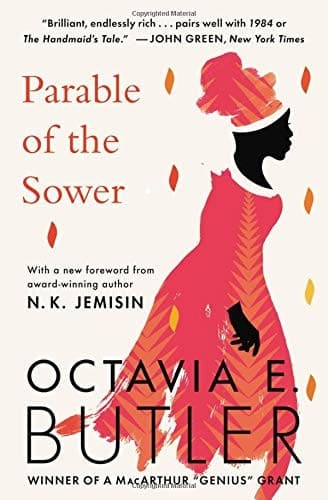
Parable of the Sower
Octavia E. Butler·1993·Four Walls Eight Windows·Sci-Fi & Fantasy
Reading level: Ages 14+ (YA) · 10-hour read · Beginner difficulty.
- Reading time
- 10h
- Difficulty
- Beginner
- Recommended age
- Ages 14+ (YA)
- Guide read
- 5min
- Editor's rating
- 4.8 / 5
- dystopia
- octavia-butler
- climate-fiction
- race
- survival
- religion
- near-future
- 1990s
— In one sentence —
Written in 1993 as a near-future extrapolation of Los Angeles. It reads now as contemporary history.
§ 01 · WHY READ
Why read
Octavia Butler wrote Parable of the Sower in 1993, set in 2024 and 2025 in a near-future Southern California. She described the world she was building as a 2020s extrapolation of conditions already visible in early-1990s Los Angeles: climate collapse producing water scarcity and heat waves, widening inequality between walled communities and the dispossessed outside, corporations buying towns and paying employees in company scrip, private security replacing public police, and the systematic abandonment of the poor by institutions that once served them.
When readers encountered the novel in 2024 and 2025 — the years Butler had named — the extrapolation had largely materialized. Not perfectly and not everywhere, but the conditions she described from 1993 were recognizable in ways that surprised even readers who had known the book for years. This is not because Butler was psychic; it is because she was paying attention to the present more carefully than most of her contemporaries, and the near-future she described was an honest extension of observed trends rather than an invented scenario.
The novel is narrated by Lauren Olamina, a fifteen-year-old Black girl living with her family in a gated neighborhood in Robledo, a suburb of Los Angeles. Lauren has "hyperempathy syndrome" — a condition that causes her to feel, physically, the pain and pleasure she observes in others — and she has, quietly, been developing a religious philosophy she calls Earthseed. When the neighborhood is destroyed, she walks north with a group of survivors, building a community around a simple idea: God is Change, and the only sustainable response to Change is to shape it.
Butler won no major awards for this novel in 1993. She won the MacArthur Fellowship in 1995. Parable of the Sower has steadily increased in readership since her death in 2006 and is now considered one of the most important American speculative fiction novels of the twentieth century.
§ 02 · CHARACTERS
Characters
Lauren Oya Olamina — the narrator and founder of Earthseed. She is fifteen at the novel's start; by the end she is seventeen and has walked hundreds of miles and buried people she loved. Her hyperempathy syndrome is both a vulnerability (she is physically incapacitated by others' pain) and an argument: she cannot separate herself from the suffering around her. Her response to a world she cannot make safe is not withdrawal but construction — she builds a new thing rather than mourning the lost one. She is one of the most fully realized protagonists in American SF.
Cory Olamina — Lauren's stepmother, a teacher who believes the walls will hold if everyone does their part. She represents the generation that trusts the structures; the novel tests that trust without mocking it.
Keith Olamina — Lauren's younger brother, who leaves the neighborhood and comes back changed. His trajectory is the novel's portrait of what the outside world does to people who try to live in it without community.
Zahra Moss, Harry Balter, Bankole — the core community that forms around Lauren on the road north. Bankole especially: an older man, a doctor, who has land in northern California and who becomes both partner and anchor. The romantic relationship is secondary to his function as the novel's argument that survival requires both the young's energy and the old's knowledge.
§ 03 · HIGHLIGHTS
Three highlights
No. 1 · The hyperempathy syndrome as political argument. Lauren's condition — she feels others' pain physically — is presented as a disability and described by most characters as a weakness. Functionally, it makes her a less effective fighter in the novel's many violent encounters. But Butler is making an argument: in a world that has become survivable only by learning not to feel others' pain, Lauren's inability not to feel it is the seed of a different kind of community. Earthseed is built on the founder's inability to separate herself from other people's suffering.
No. 2 · The burning of the neighborhood. The destruction of Robledo — pyro addicts (drug users who experience pleasure from fire, a new addiction in this world) burning the neighborhood while Lauren watches from a hiding place — is the novel's fulcrum. Before it, Lauren is preparing. After it, she is building. The scene is Butler at her most precise: the violence is not melodramatic but procedural, and Lauren's response is not grief paralysis but immediate, practical, organized action. She gathers what she can and starts walking.
No. 3 · Earthseed as a religious philosophy. "All that you touch, you change. All that you change, changes you. The only lasting truth is change. God is change." Lauren's theology — formulated in a notebook she has been keeping since she was twelve — is presented seriously, not ironically. Butler is not satirizing religion; she is arguing that in a world where all institutions have failed, what humans need is not an ideology but a practice: a way of thinking about change that converts it from threat to resource. The philosophy is simple, durable, and genuinely useful. That's the argument.
§ 04 · EDITIONS
Recommended editions
| Edition | Why pick it |
|---|---|
| Grand Central / Orbit (current standard) | The edition in print since the 2019 revival; clean text, good cover. |
| Seven Stories Press (original 1993 edition) | Collectible; the first printing is rare. |
| Audiobook (Lynne Thigpen, 2000) | Out of print; occasionally findable. The more recent audiobook (Bahni Turpin, 2020) is better and widely available. Turpin's performance is exceptional. |
Parable of the Talents (1998) is the direct sequel, covering the years after the community is established. It won the Nebula Award. Read the duology together; Sower ends at a point that is hopeful but provisional, and Talents tests the hope severely.
§ 05 · FIT
Who it's for / not for
Read this if you are…
- Anyone who finds post-apocalyptic fiction too escapist or too white. This novel is neither.
- Readers interested in how speculative fiction can function as political analysis rather than political allegory.
- Anyone who has found themselves thinking about community, mutual aid, and how people organize when institutions fail.
- A reader looking for a Black woman protagonist at the centre of a world-building project, told in her own voice.
Skip it if you are…
- Looking for the comfort of a guaranteed happy ending. The novel earns hope, but it does not guarantee it.
- Averse to violence in fiction. Butler does not flinch; the road north is dangerous and people die.
§ 06 · TIPS
Reading tips
- Read the Earthseed verses at the beginning of each chapter as part of the novel. They are Lauren's journal entries — written after the events of the chapter, often in retrospect — and they function as a second commentary on the action. Don't skip them.
- Track the hyperempathy carefully. Butler is specific about when it incapacitates Lauren and when it doesn't; the specificity is part of the argument about what the condition is actually for.
- The pacing is slow in the first section (inside the neighborhood) and faster after the burning. This is deliberate: Butler is making the neighborhood real enough that its loss matters.
- Read Parable of the Talents (1998) immediately after. The duology is a single argument; Sower is the premise and Talents is the test.
§ 07 · COMPARE
Read alongside
- Octavia E. Butler — Kindred (1979). Butler's other most essential work: time travel to antebellum Maryland, the psychology of accommodation and survival. Different premise; similar moral intelligence.
- N. K. Jemisin — The Fifth Season (2015). The closest stylistic and thematic heir: a world where disaster is constant, a protagonist with unusual abilities, a community built against the odds. Jemisin has cited Butler as a foundational influence.
- Cormac McCarthy — The Road (2006). The bleak comparison: the same American near-future wasteland, no community, no new religion, no hope. Both are honest; they are honest about different things.
- Ursula K. Le Guin — The Dispossessed (1974). Another SF novel centered on a new social philosophy and its costs. Le Guin and Butler are the two poles of what literary SF can do with political imagination.
- adrienne maree brown — Emergent Strategy (2017). The non-fiction complement: a social justice organizer's philosophy explicitly built on Butler's Earthseed. Read Sower first; Emergent Strategy is partly a reading of it.
§ 08 · DISCUSSION
Discussion questions
- Lauren's hyperempathy syndrome is presented as a disability. By the end, do you read it as a weakness, an asset, or something the novel refuses to categorize?
- Butler wrote the novel in 1993, set in 2024-2025. Which of her extrapolations have materialized? Which haven't? What does the accuracy (or inaccuracy) suggest about how speculative fiction works?
- Earthseed is Lauren's response to a world where all institutions have failed. What does the philosophy offer that institutional religion doesn't? What does it lack?
- Lauren's father is a Baptist minister whose faith holds until the neighborhood is destroyed. What does the novel say about the relationship between established religion and crisis?
- The community Lauren builds is deliberately multiracial and multi-generational. Is this political statement or practical necessity? Does Butler present it as both?
- Bankole is significantly older than Lauren and has resources she doesn't. Is their relationship equal? Does the novel think equality is the right frame?
- "God is change" is Earthseed's central proposition. Is it a religious claim, a philosophical one, or a survival strategy? Can it be all three?
- The novel ends provisionally — with arrival, not with establishment. What does the openness of the ending argue? Why doesn't Butler complete the project in this volume?
One line to remember
“All that you touch, you change. All that you change, changes you. The only lasting truth is change. God is change.”— Earthseed: The Books of the Living — Chapter 1
Appears in collections
Reading lists featuring this book
7 books
The Best Book Gifts for Graduation
Seven novels for a reader leaving one chapter and starting another.
Open list →
8 books
The Best Books for Teens
What high schoolers actually want to read — not what they're assigned.
Open list →
9 books
Science Fiction for People Who Don't Read Science Fiction
Nine novels that will change what you think the genre is allowed to do.
Open list →
7 books
Books About Starting Over in Life
Seven novels about second acts, leaving the wreckage of the first life, and building from nothing.
Open list →
6 books
The Best Books About Survival
Six novels about people who have to keep going when everything says they shouldn't.
Open list →
6 books
Best Books for Ambitious Women
Six novels that take women's serious ambition seriously, without flattering it or apologizing for it.
Open list →
6 books
Books Like 1984
From the book that directly inspired Orwell to the ones that took the nightmare somewhere new.
Open list →
5 books
Books Like Beloved
Five novels for readers who want that combination of historical weight, lyric prose, and the refusal to look away.
Open list →
6 books
Books Like The Handmaid's Tale
Six novels for readers who want that particular combination of dread, clarity, and controlled fury.
Open list →
5 books
Books Like The Road by Cormac McCarthy
Five novels with the same stripped intensity — and something The Road doesn't have.
Open list →
6 books
Books That Give You Hope
Six books that earn the word hope by refusing to look away from what makes hope hard.
Open list →
6 books
Books That Predicted the Future
Six novels that named things before we had words for them.
Open list →
7 books
Books to Read in Your 20s
Seven novels for the decade when you're figuring out who you're going to be.
Open list →
6 books
Books to Understand Race in America
From slavery to the near future — six novels that cover what history textbooks flatten.
Open list →
6 books
Books to Read When You Feel Lost in Life
Protagonists with no map who keep moving anyway — each one a different kind of lost.
Open list →
8 books
Eight Dystopian Novels Beyond 1984
Orwell's masterpiece gets all the attention. These eight books are asking harder questions.
Open list →
7 books
Feminist Literature Worth Reading
Seven books across 150 years — each making a different argument through a different form.
Open list →
You might also like
Read next
Octavia E. Butler · 1979
Kindred
Octavia Butler sends a Black woman from 1976 Los Angeles back to antebellum Maryland. The time travel is a device. The horror is real.
Read · 5 min
Ted Chiang · 2002
Stories of Your Life and Others
Ted Chiang writes 30-page stories that take longer to think about than most novels. He has won more awards per word than any writer alive.
Read · 5 min
Cixin Liu · 2008
The Dark Forest
Fan + author consensus pick for the best book in the trilogy. Two simple axioms derive the silence of the universe. After this one, you don't look at the night sky the same way.
Read · 5 min