Editor-reviewed
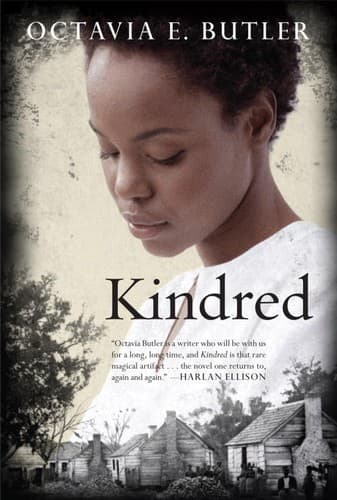
Kindred
Octavia E. Butler·1979·Doubleday·Sci-Fi & Fantasy
Reading level: Ages 14+ (adult) · 8-hour read · Beginner difficulty.
- Reading time
- 8h
- Difficulty
- Beginner
- Recommended age
- Ages 14+
- Guide read
- 5min
- Editor's rating
- 4.8 / 5
- octavia-butler
- slavery
- time-travel
- race
- american-history
- feminist-fiction
- historical-fiction
— In one sentence —
Octavia Butler sends a Black woman from 1976 Los Angeles back to antebellum Maryland. The time travel is a device. The horror is real.
§ 01 · WHY READ
Why read
Octavia Butler published Kindred in 1979, and it remains her most widely read novel — the one most likely to be assigned in schools, the one that converted the most readers to her other work, the one that demonstrates most clearly what speculative fiction can do that realist fiction cannot.
Dana, a Black woman writer living in 1976 Los Angeles with her white husband Kevin, is pulled without warning to antebellum Maryland, to a plantation, to 1815. She arrives each time at the moment when Rufus Weylin — a white child, then a teenager, then a man — is in mortal danger. She saves him. When her own danger becomes acute enough, she returns. The time travel has no mechanical explanation; Butler was not interested in one. The mechanism is kinship: Rufus is Dana's ancestor, and she must keep him alive long enough to father the child who will eventually produce the line that produces Dana. The logic is circular. The horror is that she knows this.
The novel does something no other American book has done as cleanly: it puts a contemporary reader — Black, free, professional, married — into the experience of plantation slavery not as a historical spectacle but as a lived situation she must survive and navigate. Dana is not transported as an observer; she is transported as a body that can be owned, whipped, sold, and killed. Her intelligence and her modern knowledge are tools, but they are not armor.
Butler conceived the novel in response to younger Black activists in the 1970s who she felt were dismissive of how enslaved people had endured their condition — who read accommodation as simple collaboration. Kindred is her argument that the psychology of survival under total domination is not a failure of character.
§ 02 · CHARACTERS
Characters
Dana Franklin — the narrator, twenty-six, a writer doing temp work when the novel begins. She is one of Butler's most fully rendered protagonists: precise, wry, self-aware, morally serious without being sanctimonious. Her first-person narration does something rare — it shows a character genuinely trying to understand her own compromises in real time, without the retrospective clarity that makes most first-person narration feel too tidy.
Kevin Franklin — Dana's white husband. He is well-meaning, loves Dana, and is briefly transported with her on one journey, where he is stranded for five years. What five years as a white man on an antebellum plantation does to Kevin — the subtle adjustments he has made, the parts that felt like progress — is one of the novel's quietest arguments about how environments shape people.
Rufus Weylin — Dana's ancestor. He is not a monster from birth; Butler is careful about this. He is a child who is kind to Dana in one moment and violent in the next, shaped by everything his world tells him about what he is permitted to do. His trajectory — from the boy Dana likes to the man she must contain to the crisis she cannot avoid — is the novel's clearest portrait of how slavery corrupts its beneficiaries.
Tom Weylin — Rufus's father, the plantation owner. Brutal but not gratuitously so by the standards of his world. His violence is routine, which is worse than if it were extraordinary.
Alice — a free Black woman who becomes enslaved and whom Rufus coerces into a long-term relationship. She is Dana's ancestor on the other side: where Dana has some protection through Rufus's complex attachment to her, Alice has none. Her trajectory through the novel is the one Dana must watch and cannot stop.
§ 03 · HIGHLIGHTS
Three highlights
No. 1 · The first return. Dana arrives on the plantation, saves Rufus from drowning, and is immediately threatened by a white man with a rifle. Her instinct — her modern instinct — is to protest, to explain, to assert her rights. She stops herself in time. The moment when she consciously chooses not to speak is the novel's thesis in miniature: survival under this system requires constant, intelligent suppression of every impulse her world has trained her to have. Butler does this without melodrama, in a few quiet sentences, and it is devastating.
No. 2 · The whipping. Dana is whipped on the plantation. Butler does not write around it or cut to after; she writes it. The scene is controlled and precise and refuses to aestheticize what it describes. After it, Dana reflects on how quickly the pain became something she accommodated — how the logic of survival required her to not let it paralyze her. This is Butler's answer to the activists she was writing against: not an argument, but a situation.
No. 3 · The ending. The novel's final image — what Dana loses in the course of the last return — is Butler's statement about the impossibility of surviving total domination unscathed. It is also a formal decision: the cost is literal and physical, inscribed on Dana's body. The metaphor is not a metaphor.
§ 04 · EDITIONS
Recommended editions
| Edition | Why pick it |
|---|---|
| Beacon Press (25th anniversary, 2003) | The standard US edition; includes a foreword by Butler and the best available afterword. |
| Beacon Press (current) | Same text; clean paperback. The version most widely available. |
| Audiobook (Kim Staunton) | Staunton's reading is the best available; the first-person voice requires a skilled reader. |
The novel has no sequel, though Parable of the Sower (1993) is spiritually adjacent: a different kind of survival in a different kind of crisis, the same moral intelligence.
§ 05 · FIT
Who it's for / not for
Read this if you are…
- Any reader who wants to understand American slavery as lived experience rather than historical abstraction.
- Readers of speculative fiction who haven't read Butler: this is the entry point.
- Anyone who has read The Handmaid's Tale and wants to see a different approach to the same problem — survival inside a system of total domination — from a Black woman's perspective.
- Anyone interested in the psychology of accommodation: how people survive inside systems they cannot escape, and what that costs them.
Skip it if you are…
- Averse to violence in fiction. The whippings, the coercion, and the ending are not softened.
- Looking for a novel in which the protagonist defeats the system. Dana survives; she does not win. There is a difference.
§ 06 · TIPS
Reading tips
- Don't look for the SF mechanism. The time travel has no explanation, and Butler is not withholding one — she genuinely didn't want to provide one. Accept the rule of the novel: Dana travels when Rufus needs her, returns when she's in enough danger.
- Track Dana's language as she adapts. Her modern vocabulary, her modern sense of what she's entitled to say and claim — watch when she suppresses it, when she can't, and what the cost is each time.
- Kevin's return from his stranding matters. Read the scene when Dana sees him again after five years carefully. Butler is making an argument about what five years in the antebellum South does to a well-meaning white man.
- Alice's trajectory is parallel to Dana's. They are two responses to the same situation — one with slightly more protection, one with none. The comparison is Butler's argument.
§ 07 · COMPARE
Read alongside
- Octavia E. Butler — Parable of the Sower (1993). The other essential Butler novel: survival, community-building, a Black woman protagonist. Different premise; the same moral seriousness.
- Toni Morrison — Beloved (1987). The other great American novel about the psychological costs of slavery. Morrison's approach is more oblique and more mythic; Butler's is more direct and embodied. Read them together.
- Colson Whitehead — The Underground Railroad (2016). A more recent speculative-fiction approach to the same subject: the Underground Railroad as a literal railroad. Whitehead was influenced by Butler.
- Solomon Northup — Twelve Years a Slave (1853). The historical document: a free Black man kidnapped into slavery, whose account Butler read as research. The comparison between the memoir and the novel is instructive about what fiction can do differently.
- James Baldwin — Go Tell It on the Mountain (1953). The American inheritance: what living in the aftermath of slavery does to a family across generations.
§ 08 · DISCUSSION
Discussion questions
- Dana's modern knowledge — she knows she's in the antebellum South, she knows what the rules are — protects her in some ways and endangers her in others. Map the moments where her knowledge helps and where it almost gets her killed.
- Butler said she wrote this novel in response to younger Black activists who she felt dismissed how enslaved people had endured their condition. Does the novel make that argument? Where do you see it most clearly?
- Kevin is a good man by 1976 standards who is briefly stranded in 1815. When Dana finds him again, what has changed? Does Butler condemn him?
- Dana must keep Rufus alive despite knowing what he will become. How does she think about this obligation? Does the novel give her — or the reader — a moral framework for it?
- Alice and Dana are both controlled by Rufus, but in different ways and with different levels of protection. What does the comparison between them argue?
- The time travel mechanism is never explained. What effect does this have on the reading? Would an explanation help or harm the novel?
- The ending is physically literal — Dana loses something tangible. Why does Butler choose this kind of ending rather than a less costly one?
- Kindred is often assigned in schools. Is this the right venue for it? What does institutional framing add or take away?
One line to remember
“I never wanted to depend on anyone, but the desire to survive was stronger than the desire to be independent.”— Dana — Part Three
Appears in collections
Reading lists featuring this book
9 books
Science Fiction for People Who Don't Read Science Fiction
Nine novels that will change what you think the genre is allowed to do.
Open list →
5 books
The Best Books About Colonialism
Five novels that look at empire as a mechanism — what it does to colonizers and colonized, and what it costs to refuse to look away.
Open list →
7 books
Books About Identity and Belonging
Seven novels about the self that society refuses, and the self that refuses society.
Open list →
7 books
The Best Books About Motherhood
Seven novels about motherhood handled with full weight — what it costs, what it makes possible, what it cannot prevent.
Open list →
6 books
Best Books for Ambitious Women
Six novels that take women's serious ambition seriously, without flattering it or apologizing for it.
Open list →
5 books
Books Like Beloved
Five novels for readers who want that combination of historical weight, lyric prose, and the refusal to look away.
Open list →
6 books
Books Like The Handmaid's Tale
Six novels for readers who want that particular combination of dread, clarity, and controlled fury.
Open list →
6 books
Books to Understand Race in America
From slavery to the near future — six novels that cover what history textbooks flatten.
Open list →
7 books
Feminist Literature Worth Reading
Seven books across 150 years — each making a different argument through a different form.
Open list →
You might also like
Read next
Octavia E. Butler · 1993
Parable of the Sower
Written in 1993 as a near-future extrapolation of Los Angeles. It reads now as contemporary history.
Read · 5 min
Ted Chiang · 2002
Stories of Your Life and Others
Ted Chiang writes 30-page stories that take longer to think about than most novels. He has won more awards per word than any writer alive.
Read · 5 min
Cixin Liu · 2008
The Dark Forest
Fan + author consensus pick for the best book in the trilogy. Two simple axioms derive the silence of the universe. After this one, you don't look at the night sky the same way.
Read · 5 min