Book list · Editor's pick·Vol. 001·Sci-Fi & Fantasy
Eight Dystopian Novels Beyond 1984
Orwell's masterpiece gets all the attention. These eight books are asking harder questions.
- Books
- 8
- Total reading
- 70h
- Authors
- 7
- Time span
- 1924–2014
- dystopia
- political-fiction
- speculative-fiction
- 1984
- authoritarian
- classic-sf
Updated 2026-05-21
— Why read this list —
1984 is the dystopia everyone has read. These are the ones that go further.
Why these eight and not 1984
Nineteen Eighty-Four is the best-known dystopian novel and one of the most important novels of the twentieth century. It is also, by this point, so culturally saturated — Big Brother, Room 101, thoughtcrime, doublethink — that reading it for the first time feels like recognition rather than discovery. The ideas have been extracted and distributed so widely that the novel itself can feel redundant for anyone who has already absorbed them secondhand.
This list doesn't argue against Orwell. It argues that the genre he named has produced harder questions than he asked.
Zamyatin, writing in 1924, built the template Orwell used — and did it first, in a more formally inventive way. Huxley made the more accurate prediction: pleasure states are more stable than fear states, and we've spent the last thirty years building the infrastructure to prove it. Atwood documented the historical precedents for every element of Gilead while critics were calling her book implausible. Ishiguro built a dystopia so quiet that its characters don't recognize it, and asked whether their compliance differs in kind from ours.
These eight books aren't here because they're better than Orwell. They're here because most people who've read 1984 haven't read what it was responding to, what it was predicting alongside, and what its successors did with the argument. Reading the list is reading the genre's full conversation rather than one famous entry point into it.
What connects these books
All eight are about the relationship between systems and selves: what political and social structures do to individual consciousness, and how individuals accommodate or resist that pressure.
The mechanisms differ: terror (Zamyatin), pleasure (Huxley), biological control (Atwood), bureaucratic acceptance (Ishiguro), economic collapse (Butler), isolated community (Golding), historical precedent (Liu), structural absence (Mandel). But the core question is consistent: what do we become when the conditions we live in are designed — or have collapsed — in ways that make being fully human difficult?
None of the eight books ends with a clean answer. Several of them — Ishiguro's especially, Butler's in a different way — deliberately leave open whether their protagonists' accommodation to their circumstances is a failure or a kind of wisdom. This is what makes the genre honest: it asks the question without pretending to own the answer.
A note on 1984
Read it anyway, if you haven't. The list above assumes Orwell's novel as a kind of shared vocabulary — the arguments of the other eight are partly legible in relation to it. But read Zamyatin first if you can. It will change how you read Orwell, and that change is the point.
The eight entries follow.
Reading paths
Three orders. Pick one before you start.
Historical order: the genre building on itself
We → Brave New World → The Handmaid's Tale → Never Let Me Go → Parable of the Sower. Read these five in publication order and you're watching a genre argument compound across ninety years. Zamyatin invents the template; Huxley flips its mechanism; Atwood documents its sources; Ishiguro internalizes it; Butler makes it contemporary. Each book is in conversation with the ones before it.
Book 1›Book 2›Book 3›Book 4›Book 5
By what the dystopia uses to control people
Fear (We) → Pleasure (Brave New World) → Biology (The Handmaid's Tale) → Acceptance (Never Let Me Go) → Economic collapse (Parable of the Sower). Five different mechanisms, five different arguments about how systems of control actually work. Read in this order and you have a political science seminar disguised as fiction.
Book 1›Book 2›Book 3›Book 4›Book 5
If you're interested in how characters respond
Lord of the Flies → Three-Body Problem → Station Eleven → Parable of the Sower. Four books about what people do when systems fail or are absent. Golding shows immediate reversion; Liu shows complicity and betrayal; Mandel shows grief and reconstruction; Butler shows the one character on this list who actively tries to build something better.
Book 6›Book 7›Book 8›Book 5
The 8 books
In publication order
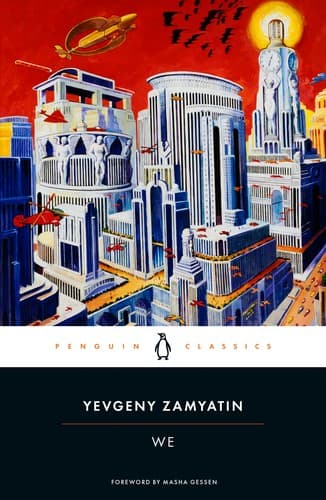
Book 1·The original
We
Yevgeny Zamyatin·1924·trans. Natasha Randall ()
The novel that Orwell read before writing 1984 and Huxley read before writing Brave New World. Written in Soviet Russia in 1924, banned immediately, not published in Russian until 1988. A mathematician in a glass city where everything is transparent and everyone is numbered, not named, falls in love and begins to remember that he has an imagination. Zamyatin invented the template. The two famous successors refined it. None of them surpassed it for the quality of the original terror — the horror of a self dissolving into system. Read the Natasha Randall translation.
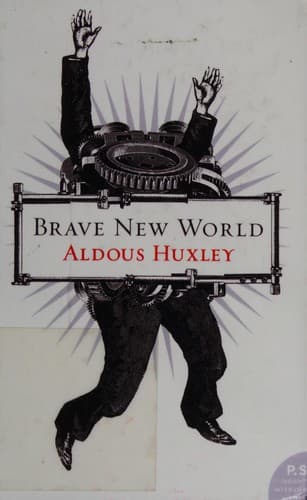
Book 2·The pleasure-state argument
Brave New World
Aldous Huxley·1932
The harder argument. Huxley's dystopia doesn't crush people with fear; it sedates them with pleasure. Citizens are genetically conditioned from conception, socially class-assigned before birth, and kept happy with a drug called Soma. The system is stable because no one wants to leave it. Huxley's 1958 essay Brave New World Revisited argues — convincingly — that his vision was more accurate than Orwell's because totalitarianism is more likely to arrive as entertainment than terror. Re-reading the novel after reading the essay is unsettling in a way that no amount of Orwell manages.
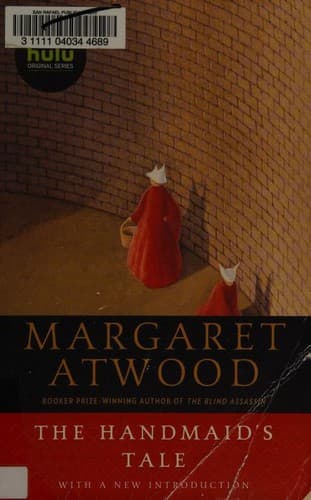
Book 3·The documented future
The Handmaid's Tale
Margaret Atwood·1985
Atwood's rule for herself while writing: nothing in the book that hasn't already happened somewhere. The republic of Gilead — a near-future America where fertility rates have collapsed and women are assigned reproductive roles by the state — is assembled from documented historical precedents, not invention. This is the dystopia that has aged worst, meaning most accurately. Atwood is a better prose stylist than Orwell, and the novel's formal construction — the appendix at the end that repositions everything you've read — is one of the smartest structural moves in speculative fiction.
Book 4·The quiet catastrophe
Never Let Me Go
Kazuo Ishiguro·2005
The most quietly devastating entry on this list. Ishiguro's dystopia never announces itself — three friends grow up at a gentle English boarding school, and the horror of their situation is revealed so gradually that you almost accept it before you understand it. This is what makes it the most formally interesting dystopian novel since Atwood: its subjects have also been conditioned to accept their fate, and the reader's slow recognition mirrors their own. Ishiguro is interested not in resistance but in complicity — in how ordinary good people accommodate themselves to unjust systems. The question it leaves you with is whether any of us are different.
Book 5·The one that's already happened
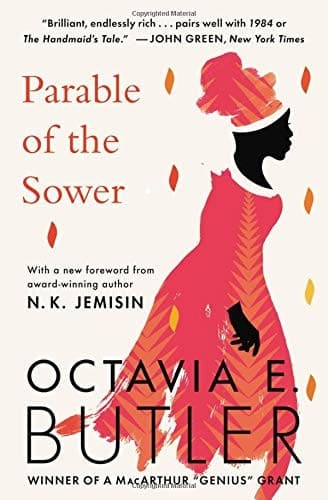
Parable of the Sower
Octavia E. Butler·1993
Butler's dystopia is the most current on this list — not future at all, really, but a 2020s extrapolation of conditions already visible in early-1990s Los Angeles. Climate collapse, private security replacing police, gated communities surrounded by the dispossessed, corporations owning the towns their employees live in. Butler wrote it as a near-future extrapolation; it reads now as history. Her protagonist doesn't resist the system by fighting it — she walks away and tries to build something different. This is the only explicitly hopeful novel on this list, and the hope costs more than the despair of the others.
Book 6·The microscope version
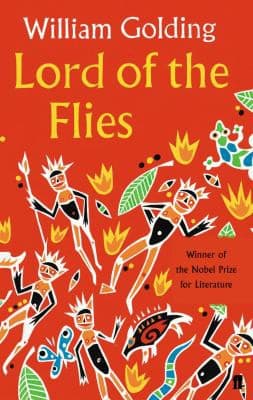
Lord of the Flies
William Golding·1954
The miniature version. Golding doesn't build an authoritarian state; he builds one from scratch using only schoolboys, a remote island, and three weeks. The argument is that the political systems we criticize are not aberrations — they are what happens when the structures that restrain them are removed. Golding's island is the most efficient laboratory the genre has produced for this particular thesis. Technically not science fiction by any definition, but formally a dystopia. The most efficient book on this list: 225 pages to the complete argument.
Book 7·The historical argument
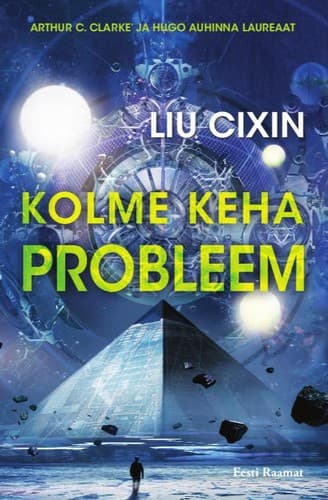
The Three-Body Problem
Cixin Liu·2008·trans. Ken Liu (2014)
The unconventional pick. Liu Cixin's novel isn't set in a dystopia — but its opening chapters, set during the Cultural Revolution, are the most viscerally realized portrait of ideology as system of terror in any novel on this list. The struggle sessions, the denouncements, the physics professor beaten to death in front of his students and daughter: Liu isn't building a thought experiment, he's describing something that happened, and the entire trilogy's moral logic flows from this opening. If dystopian fiction is about understanding how ordinary people become instruments of a system that destroys them, the first fifty pages of Three-Body belong here more than most classics of the genre.
Book 8·The absence argument
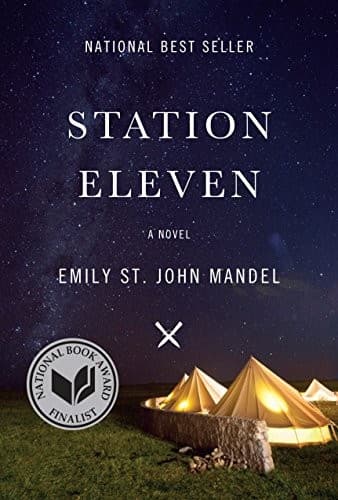
Station Eleven
Emily St. John Mandel·2014
The inverted case. Mandel's post-collapse world isn't authoritarian — it's absent of authority entirely. What grows in its place is not freedom but small tyrannies: local warlords, prophet figures exploiting grief, the quiet violence of resource scarcity. Mandel is asking what dystopian fiction rarely asks: not 'what if the state becomes monstrous' but 'what if the state disappears.' The answer is that humans rebuild hierarchy immediately, and the forms it takes are shaped by what they remember and what they've lost. One of the most formally ambitious uses of nonlinear structure in recent SF.