Golden set · editor-reviewed
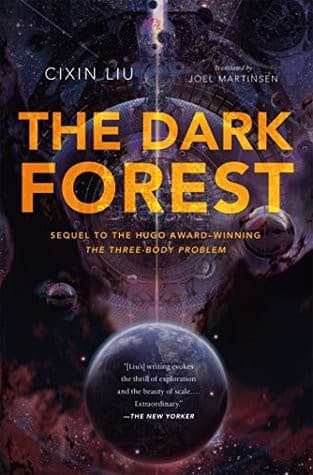
The Dark Forest
Remembrance of Earth's Past · Book Two
Cixin Liu·2008·Tor Books·Sci-Fi & Fantasy
Reading level: Ages 14+ (adult) · 16-hour read · Intermediate difficulty.
- Reading time
- 16h
- Difficulty
- Intermediate
- Recommended age
- Ages 14+
- Guide read
- 5min
- Editor's rating
- 4.8 / 5
- hard-sf
- chinese-sf
- fermi-paradox
- game-theory
- cosmic-sociology
— In one sentence —
Fan + author consensus pick for the best book in the trilogy. Two simple axioms derive the silence of the universe. After this one, you don't look at the night sky the same way.
§ 01 · WHY READ
Why read
If The Three-Body Problem is the skeleton, The Dark Forest is the soul. The trilogy's diehards — and Liu Cixin himself — generally agree this is the best of the three books. It does something almost no SF novel succeeds at: derives an entire model of the universe from two stated axioms, then makes those axioms scary.
The axioms:
- Survival is the primary need of any civilization.
- Civilizations continuously grow and expand, but the total matter in the universe remains constant.
From these, the protagonist Luo Ji derives dark forest theory: the universe is a forest in which every civilization is a hunter with a weapon. When you detect another hunter, the only rational move is to shoot first. Anything else risks your species' survival.
This is one of the most influential SF premises of the 21st century. It is a working answer to the Fermi paradox — where is everyone? They're hiding, because the smart ones learned to. It is also a working critique of the Western SF assumption that first contact will be a moment of communion. Read this book and the night sky becomes, briefly, sinister.
But the book is more than its premise. The Dark Forest is also a deeply weird, deeply moving character study of an ordinary man, Luo Ji, who is handed humanity's survival as a job, refuses it for as long as he can, and finally grows up. Liu Cixin has a reputation for "flat" characters; that reputation does not survive this book. Luo Ji's arc is the most complete piece of human writing in the trilogy.
§ 02 · CHARACTERS
Characters
The book organizes its cast around four answers to the question: how do you fight a war you can't win?
The four Wallfacers · four strategies for the unwinnable
- Luo Ji — sociologist, drifter, the only Wallfacer with a real claim to the role; his plan looks, for most of the book, like he has no plan at all. The trilogy's most fully written character, and the only one whose arc resolves cleanly.
- Frederick Tyler — American general, believes a ghost fleet (using ball-lightning physics) can win an unwinnable battle. His exit defines the book.
- Manuel Rey Diaz — Venezuelan politician, builds a stellar-hydrogen-bomb deterrent. Pure mutually-assured-destruction logic.
- Bill Hines — Japanese-British neuroscientist, believes the answer is altering the human brain itself so that humans become unable to lose. His arc has the trilogy's most uncomfortable ethical questions.
The deterrence arc
- Zhuang Yan — Luo Ji's "perfect wife," conjured for him by the Wallfacer authority. The most-criticized element of the book; readers disagree sharply on whether this is patriarchal fantasy or a metaphor about how invention becomes love. Both readings have evidence.
- Da Shi (Shi Qiang) — returns from Book 1 as Luo Ji's bodyguard and human anchor.
The future line · 200 years after hibernation
- Zhang Beihai — Space Force political commissar; the most quietly devastating character in the trilogy. His arc — and the way it ends — is the most ambitious piece of long-game writing Liu Cixin attempts.
- Zhang Beihai's father — almost no page time; the most ideologically important character. "Think more," he tells his son. The trilogy spends 600 pages unpacking those two words.
The opposition
- The sophons — Trisolaran surveillance particles; nearly omniscient, present in every chapter as the readers' constant awareness of being watched.
- The Trisolarans — for the first time, have a voice.
Reading key: Luo Ji's arc is the surface; Zhang Beihai's future history is the middle layer; dark forest theory is the foundation. All three are running at once.
§ 03 · HIGHLIGHTS
Three highlights
No. 1 · The fairy tale Luo Ji tells Zhuang Yan. Mid-book, in his retreat in the Alps, Luo Ji tells his imaginary wife a story about a magician painter who paints things into and out of existence. Most first-time readers register this as filler. It is the metaphysical center of the trilogy. The fairy tale is about what is real, what is invented, and what becomes real because it was invented. Reread it once the dark forest theory has clicked, and it lights up retroactively.
No. 2 · The Natural Selection and the droplet. The Battle of Darkness, in which the future Space Fleet — a thousand of humanity's most advanced warships — encounters a Trisolaran probe the size of a small refrigerator. The ensuing engagement is the most consequential set-piece in modern Chinese SF and, for a lot of readers, a turning point in their relationship with the trilogy. Hubris vaporized in one chapter.
No. 3 · Luo Ji's curse. The book's climax. Luo Ji, alone, with no fleet, no ally, and a piece of paper, casts a single move at the entire Trisolaran civilization — and stops a 200-year invasion with one sentence. This is the most famous moment in modern Chinese SF. The scene's secret is that the book has been quietly teaching you the rules of cosmic sociology for 400 pages so that, when the curse lands, you know exactly what it means. Few thrillers earn a payoff this completely.
§ 04 · EDITIONS
Recommended editions
| Edition | Why pick it |
|---|---|
| Tor Books (US, 2015) · Joel Martinsen translation | The English-language canonical text. Martinsen is a respected literary translator. Ken Liu did not translate this volume; some readers find the prose slightly more workmanlike than Books 1 and 3 — most don't. |
| Head of Zeus (UK, 2015) | UK edition. Same translation; different cover. |
| Chongqing Publishing (China, 2008) · Chinese original | Original. |
| Tencent Video Season 2 (China, in production as of 2026) | Faithful adaptation of Book 2 was greenlit; release date not finalized. |
| Netflix Season 2 (US, expected 2026–27) | Adapts elements of Books 2 and 3 together. Useful, partial. |
| Audible · P. J. Ochlan narration | The English audio. ~22 hours. |
Important: as of 2026 there is no faithful complete screen adaptation of The Dark Forest. The book is the only way to actually read this story.
§ 05 · FIT
Who it's for / not for
Read this if you are…
- A reader of concept-first SF who wants one of the cleanest examples of premise-driven worldbuilding in the genre.
- A philosophy or game-theory reader; this is the SF novel game theorists keep recommending to non-game-theorists.
- A returning Three-Body reader who suspected Book 1 was building toward something. It was. This is it.
Skip it if you are…
- Allergic to the Luo Ji / Zhuang Yan plotline. The patriarchal optics are real; weigh whether you can read past them.
- Someone who needs action sequences to be the point. The book's biggest set-pieces are arguments and chess-game positions, not battles.
- A reader of the first book who decided you didn't like Liu Cixin's prose. Joel Martinsen's English in Book 2 is not radically different from Ken Liu's in Book 1; if Book 1 didn't land, this one won't either.
§ 06 · TIPS
Reading tips
- Difficulty: medium-to-hard. The cosmic sociology bits require attention but no math.
- Length: about 130,000 words in English; 15–18 hours. The trilogy's most propulsive volume.
- The two time jumps — the 200-year hibernation and the late-book Doomsday Battle — are the trilogy's biggest pacing risks. Pause briefly at each. Take a break, then continue; the next section will reward you.
- If you read only one Three-Body book, read this one. It has the highest information density, the most complete worldview, and the cleanest arc.
- Skim discipline. The Tyler and Rey Diaz sections drag. You can skim. You cannot skim Hines, and you cannot skim Zhang Beihai.
§ 07 · WHERE IT FITS IN THE TRILOGY
Where it fits in the trilogy
Read The Dark Forest after The Three-Body Problem if you want the trilogy in publication order; read it before Death's End if you want the cleanest escalation from first contact to cosmic deterrence. It is also the center of our Three-Body trilogy reading guide, because almost every argument readers have about Liu Cixin's universe eventually passes through Luo Ji's dark forest theory.
The short version: Book 1 asks whether humanity can understand the threat, Book 2 asks whether humanity can survive the threat, and Book 3 asks what survival costs once the whole universe is listening.
§ 07 · COMPARE
Read alongside
- Isaac Asimov — Foundation and Empire (1952). Foundation believes history is predictable and progress is real. The Dark Forest says: not in this universe. Read in conversation.
- Vernor Vinge — A Fire Upon the Deep (1992). A cosmologically ambitious, broadly optimistic alternative to Liu's view of galactic civilization. Useful counterweight.
- Arthur C. Clarke — 2001: A Space Odyssey (1968). Clarke believes higher intelligences will save us. Liu believes they will eat us. Read both.
- Yan Lianke — Dream of Ding Village (2006). Not SF — adult literary fiction by one of Liu Cixin's contemporaries. Useful for understanding the cultural register Liu is writing inside.
§ 08 · DISCUSSION
Discussion questions
- Dark forest theory is a strong working answer to the Fermi paradox. The "Great Filter" hypothesis is the main alternative. Which is more plausible — and which is more falsifiable?
- Luo Ji's relationship with Zhuang Yan is the book's most-criticized element. Read it as patriarchal fantasy; read it as a metaphor about how invented things become real. Both readings have textual support. Which holds up better, and where does it break?
- The four Wallfacers represent four strategies for facing an unwinnable existential threat. Which has the strongest moral defense? Which would actually work?
- Zhang Beihai's father says only "Think more." Trace those two words through the novel. What is the book teaching by repeating them?
- Luo Ji's arc (drift → hedonism → pain → responsibility → deterrence) is the trilogy's most complete character arc. Is it too neat — or has Liu been earning it the whole time?
- If dark forest theory were true, should humanity stop broadcasting? METI (Messaging to Extraterrestrial Intelligence) is an actual real-world debate. The book's position is clear; what is yours?
- The Doomsday Battle deletes a thousand human warships in fifteen minutes with one foreign object. Read this as Liu's verdict on a specific kind of human pride. Whose pride?
- Compared to Book 1, are the women in this book a step forward (Zhang Beihai's daughter, AA) or a step back (Zhuang Yan, Mu Xing)? Which scenes carry the verdict?
One line to remember
“The universe is a dark forest. Every civilization is an armed hunter stalking through the trees like a ghost.”— Luo Ji, explaining cosmic sociology — Part III, Dark Forest
Appears in collections
Reading lists featuring this book
6 books
Most Addictive Books to Read
Six books with hooks so specific you'll remember exactly where you were when you couldn't stop.
Open list →
3 books
Liu Cixin's Three-Body Trilogy · A 3-Book Reader's Guide
Three novels, two translators, one universe that ends. Where you start depends on what you came for.
Open list →
6 books
What to Read After The Three-Body Problem
Continue the trilogy, then six novels with the same intellectual ambition.
Open list →
You might also like
Read next
Ted Chiang · 2002
Stories of Your Life and Others
Ted Chiang writes 30-page stories that take longer to think about than most novels. He has won more awards per word than any writer alive.
Read · 5 min
Octavia E. Butler · 1979
Kindred
Octavia Butler sends a Black woman from 1976 Los Angeles back to antebellum Maryland. The time travel is a device. The horror is real.
Read · 5 min
Octavia E. Butler · 1993
Parable of the Sower
Written in 1993 as a near-future extrapolation of Los Angeles. It reads now as contemporary history.
Read · 5 min