Editor-reviewed
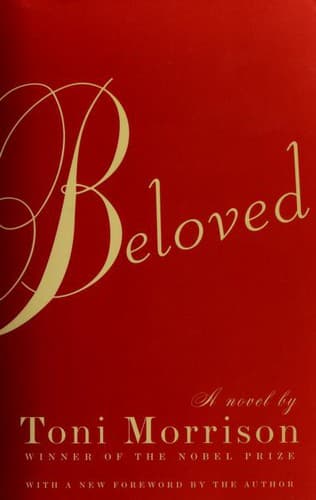
Beloved
Toni Morrison·1987·Alfred A. Knopf·Literature
Reading level: Ages 16+ (adult) · 11-hour read · Advanced difficulty.
- Reading time
- 11h
- Difficulty
- Advanced
- Recommended age
- Ages 16+
- Guide read
- 6min
- Editor's rating
- 5.0 / 5
- toni-morrison
- slavery
- american-literature
- pulitzer
- nobel
- ghost-story
- historical-fiction
- race
— In one sentence —
Toni Morrison said she wrote this novel to give voice to the sixty million. It won the Pulitzer, the Nobel, and is the greatest American novel of the second half of the twentieth century.
§ 01 · WHY READ
Why read
Toni Morrison dedicated Beloved "to the sixty million and more" — the estimated number of Africans who died in the Middle Passage and the slave trade. She said she wrote the novel because American literature had no way to speak adequately about what slavery had done — that the existing forms, the plantation narrative, the slave memoir, the historical novel — all told the story from outside, or required the enslaved person to perform comprehensibility for a white audience.
The novel is based on the story of Margaret Garner, an enslaved woman who escaped from Kentucky to Cincinnati in 1856, was captured under the Fugitive Slave Act, and killed her two-year-old daughter rather than allow her to be taken back into slavery. Garner was prosecuted under the Fugitive Slave Act, not for murder — the law did not recognize enslaved people as persons capable of murder. The case was reported in the Black newspaper The American Baptist; Garner became a cause célèbre in abolition circles; then she was largely forgotten. Morrison found the story in 1974 while editing a collection of Black history documents and spent thirteen years writing the novel.
The form of the novel is the argument. Morrison does not tell the story of Sethe's infanticide — that word is never used — in the conventional sequence of cause and effect. The novel begins years after the act, in 1873, with Sethe living in a haunted house in Cincinnati. The ghost's identity, the backstory, the full weight of what happened at Sweet Home (the ironically named Kentucky plantation): all of it arrives in fragments, in memory, in trauma's logic of what can and cannot be approached directly. The reader reconstructs what happened the way survivors reconstruct what they cannot afford to remember whole.
Morrison won the Pulitzer Prize in 1988 and the Nobel Prize in Literature in 1993. She is the standard against which all American fiction of the last half-century is measured.
§ 02 · CHARACTERS
Characters
Sethe — formerly enslaved, now living at 124 Bluestone Road, Cincinnati. She escaped from Sweet Home eighteen years before the novel begins; she killed her daughter before she could be taken back. She is one of the most complex protagonists in American fiction: not because Morrison explains her but because the novel renders her consciousness with a precision that makes her acts legible without making them available for easy judgment. She is not a character to have an opinion about; she is a consciousness to inhabit.
Beloved — the ghost who materializes as a young woman and comes to live in the house. She is the dead daughter, returned. She is also — Morrison has said — the embodiment of all the dead of the Middle Passage, the accumulated grief of sixty million. She is both literal and symbolic simultaneously, and the novel does not resolve the tension between the two readings; it makes both meanings present at once. She is the most formally ambitious character in American fiction since Faulkner.
Denver — Sethe's surviving daughter, eighteen at the novel's start. She has never left the yard of 124; the haunting and the community's avoidance of the house have enclosed her. Her emergence into the community in the novel's third section — her decision to go out and ask for help — is Morrison's most hopeful sequence.
Paul D — a man who was enslaved at Sweet Home with Sethe, who arrives at 124 eighteen years later. His relationship with Sethe — its tenderness, its difficulty, his response to learning what she did — is the novel's central moral test. He cannot, initially, hold what Sethe did; the novel watches him discover whether he can.
Baby Suggs (holy) — Sethe's mother-in-law, who was freed before the novel begins and who held gatherings in the Clearing where Black people came to love their bodies — to love what the system had tried to teach them to despise. She died before the novel begins; her presence pervades it.
§ 03 · HIGHLIGHTS
Three highlights
No. 1 · The Clearing. Baby Suggs, holy, led gatherings in a circular clearing in the woods where the community came and she told them to love their flesh — the flesh that was beaten, that was branded, that was not considered theirs to own. Morrison's rendering of this is the novel's most lyrical passage and its most political: the radical act of teaching people whose bodies had been property to inhabit and love those bodies. Baby Suggs is doing theology with no church and no denomination except the experience of the people around her.
No. 2 · The stream-of-consciousness chapter. Roughly two-thirds through the novel, Morrison gives Beloved an extended interior monologue that is unlike anything else in American fiction: a run-on, punctuation-minimal stream of consciousness that moves between Beloved's childhood, the boat, the Middle Passage, the holding place, and 124. It is not realist; it is not coherent in the conventional sense; it is what the novel has been preparing you to receive — the voice of the unvoiced dead. It is the sixty million speaking. Reading it slowly is not optional.
No. 3 · "Sixty million and more." The dedication. Before the novel begins, Morrison has already named what the novel is for. Every difficult formal choice — the non-linear narrative, the unreliable chronology, the chapter that refuses conventional syntax — exists in service of that dedication. The novel's difficulty is not aesthetic experiment; it is moral necessity. A conventionally told story about this subject would have misrepresented it.
§ 04 · EDITIONS
Recommended editions
| Edition | Why pick it |
|---|---|
| Vintage International (paperback) | The standard US edition; includes a foreword by Morrison written in 2004 in which she discusses the process of writing the novel. Read the foreword after the novel. |
| Knopf (hardcover, first edition) | Collectible; the original cover image (an abstracted Black face) was designed by Morrison's art director at Random House. |
| Audiobook (Toni Morrison reading) | Morrison's own reading is one of the essential recordings in American literature. Her voice, her rhythm, her own understanding of the text's pacing: this is the correct audio experience. |
§ 05 · FIT
Who it's for / not for
Read this if you are…
- Any reader who takes American literature seriously and has not yet read Morrison. This is the place to start.
- Readers interested in how literary form can be in service of historical and moral argument — how the way a story is told can be as important as what it says.
- Anyone who has read To Kill a Mockingbird and wants to read the novel Morrison said she wrote partly in response to the tradition that Mockingbird represents: a story told from inside, not from outside.
- Readers who are ready to be changed by a book.
Skip it if you are…
- Looking for a novel with a conventional plot structure. Beloved is not structured chronologically; it is structured by trauma's logic of what can be approached and what must be circled.
- Not prepared for the difficulty. The novel is advanced: the stream-of-consciousness chapter, the non-linear chronology, the multiple simultaneous meanings of Beloved's presence. This is not difficulty for its own sake — but it is real difficulty.
§ 06 · TIPS
Reading tips
- Don't try to establish a clear timeline on first read. The novel moves in and out of memory, forward and back; the reconstruction of what happened at Sweet Home arrives in pieces. Trust Morrison's sequencing.
- The stream-of-consciousness chapter is the heart of the book. When you reach it, read it at one sitting, slowly, twice if needed. It is the sound of the sixty million. Everything else in the novel is preparing you to be able to hear it.
- Read the foreword last. Morrison's 2004 foreword to the Vintage edition discusses the novel's origins and genesis; reading it first explains what the novel is going to do, which reduces the experience of being placed inside it. Read it after.
- Baby Suggs's theology is a real argument. When she says love your flesh, love your heart, she is making a political and spiritual claim about the restoration of personhood that the slave system spent its entire existence destroying. Read it as argument, not as metaphor.
- "This is not a story to pass on." The novel's final line appears three times in three different grammatical valences. On the third reading, it means something different from the first. Track it.
§ 07 · COMPARE
Read alongside
- Toni Morrison — Song of Solomon (1977). Morrison's earlier novel; different in tone (warmer, more comic in places), equally dense. A good companion after Beloved.
- Harriet Jacobs — Incidents in the Life of a Slave Girl (1861). The enslaved woman's memoir: the autobiography that had to perform comprehensibility for its white abolitionist audience in ways Beloved explicitly refuses to. The comparison is clarifying.
- Octavia E. Butler — Kindred (1979). The speculative fiction companion: a Black woman transported back to slavery, the same question about survival and accommodation, a different formal approach. Butler's directness vs. Morrison's obliqueness.
- William Faulkner — The Sound and the Fury (1929). Morrison's acknowledged predecessor in formal difficulty: the stream-of-consciousness method, the non-linear chronology, the legacy of the past as an unresolved present. Morrison wrote her doctoral dissertation on Faulkner.
- James Baldwin — Go Tell It on the Mountain (1953). The male counterpart: the psychological cost of Black life in America, rendered from inside a single consciousness, through the lens of a specific religious tradition.
§ 08 · DISCUSSION
Discussion questions
- Morrison structures the novel around trauma's logic — the thing cannot be approached directly but must be circled. Where do you see this structure? What would be lost if the novel were told chronologically?
- Sethe killed her daughter. Paul D says she has "two feet, not four" when he learns what she did — she acted like an animal. Sethe says she had "more" love than anyone knew. Who is right? Does Morrison give you a way to decide?
- Beloved is simultaneously a ghost, the returned dead daughter, and an embodiment of the sixty million. How does Morrison hold these meanings simultaneously? When are you reading Beloved as one, when as another?
- Baby Suggs holds gatherings in the Clearing and tells the community to love their flesh. What is the political argument this scene is making? Why does this matter more than a conventional sermon?
- The stream-of-consciousness chapter is without conventional punctuation and chronology. What is it doing that could not be done in a conventionally structured chapter?
- Denver's emergence from the yard — going out into the community to ask for help — is the novel's turn toward hope. What makes it feel earned rather than sentimental?
- Morrison dedicated the novel "to the sixty million and more." How does the dedication change what you understand the novel's purpose to be? What does it claim for fiction that history cannot claim?
- "This is not a story to pass on" appears three times with different meanings. By the third occurrence, what do you understand it to mean?
One line to remember
“This is not a story to pass on.”— Part Three — closing pages
Appears in collections
Reading lists featuring this book
7 books
The Best Book Gifts for Mother's Day
Seven novels that take mothers seriously as people, not just as mothers.
Open list →
5 books
The Best Books About Colonialism
Five novels that look at empire as a mechanism — what it does to colonizers and colonized, and what it costs to refuse to look away.
Open list →
6 books
Best Books About Grief and Loss
Six different kinds of grief — romantic, existential, maternal, historical, friendship, childhood.
Open list →
7 books
Books About Identity and Belonging
Seven novels about the self that society refuses, and the self that refuses society.
Open list →
7 books
The Best Books About Motherhood
Seven novels about motherhood handled with full weight — what it costs, what it makes possible, what it cannot prevent.
Open list →
10 books
Books About the American South
Ten books, ten Souths — some in direct contradiction.
Open list →
6 books
Best Books for Ambitious Women
Six novels that take women's serious ambition seriously, without flattering it or apologizing for it.
Open list →
5 books
Books Like Beloved
Five novels for readers who want that combination of historical weight, lyric prose, and the refusal to look away.
Open list →
6 books
Books That Will Make You Cry
Direct about what hits and why — no sentimentality, just the moments that break through.
Open list →
6 books
Books to Read After a Breakup
Six books that sit with you in the loss — and quietly help you rebuild.
Open list →
6 books
Books to Understand Race in America
From slavery to the near future — six novels that cover what history textbooks flatten.
Open list →
7 books
Feminist Literature Worth Reading
Seven books across 150 years — each making a different argument through a different form.
Open list →
8 books
Nobel Prize Winning Novels Worth Reading
Eight novels by Nobel laureates in Literature — chosen not because the prize certifies them, but because they are the ones a first-time reader of Nobel fiction can actually get inside.
Open list →
10 books
Ten Novels to Understand the American South
A literature that carries the full weight of American history — grace and violence together.
Open list →
6 books
Best Pulitzer Prize Novels Worth Reading Now
Six winners that held up — and one whose controversy is part of the point.
Open list →
You might also like
Read next
William Faulkner · 1936
Absalom, Absalom!
Four narrators reconstruct a man who destroyed his family. The story keeps changing. That is the point.
Read · 7 min
Leo Tolstoy · 1878
Anna Karenina
Not just a love story. Two parallel lives — Anna's destruction, Levin's salvation — ask the same question: how should a person live?
Read · 6 min
Charles Dickens · 1853
Bleak House
Dickens's masterpiece — a legal satire, a detective novel, and a social panorama in one impossible structure.
Read · 7 min