Editor-reviewed
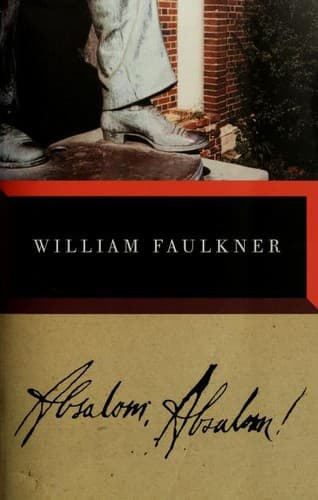
Absalom, Absalom!
William Faulkner·1936·Random House·Literature
Reading level: Ages 18+ (adult) · 14-hour read · Advanced difficulty.
- Reading time
- 14h
- Difficulty
- Advanced
- Recommended age
- Ages 18+
- Guide read
- 7min
- Editor's rating
- 5.0 / 5
- faulkner
- american-literature
- southern-gothic
- classic
- experimental
- slavery
- civil-war
— In one sentence —
Four narrators reconstruct a man who destroyed his family. The story keeps changing. That is the point.
§ 01 · WHY READ
Why read
Absalom, Absalom! is Faulkner's most ambitious novel and, by most measures, the great American novel of the twentieth century — not the most beloved, not the most readable, but the one that does the most. It is a novel about the South and about the impossibility of knowing the past and about what slavery built and destroyed, told through four narrators who are collectively trying to reconstruct a story they were not present for, about a man they did not know, a hundred years ago.
Thomas Sutpen arrived in Yoknapatawpha County in 1833 with no money, no past, and an idea he called his "design." He built a plantation called Sutpen's Hundred, married, had children, fought in the Civil War, and came home to watch everything he built collapse. The novel is an attempt to explain why — to understand what Sutpen was, what he was trying to accomplish, and what destroyed it.
The novel cannot be explained outside its method. It is told in layers of narration: Rosa Coldfield telling Quentin Compson in 1909, Quentin's father telling Quentin later, Quentin and his Harvard roommate Shreve reconstructing the story together in a cold dormitory in 1910. Each narrator has different information, different investments, different guesses. The story changes with each telling. The reader never gets a stable, authoritative account, because that is not how the past works and that is not how the South's reckoning with its history works.
The connection to the title: Absalom, in the Bible, is David's beloved son who rebels and is killed. When David learns of the death, he cries: "O my son Absalom, my son, my son Absalom! would God I had died for thee." Faulkner's Absalom is Charles Bon — and the father who failed to acknowledge him. The parallels are not neat. They never are.
§ 02 · CHARACTERS
Characters
Thomas Sutpen — the novel's absent center. He is described, recalled, reconstructed, but never directly rendered in interiority. What he was, what he wanted, what he understood — all of this arrives filtered through four narrators' interpretations. Faulkner leaves the deepest question unanswered: did Sutpen know what he was doing, or was he simply blind to what his "design" required?
Charles Bon — Sutpen's eldest son from a first marriage Sutpen abandoned when he discovered his wife had Black ancestry. He appears at the University of Mississippi, befriends Henry Sutpen (his half-brother), falls in love with Henry's sister Judith. Whether he knows Sutpen is his father, whether he wants acknowledgment or revenge, whether he would have stopped if Sutpen had spoken — this is the novel's central unanswerable question.
Henry Sutpen — who kills Charles Bon at the gate of Sutpen's Hundred in 1865. The novel circles this act for 400 pages: why did Henry do it? Faulkner provides two different answers across the novel. The final answer — delivered by Quentin in the dormitory at Harvard — changes everything you thought you understood.
Rosa Coldfield — who was there, who is telling Quentin, who has been wrong about the central facts, who has spent forty-three years carrying her wrong understanding. Her narration is furious, lyrical, and unreliable. It is also the most emotionally immediate.
Quentin and Shreve — the two young men reconstructing the story in a cold room in Cambridge. Quentin is from Mississippi; Shreve is Canadian. Their collaboration — Shreve's outsider's improvisation, Quentin's insider's grief — is the novel's most moving relationship.
§ 03 · HIGHLIGHTS
Three highlights
No. 1 · The question of why Henry killed Charles Bon. The novel's first explanation: Henry killed Bon because Bon was planning to commit bigamy, having already married a woman in New Orleans. This explanation takes 300 pages. Then Faulkner reveals that Bon had Black ancestry — that Sutpen's rejection of his first wife was a rejection of her race — and that this is why Henry killed him. Race, not bigamy. The novel's history of the South is rewritten in that revision.
No. 2 · Quentin and Shreve in Cambridge. Chapter 8 — the longest chapter, the emotional center — is Quentin and Shreve talking through the night, building their version of events, the two of them becoming the characters as they speak. Shreve's Canadian improvisation and Quentin's Mississippi grief produce something that is neither fact nor fiction but the way the past actually exists: in the stories people tell each other to make sense of what was done.
No. 3 · The final exchange. "Why do you hate the South?" Shreve asks Quentin. Quentin says he does not hate it, says it quickly, but the book ends there. The reader has just spent 400 pages inside Quentin's relationship to the South and its history. "I don't hate it," repeated in the cold, does not convince anyone, including Quentin.
§ 04 · EDITIONS
Recommended editions
| Edition | Why pick it |
|---|---|
| Vintage International (paperback) | The standard edition; includes the genealogy and the map of Yoknapatawpha County, both essential. Do not read without the genealogy within reach. |
| Library of America — Faulkner: Novels 1936–1940 | The scholar's edition; clean text, authoritative, includes The Unvanquished and If I Forget Thee, Jerusalem. For the committed reader. |
| Audiobook (Grover Gardner) | Gardner handles the layered narration with more clarity than most readers manage silently. Hearing the voices distinguished is a genuine aid. |
§ 05 · FIT
Who it's for / not for
Read this if you are…
- Readers who are ready for a novel that does not resolve into a stable account. If you want to know what happened, you will not get a clean answer. If you want to understand what it means that we cannot know, this is the novel.
- Anyone interested in what American literature has to say about slavery, race, and the South's self-understanding. Faulkner says it through formal difficulty: the opacity is not a stylistic choice, it is a moral argument.
- Readers who have already read The Sound and the Fury and want to go further.
Skip it if you are…
- Looking for a novel to read for pleasure in the conventional sense. This is work. It is rewarding work, but it is work.
- Put off by unreliable narrators. Every narrator in this novel is wrong about something crucial. The truth arrives late, changed, and still not complete.
§ 06 · TIPS
How to read it
Use the genealogy. It is at the back of the Vintage edition; move it to the front. You need to know who is related to whom before you can follow the revelations.
Read the chapter headings for their dates. Faulkner is moving between 1833, 1865, 1909, and 1910 without always announcing it. The dates tell you where you are.
Do not try to hold the full picture on first read. Read for experience rather than comprehension on the first pass. The second read — if you return — reveals the architecture.
The climax of Chapter 8, where Quentin and Shreve reconstruct the crucial conversation between Henry and Bon, is the novel's emotional peak. Read it slowly.
§ 07 · COMPARE
Read alongside
- William Faulkner — The Sound and the Fury (1929). The predecessor; introduces the Compson family and Quentin. Reading Sound and Fury first gives Absalom additional depth, though neither requires the other.
- Toni Morrison — Beloved (1987). Morrison wrote her doctoral dissertation on Faulkner; Beloved is in direct conversation with the Southern Gothic tradition. The comparison clarifies what each novel is doing with the history of slavery.
- Gabriel García Márquez — One Hundred Years of Solitude (1967). Márquez acknowledged Faulkner as a primary influence. The comparison shows how the Faulknerian method traveled into Latin American magical realism.
§ 08 · DISCUSSION
Discussion questions
- The novel gives two different reasons for Henry's killing of Charles Bon: bigamy, and then race. Why does Faulkner withhold the second explanation for 300 pages? What does the revision do to the first explanation?
- Each narrator reconstructs the past with incomplete information and personal investment. Whose account is most trustworthy? Is any account trustworthy?
- Thomas Sutpen's "design" required him to abandon his first wife and son when he discovered their racial ancestry. The novel treats this as a blindness rather than an evil. Is that distinction meaningful?
- Quentin and Shreve are inventing scenes and dialogue they could not have known. What is the novel suggesting about how history is made?
- "Why do you hate the South?" What is the novel's answer to Shreve's question? What is Quentin's answer?
- The novel is told entirely from white perspectives. What does the novel know, and not know, about the Black characters?
One line to remember
“Maybe nothing ever happens once and is finished. Maybe happen is never once but like ripples maybe on water after the pebble sinks.”— Chapter 7
You might also like
Read next
William Faulkner · 1930
As I Lay Dying
Fifteen narrators carry a dead woman across Mississippi. Each one sees something different. Faulkner shows you all of it.
Read · 6 min
William Faulkner · 1932
Light in August
A man who does not know his race. A pregnant woman looking for her lover. A community that destroys what it cannot categorize.
Read · 6 min
William Faulkner · 1929
The Sound and the Fury
The fall of a Southern family told four times, from four perspectives, starting with a character who cannot tell time. Faulkner said he wrote it five times and never got it right.
Read · 5 min