Editor-reviewed
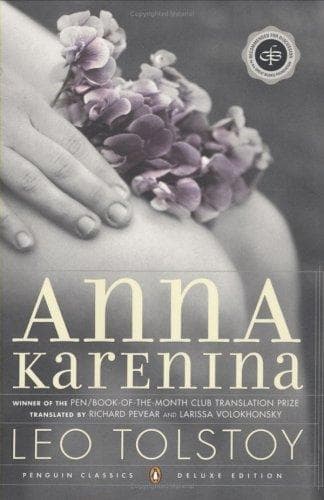
Anna Karenina
Leo Tolstoy·1878·Various (public domain)·Literature
Reading level: Ages 16+ (adult) · 30-hour read · Intermediate difficulty.
- Reading time
- 30h
- Difficulty
- Intermediate
- Recommended age
- Ages 16+
- Guide read
- 6min
- Editor's rating
- 4.9 / 5
- tolstoy
- russian-literature
- classic
- 19th-century
- canonical
- love
- marriage
— In one sentence —
Not just a love story. Two parallel lives — Anna's destruction, Levin's salvation — ask the same question: how should a person live?
§ 01 · WHY READ
Why read
Tolstoy published Anna Karenina between 1875 and 1878, and Dostoevsky immediately called it a flawless work of art. He was right. The novel opens with the most famous first sentence in fiction, and everything that follows earns it.
The novel runs two stories in parallel. Anna Karenina, a beautiful, intelligent woman in a respectable but loveless marriage, falls in love with Vronsky, a young officer, and leaves her husband and son for him. The relationship begins in passion and gradually suffocates under social ostracism, jealousy, and Anna's growing desperation. The parallel story follows Konstantin Levin — a landowner, philosopher, farmer, questioner — as he pursues Kitty, marries her, works his land, has a son, and arrives, at the end, at something like a personal faith. The two stories are not simply contrast; they are Tolstoy's dual answer to the same question he is working out as he writes.
That question is: what makes a life worth living? Anna's destruction is not punishment for adultery — Tolstoy is not simple enough for that. It is the result of being a person of large capacities in a world that offers those capacities no legitimate channel. Levin's salvation is not the triumph of conventional virtue — he is also restless, unhappy, and searching for most of the novel. What he finds, in the final pages, is something provisional and personal. Tolstoy does not offer it as universally applicable.
The first sentence tells you what the novel is about: unhappy families are each unhappy in their own way. Anna Karenina is a sustained investigation of that specific, irreducible particularity.
§ 02 · CHARACTERS
Characters
Anna Karenina — one of the most fully realized women in fiction: beautiful, intelligent, warm, capable of fierce love, and gradually consumed by jealousy and the narrowing of her world. She is not a victim of one bad decision but of a system — social, psychological, and ultimately structural — that allows her no good options. Her final hours, on the train platform, are among the most devastating pages in any novel.
Konstantin Levin — Tolstoy's self-portrait: restless, questioning, awkward in society, at home on his estate, unable to accept conventional answers. His love for Kitty is the novel's emotional center, and his philosophical journey in the final section — toward something like faith — is the resolution Tolstoy needs even when Anna's story cannot resolve.
Alexei Vronsky — the officer Anna destroys herself for: honorable, handsome, genuinely in love, and ultimately inadequate to what she needs. He is not a villain. He does everything a good man of his class would do. This is precisely the problem.
Kitty Shcherbatsky — Levin's wife: initially disappointed (she turns down Levin to pursue Vronsky, who doesn't propose), then ill, then recovered, then genuinely happy. Her arc is quieter than Anna's but not less considered — Tolstoy takes her seriously as a person in a way that many 19th-century novelists would not.
§ 03 · HIGHLIGHTS
Three highlights
No. 1 · Anna and Levin's single meeting. These two characters, whose stories run in parallel for 800 pages, meet exactly once — at a dinner party near the end. The scene is short and ostensibly inconsequential. Both characters are drawn to the other; Levin is captivated by Anna's intelligence and warmth; Anna is briefly alive in a way she hasn't been. It is one of the saddest scenes in the novel, because we understand everything it is not going to become.
No. 2 · Levin mowing. Levin joins his peasants in cutting hay — a long physical sequence that is simultaneously agricultural description and spiritual experience. He falls into the rhythm of the work, loses himself in it, and emerges changed. It is Tolstoy's most direct statement about the relationship between physical labor and human meaning, and it is written with a vividness that makes the reader feel the work.
No. 3 · The train platform. Anna's death is prepared over many pages — her jealousy, her growing delusion, her separation from Vronsky, her final desperate ride toward the station. The decision, when it comes, feels both sudden and inevitable. Tolstoy shows the last seconds in a way that is respectful of the event's enormity without exploiting it. The light going out is the novel's final image.
§ 04 · EDITIONS
Recommended editions
Richard Pevear and Larissa Volokhonsky (Penguin Classics, 2000) is the standard recommendation for readers approaching the Russian classics — their translation is the most literal and preserves Tolstoy's rhythm and repetition. Their Tolstoy is better than their Dostoevsky.
Rosamund Bartlett (Oxford World's Classics, 2014) is an excellent alternative — Bartlett is a major Tolstoy scholar and her translation is both accurate and very readable. Particularly recommended for readers who find P&V sometimes stiff.
Constance Garnett (1901) is the translation many readers' grandparents used, and it remains readable; but Garnett sometimes smooths over Tolstoy's deliberate stylistic roughness, and a more recent translation gives you more of what Tolstoy intended.
§ 05 · FIT
Who it's for / not for
Read this if you are…
- Anyone who wants to understand what the novel form can do at its maximum — this is a plausible candidate for the greatest novel ever written.
- Readers who are willing to engage with both the social drama and the philosophical sections.
- Anyone who has read and loved Madame Bovary and wants to see the same question answered at twice the scale and depth.
Skip it if you are…
- Deterred by length and Russian names: 800 pages and an unfamiliar cast require commitment. But the Russian name difficulty is overstated — Tolstoy's characters are vivid enough that you will stop losing track within 50 pages.
- Looking only for Anna's story: Levin is equally central, and readers who try to skip his sections will find the novel diminished.
§ 06 · TIPS
How to read it
The Russian name problem is real but manageable. Most characters have two or three forms of their name (Anna / Annushka; Konstantin Levin / Kostya). Keep a character list for the first 100 pages; after that you won't need it.
Levin is not the boring part. Readers who have been told to tolerate Levin's philosophical sections in order to get back to Anna are being given bad advice. Levin's sections are the novel's philosophical spine — the question Anna's story poses, Levin's story attempts to answer.
§ 07 · COMPARE
Read alongside
- Gustave Flaubert — Madame Bovary (1857). The smaller, more precise version of the same experiment: a woman trapped by the gap between what she desires and what her world offers. Reading them together shows two different scales of ambition.
- Leo Tolstoy — War and Peace (1869). The larger Tolstoy: more characters, more history, more philosophy, more everything. Read Anna Karenina first.
- Edith Wharton — The Age of Innocence (1920). Wharton's New York society novel asks similar questions about the individual vs. social convention, at a smaller scale and with more irony.
§ 08 · DISCUSSION
Discussion questions
- The novel opens with "All happy families are alike; each unhappy family is unhappy in its own way." By the end, do you believe this? What does it mean?
- Is Anna punished for adultery? Or is the novel more complicated than a moral lesson? What kills Anna?
- Levin and Anna meet only once. What does this single scene accomplish?
- Vronsky is not a bad man. He loves Anna and does what a good man of his class would do. Why is this insufficient?
- Tolstoy was suspicious of art, urban society, and romantic love — and wrote one of the greatest love stories ever written. How do you reconcile this?
- Levin's final pages describe a personal faith he cannot explain to anyone else. Is this a satisfying ending for the novel's philosophical questions? Is it meant to be?
One line to remember
“All happy families are alike; each unhappy family is unhappy in its own way.”— Leo Tolstoy — Anna Karenina
Appears in collections
Reading lists featuring this book
7 books
The Best Book Gifts for Mother's Day
Seven novels that take mothers seriously as people, not just as mothers.
Open list →
7 books
The Best Books About Motherhood
Seven novels about motherhood handled with full weight — what it costs, what it makes possible, what it cannot prevent.
Open list →
7 books
The Best Books for a Long Flight
Seven books substantial enough to disappear into for ten hours in a metal tube.
Open list →
You might also like
Read next
Leo Tolstoy · 1869
War and Peace
580,000 words. 580 named characters. The Napoleonic invasion of Russia. And somehow, also, the best novel about how to live.
Read · 6 min
William Faulkner · 1936
Absalom, Absalom!
Four narrators reconstruct a man who destroyed his family. The story keeps changing. That is the point.
Read · 7 min
Toni Morrison · 1987
Beloved
Toni Morrison said she wrote this novel to give voice to the sixty million. It won the Pulitzer, the Nobel, and is the greatest American novel of the second half of the twentieth century.
Read · 6 min