Editor-reviewed
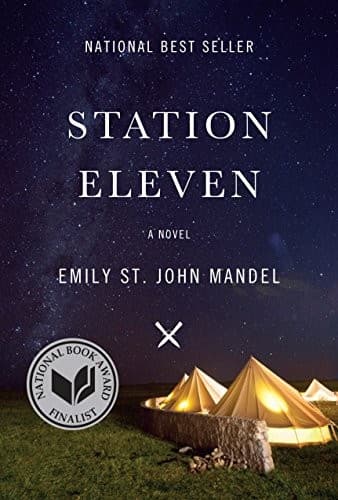
Station Eleven
Emily St. John Mandel·2014·Knopf·Fiction
Reading level: Ages 14+ (YA) · 9-hour read · Beginner difficulty.
- Reading time
- 9h
- Difficulty
- Beginner
- Recommended age
- Ages 14+ (YA)
- Guide read
- 5min
- Editor's rating
- 4.4 / 5
- post-apocalyptic
- literary-sf
- pandemic
- art
- memory
- survival
- 2010s
— In one sentence —
A pandemic kills most of humanity. Twenty years later, a travelling Shakespeare company performs for survivor settlements. Mandel is interested in what survives and why.
§ 01 · WHY READ
Why read
Station Eleven was published in 2014, six years before a pandemic changed the reading context of everything in it. Mandel didn't predict COVID-19 — the Georgian Flu of her novel kills 99% of the population within weeks, a different scale entirely — but she was writing about the same underlying question: what do humans reach for when the structures they take for granted are gone?
Her answer is unusual in post-apocalyptic fiction. Most novels in the genre are interested in the collapse — the violence, the resource competition, the horror of transition. Mandel is largely uninterested in the horror. Her novel takes place partly in the weeks of the collapse and partly twenty years later, and in the twenty-years-later sections, the world she shows us is livable. Small settlements around the Great Lakes. Electricity is gone, but communities have formed. And most strikingly: a traveling company of actors and musicians — the Traveling Symphony — moves between settlements performing Shakespeare and classical music.
"Survival is insufficient." The phrase is painted on the Symphony's caravans, taken from a Star Trek: Voyager episode. It is Mandel's thesis: after a civilization ends, the first imperative is physical survival, but the second imperative — which humans reach for very quickly — is meaning. Art. Story. The things that make survival worth continuing.
This is a contrarian position in the genre, and Mandel earns it through form rather than assertion. The novel's nonlinear structure — moving between the night of the collapse, the twenty years after, and the pre-collapse lives of its characters — constantly juxtaposes what was with what is, and what survives the juxtaposition is never what you'd predict.
§ 02 · CHARACTERS
Characters
The novel has a large cast connected by a series of pre-collapse relationships that converge on a single night: the night Arthur Leander, a famous actor, dies on stage during a performance of King Lear in Toronto.
Kirsten Raymonde — eight years old the night Arthur dies on stage; twenty-eight in the post-collapse sections, an actor with the Traveling Symphony. She doesn't remember most of the collapse years. She collects tabloid articles about Arthur Leander and carries two issues of a graphic novel, Station Eleven, whose author she doesn't know. Her search for memory and connection drives the post-collapse narrative.
Arthur Leander — the novel's gravitational center who is dead before page five. We learn him entirely in retrospect: a Canadian actor who became famous, married three times, and died performing King Lear. The novel's pre-collapse sections reconstruct his life through the eyes of people who loved him — and the reconstruction is Mandel's argument about what survives a life.
Jeevan Chaudhry — in the audience the night Arthur dies; a former entertainment journalist becoming an EMT. He tries to save Arthur, fails, and then receives a phone call from a doctor friend telling him to stockpile food immediately. His first-person experience of the collapse is the novel's most visceral section.
Clark Thompson — Arthur's oldest friend, who ends up stranded in an airport that becomes a permanent settlement. He creates the Museum of Civilization — a collection of pre-collapse objects that survivors donate. His chapters are the novel's meditation on what material culture means once the civilization that produced it has ended.
The Prophet — the novel's antagonist, who leads a religious cult in the post-collapse settlements. His identity is the novel's central mystery, connected to the pre-collapse world in ways that take time to become clear.
§ 03 · HIGHLIGHTS
Three highlights
No. 1 · The Museum of Civilization. Clark, stranded at Severn City Airport, begins collecting objects that pre-collapse travelers have left behind: laptops, smartphones, credit cards, a stiletto heel. He displays them in an unused airport gate. Survivors come to look. Children who were born after the collapse stand in front of an iPhone and cannot entirely understand what it was for. The museum is Mandel's most direct statement of the novel's theme: the things a civilization makes say something about what that civilization valued, and that something survives even after the civilization doesn't.
No. 2 · The nonlinear structure. Mandel moves freely between three time periods — the night of the collapse (Year Zero), the twenty years after (Year Twenty), and the decade before (the pre-collapse life of Arthur and the people around him). The effect is that the reader constantly knows things the characters don't, and doesn't know things the narrative withholds. When the pre-collapse and post-collapse lives of two characters turn out to be connected in a way neither knows, the structure creates an emotion — call it longing for the connections that were possible — that the plot itself can't produce. The form is the argument.
No. 3 · "Survival is insufficient." The phrase is painted on the Traveling Symphony's caravans. In the novel's context it is simultaneously practical (you have survived; you need more than survival) and philosophical (what is "enough" for a human life?). Mandel never explains the phrase — she just puts it there, lets it accumulate meaning through context, and ends the novel in a way that the phrase, in retrospect, has predicted. The borrowed origin (from Star Trek) is part of the point: art and story are the things humans bring with them into catastrophe, and the art they bring is the art that mattered to them before.
§ 04 · EDITIONS
Recommended editions
| Edition | Why pick it |
|---|---|
| Knopf / Vintage (standard paperback) | The canonical edition; clean text. |
| Pan Macmillan (UK) | UK edition; identical text. |
| Audible (Kirsten Potter, narrating) | One of the best audiobook performances of the decade. Potter handles the novel's time-switching exceptionally well. Strongly recommended if you use audiobooks. |
The HBO Max series (2021, showrunner Patrick Somell) is a thoughtful adaptation that restructures the timeline and expands several storylines. It is a different artifact from the novel — more propulsive, more focused on the Prophet as antagonist — and worth watching if you've read the book, not instead of reading it. The series aired during COVID-19 and the reception was complicated by that context.
§ 05 · FIT
Who it's for / not for
Read this if you are…
- A reader who avoids post-apocalyptic fiction because it's too dark. This is the exception: Mandel is interested in what persists, not what's lost.
- Anyone who had a hard time reading it during 2020-2021 and wants to try again now that the immediate context has changed.
- Readers interested in nonlinear narrative as a formal tool — the structure is doing real work here.
- Anyone who has ever thought about what in their own life would survive a civilization-level reset.
Skip it if you are…
- Looking for sustained horror or thriller tension. The Prophet sections are the most conventionally tense, but this is not a thriller.
- Reading during an active pandemic. Mandel herself has said she found it difficult that the book was being read during COVID-19.
§ 06 · TIPS
Reading tips
- Don't fight the nonlinearity. The novel moves between timelines without signposting every transition. Give it 50 pages before the pattern becomes comfortable.
- Track the graphic novel, Station Eleven. The comic that Kirsten carries is real (within the novel's world) and its plot gradually becomes legible. It is not decoration.
- The connections between characters matter more than you realize on a first read. Mandel's structure means you often don't know a connection exists until a chapter or two after the relevant information has appeared.
- Read during a period of ordinary life, not crisis. The novel's argument is about the value of ordinary life as seen from the perspective of its loss. It lands differently when ordinary life is not itself under threat.
§ 07 · COMPARE
Read alongside
- Cormac McCarthy — The Road (2006). The other great contemporary post-apocalyptic novel, and nearly everything Mandel's isn't: bleak, relentless, stripped of hope, focused entirely on the collapse. Read together they define the genre's extremes.
- Kazuo Ishiguro — Never Let Me Go (2005). Another literary-SF novel interested in what survives loss and how humans accommodate themselves to circumstances they can't change. Similar emotional temperature.
- Emily St. John Mandel — The Glass Hotel (2020) and Sea of Tranquility (2022). Mandel has written a loose trilogy of novels connected by characters and themes; Station Eleven characters appear briefly in the later books. All three reward reading in sequence.
- Colson Whitehead — Zone One (2011). Post-apocalyptic New York; more conventionally horrific than Station Eleven, but equally interested in what memory and continuity mean after catastrophe.
- David Mitchell — Cloud Atlas (2004). The structural comparison: a novel told in six nested time periods, each connected to the others, making a large argument about the persistence of human patterns across time.
§ 08 · DISCUSSION
Discussion questions
- The Traveling Symphony performs Shakespeare and classical music because "survival is insufficient." What does this choice say about what humans value when stripped of everything else? Do you find it convincing?
- The novel is structured nonlinearly, jumping between pre-collapse, collapse, and post-collapse timelines. What does the structure do that a linear narrative couldn't?
- Clark's Museum of Civilization collects pre-collapse objects — iPhones, credit cards, a stiletto heel — and children who were born after the collapse stand in front of them without fully understanding what they were for. What is Mandel saying about material culture and memory?
- Arthur Leander is the novel's gravitational center but is dead by page five. Is he a character or a device? What would the novel lose if we knew less about his pre-collapse life?
- The Prophet's ideology is built on the idea that the collapse was a correction — a punishment for pre-collapse excess. Is this a coherent worldview? Is it wrong?
- Kirsten doesn't remember most of the collapse years. The novel suggests this is protective. Is forgetting a survival mechanism? What does it cost?
- "Survival is insufficient" is taken from a Star Trek: Voyager episode. Does the borrowed origin change how you read it as the novel's central thesis?
- By the novel's end, electric light is visible on the horizon — the beginning of a recovery. Mandel ends on hope. Is the hope earned? What has the novel done to earn it?
One line to remember
“Survival is insufficient.”— Star Trek: Voyager — painted on the Traveling Symphony's caravans
Appears in collections
Reading lists featuring this book
7 books
Best Book Club Books for Discussion
Seven books that generate real conversation — not just summaries.
Open list →
7 books
The Best Book Gifts for Christmas
Seven novels that survive being unwrapped in front of an audience.
Open list →
8 books
The Best Books for Teens
What high schoolers actually want to read — not what they're assigned.
Open list →
9 books
Science Fiction for People Who Don't Read Science Fiction
Nine novels that will change what you think the genre is allowed to do.
Open list →
7 books
Books About Starting Over in Life
Seven novels about second acts, leaving the wreckage of the first life, and building from nothing.
Open list →
6 books
The Best Books About Survival
Six novels about people who have to keep going when everything says they shouldn't.
Open list →
5 books
Books Like Harry Potter for Adults
From the closest match to the most literary departure — each preserves something specific from Rowling.
Open list →
5 books
Books Like The Road by Cormac McCarthy
Five novels with the same stripped intensity — and something The Road doesn't have.
Open list →
6 books
Books That Give You Hope
Six books that earn the word hope by refusing to look away from what makes hope hard.
Open list →
7 books
Books to Read in Your 20s
Seven novels for the decade when you're figuring out who you're going to be.
Open list →
6 books
Most Addictive Books to Read
Six books with hooks so specific you'll remember exactly where you were when you couldn't stop.
Open list →
8 books
Eight Dystopian Novels Beyond 1984
Orwell's masterpiece gets all the attention. These eight books are asking harder questions.
Open list →
You might also like
Read next
J. K. Rowling · 1999
Harry Potter and the Prisoner of Azkaban
The Harry Potter book built as a closed-loop mystery: no Voldemort duel, one escaped godfather, dementors as depression, and a time-turner ending that rewards rereading.
Read · 5 min
Kazuo Ishiguro · 2005
Never Let Me Go
A science-fiction novel so quiet about being science fiction that most readers finish it before they realize what they've agreed to.
Read · 5 min
J. K. Rowling · 2007
Harry Potter and the Deathly Hallows
Read for six books as a story about good defeating evil — actually a story about a seventeen-year-old learning to die. The subject was hidden in plain sight for six books before this one named it.
Read · 5 min