Golden set · editor-reviewed
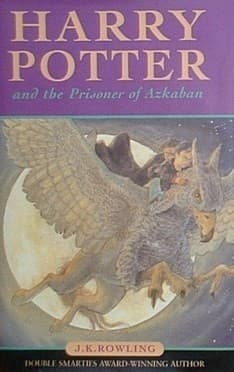
Harry Potter and the Prisoner of Azkaban
Harry Potter · Book Three
J. K. Rowling·1999·Bloomsbury·Fiction
Reading level: Ages 9–12 (middle grade) · 9-hour read · Beginner difficulty.
- Reading time
- 9h
- Difficulty
- Beginner
- Recommended age
- Ages 9–12
- Guide read
- 5min
- Editor's rating
- 4.7 / 5
- coming-of-age
- british-boarding-school
- modern-fantasy
- millennial-canon
- 1990s
- psychological-fiction
— In one sentence —
The Harry Potter book built as a closed-loop mystery: no Voldemort duel, one escaped godfather, dementors as depression, and a time-turner ending that rewards rereading.
§ 01 · WHY READ
Why read
A serious case can be made — and a lot of serious readers have made it — that Prisoner of Azkaban is the best book in the seven-book series. The case is worth laying out because Book 3 is not a Voldemort installment. It is a closed-loop mystery about Sirius Black, Remus Lupin, Peter Pettigrew, the Marauder's Map, dementors, false memory, and the moment Harry realizes his parents left him a history rather than just a scar.
Three things make Book 3 different:
-
Voldemort is not in it. Across 317 pages, the series's main antagonist gets approximately zero screen time. Rowling proves the series doesn't need its central villain to hold. Most genre fiction can't survive removing its top monster for an entire installment; Azkaban is arguably the strongest book of the seven.
-
The parents come back. Sirius Black, Remus Lupin, Peter Pettigrew, and the absent ghost of James Potter walk onto the page together. For two books we've had a thirteen-year-old protagonist with no parental generation — only his own age cohort and a few benign elders. Azkaban gives him the full inheritance of his father's friendships, including the betrayal that destroyed them, and asks him to do something about it. It changes what kind of book this can be.
-
The climax is not a fight. It's a conversation in a shack. A man wrongfully imprisoned for twelve years is recognized as innocent. The villain doesn't die. The hero doesn't kill anyone. Knowledge changes everything. This is an extraordinarily mature move in a children's novel — the kind of thing Le Guin and Susan Cooper did a generation earlier, but very few writers since.
If you reread one Harry Potter book in your life, the consensus answer is this one. The consensus is correct.
§ 02 · CHARACTERS
Characters
The book is organized around the return of the parent generation.
The four Marauders · the father generation
- Sirius Black — Harry's godfather. The most successful reversal in the series: from "wanted murderer who killed thirteen Muggles" in chapter 3 to "the family Harry has been missing for twelve years" by chapter 19. Read this arc as a writer studying how to land a U-turn.
- Remus Lupin — Defense Against the Dark Arts teacher; werewolf. Harry's first competent teacher, his first surrogate father, and the book's quietest moral center. Lupin is the character who treats Harry like a person before treating him like the Boy Who Lived.
- Peter Pettigrew · Wormtail — the betrayer. The series's running interest in small, frightened men who do terrible things to please powerful ones starts here.
- James Potter — Harry's dead father, finally given a real shape rather than a name on a gravestone.
The present line
- Hermione has more on her plate in Book 3 than in any other book of the series. She breaks down. She apologizes. She saves the day twice — once with a time-turner, once with a punch. Rowling later said the Hermione arc here is the writing she's proudest of in the early series.
- Buckbeak — a hippogriff sentenced to die for an injury he didn't cause. The book's mirror image of Sirius: another innocent wrongly condemned, also rescued.
The school
- Professor Trelawney — the Divination teacher. Initially comic relief; delivers the most important prophecy in the series at the end.
- Snape — Harry's hatred of him peaks in this book (Snape wants Sirius dead and is willing to lie to make it happen). Reread him after Book 7 knowing what we know, and these scenes contain the most quietly devastating writing in the entire series.
§ 03 · HIGHLIGHTS
Three highlights
No. 1 · Dementors as depression. Rowling has stated on the record that the dementors were her literal metaphor for the depression she experienced in her twenties — "the absence of being able to feel hope or happiness, the feeling that things will never get better." The result is the most exact picture of clinical depression in twentieth-century children's literature: you don't get sad around a dementor, you get cold and emptied of every good memory you have ever had. Discuss this aloud with a teenager and you may be doing more for them than a therapist will manage in two visits.
No. 2 · The Patronus charm. The defense against the dementor is a single, specific, sustained happy memory, made bright enough to push the dark back. Harry's Patronus takes the form of a stag — his dead father's Animagus form. The literal scene-level achievement is that Harry produces his father's protective spirit by remembering a moment in which he was loved. As metaphor for what trauma survivors actually do to keep going, this is as exact as any in modern fantasy.
No. 3 · The time-turner. Rowling has since said introducing time-travel into the world was a mistake that broke later magical logic. Fair self-criticism — but this book's use of it is a textbook of how to deploy time-travel without paradox. The story isn't Hermione goes back and changes things. The story is the second pass through the scene reveals that the events you saw were always being saved by future selves. The chapter title is "Hermione's Secret." Read it twice.
§ 04 · EDITIONS
Recommended editions
| Edition | Why pick it |
|---|---|
| Bloomsbury UK first edition (1999) | The canonical text. Title is the same in UK and US. |
| Scholastic US edition (1999) | Minimal Americanization at this point — almost identical to the UK text. |
| Bloomsbury House Editions (2019) | Twentieth-anniversary house-color paperbacks. |
| Jim Kay illustrated edition (Bloomsbury 2017) | The Knight Bus and Hogsmeade spreads are particular highlights. |
| MinaLima illustrated edition (Scholastic 2022) | Marauder's Map fold-out is gorgeous. |
| Stephen Fry audiobook (UK) | Fry's Sirius is one of the best voice performances in audio fiction. |
| Jim Dale audiobook (US) | Grammy-winning. |
| 2004 film (Alfonso Cuarón) | Watch this one. Cuarón's Azkaban is by clear consensus the most artistically distinguished entry in the eight-film series. It reset the visual language of the franchise — every Potter film after it is in conversation with Cuarón's color palette, framing, and willingness to take the source material as a real novel. The book and the film together are bigger than the book alone. |
| HBO television series | Season 3 expected ~2028. |
Recommended order: read the book first. Then watch Cuarón's film. Then reread the book. There is no other Harry Potter installment for which we'd recommend that sequence.
§ 05 · FIT
Who it's for / not for
Read this if you are…
- Returning to Harry Potter as an adult and want to know which book holds up best. (This one.)
- A reader of psychological realism who has stayed out of the series because you assumed it was for children. Book 3 is your entry point.
- A writer studying how to handle a parental backstory across multiple installments without the wheels coming off.
Skip it if you are…
- A reader who needs a clear villain–hero confrontation as a climax. The climax of Azkaban is a recognition, not a duel.
- Someone allergic to time-travel as a plot device. The use here is good but it is the device.
§ 06 · TIPS
Reading tips
- Difficulty: medium. Sentences are longer than in Books 1–2; the moral stakes are adult.
- Length: ~107,000 words; 8–10 hours.
- Read aloud age: 9+. The dementor sequences may be too much for younger readers.
- Highest reread value in the series. The foreshadowing density is unmatched. On a third read, half of Lupin's dialogue is heartbreaking.
- Pair with the Cuarón film. Yes, really. The film is doing work the book leaves implicit.
§ 07 · COMPARE
Read alongside
- Susan Cooper — The Dark Is Rising (1973). The other great post-WWII children's-fantasy series in which the adult past breaks into the child's present. Azkaban is in direct lineage with Cooper, whether or not Rowling cites her.
- Diana Wynne Jones — The Lives of Christopher Chant (1988). A masterful handling of inherited adult problems in a children's-fantasy frame. The book Rowling probably read.
- Madeleine L'Engle — A Swiftly Tilting Planet (1978). L'Engle's third Murry book, like Azkaban a series turning point that does not feature the main villain.
- Star Wars — The Empire Strikes Back (1980). Cited so often it's a cliché, but: Azkaban is the Empire of Harry Potter — the second sequel that turns out to be the artistic peak of the franchise.
§ 08 · DISCUSSION
Discussion questions
- Rowling has called the time-turner a creative mistake. Reread the time-turner sequence with that in mind: is it actually broken, or only broken in retrospect once the series's later magical logic catches up to it?
- The dementor-as-depression metaphor is studied in psychiatry seminars. Is making a clinical condition into a fantasy creature a help to readers who have it — or does it risk romanticizing the condition the way Sylvia Plath sometimes gets accused of doing?
- Lupin is the series's first openly othered character — a werewolf, allegorical of HIV / stigmatized illness. Does Rowling deliver on what she sets up here in the later books? Where does the arc let him down?
- Harry's hatred of Snape is at its peak in Book 3, and Snape's behavior is at its worst (he is willing to send an innocent man to the dementor's kiss). Now that you know the full Snape story, reread the Shrieking Shack sequence. What do you read differently?
- The Buckbeak side-plot and the Sirius main plot rhyme almost exactly — two innocents condemned, two rescues. What does the doubling buy the story that a single innocence-restored arc wouldn't?
- "Happiness can be found, even in the darkest of times, if one only remembers to turn on the light." Is this a children's book line, an adult line, or a self-help line — and how can you tell?
- If Cuarón had directed all eight films, would the franchise be better? Argue both sides.
- If you came to Harry Potter as an adult and read only one of the seven, which would you read — and why isn't it this one?
One line to remember
“Happiness can be found, even in the darkest of times, if one only remembers to turn on the light.”— Albus Dumbledore — Chapter 22, Owl Post Again
Appears in collections
Reading lists featuring this book
7 books
Harry Potter · A 7-Book Reader's Guide
Seven novels, one boy who grows up. Where to start, how to pace, what each book is actually about — and when to take a break.
Open list →
7 books
Harry Potter Reading Level by Book
The age range, reading difficulty, and content notes for every book in the Harry Potter series — book by book.
Open list →
10 books
Books That Earn Every Hour: Ten Essential Long Reads
Not long because they couldn't be shorter. Long because the size is the point.
Open list →
You might also like
Read next
Kazuo Ishiguro · 2005
Never Let Me Go
A science-fiction novel so quiet about being science fiction that most readers finish it before they realize what they've agreed to.
Read · 5 min
Emily St. John Mandel · 2014
Station Eleven
A pandemic kills most of humanity. Twenty years later, a travelling Shakespeare company performs for survivor settlements. Mandel is interested in what survives and why.
Read · 5 min
Kathryn Stockett · 2009
The Help
Jackson, Mississippi, 1962. Three women — two Black maids and a young white woman — collaborate on a book that could destroy all of them. A novel about courage, complicity, and the stories that get left out.
Read · 4 min