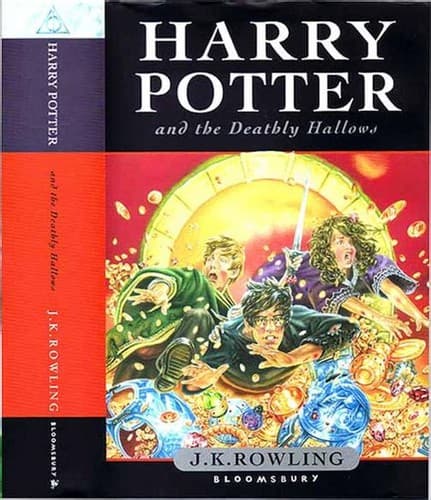
Golden set · editor-reviewed
Harry Potter and the Deathly Hallows
Harry Potter · Book Seven
J. K. Rowling·2007·Bloomsbury·Fiction
Reading level: Ages 12+ (YA) · 16-hour read · Intermediate difficulty.
- Reading time
- 16h
- Difficulty
- Intermediate
- Recommended age
- Ages 12+ (YA)
- Guide read
- 5min
- Editor's rating
- 4.6 / 5
- coming-of-age
- british-boarding-school
- modern-fantasy
- millennial-canon
- series-finale
- 2000s
— In one sentence —
Read for six books as a story about good defeating evil — actually a story about a seventeen-year-old learning to die. The subject was hidden in plain sight for six books before this one named it.
§ 01 · WHY READ
Why read
If you've read Books 1 through 6, there is no real argument for skipping Book 7. The question worth discussing is how to read it, because Deathly Hallows is the most-underestimated volume in the series. Most readers come to it expecting Harry defeats Voldemort. That is technically what happens in the plot. It is not what the book is about.
The book is about how a seventeen-year-old prepares to die, and what it means to walk into death on purpose.
The structure of Deathly Hallows is a pilgrimage, not a war story:
- Leave home.
- Wander, hungry, in the wilderness.
- Hunt for relics that will not save you.
- Walk into death.
Read in that frame, Rowling's last book turns out to be a religious novel disguised as a fantasy adventure — and specifically the last serious entry in the British Christian children's-fantasy lineage that runs through MacDonald, Nesbit, Lewis, and Tolkien. The three Deathly Hallows (Cloak, Stone, Wand) map cleanly onto the three temptations of the desert — hiding from God, raising the dead, ruling over others — and Harry's choice to keep the Cloak alone is the book's spiritual punchline.
You haven't really read Harry Potter until you've read this book. Most readers think they have.
§ 02 · CHARACTERS
Characters
The book's organizing principle is every character has to choose, and there is nowhere left to hide.
The trio · their final form
- Harry — moves from "the boy who wants to live" to "the man preparing to die" across roughly four hundred pages. The most complete character arc in the series, and the only one that ends on a literal death and return.
- Ron — has the book's most painful interior moment: a stretch where he abandons Harry and Hermione, comes back unable to forgive himself, and is forgiven anyway. This arc is the most underrated piece of male-friendship writing in the series.
- Hermione — becomes, at last, the trio's spine. The scene in which she modifies her parents' memories and sends them to Australia so they won't be hunted for being her family is, in passing, the most cleanly devastating sacrifice in the series.
Mentors · undone
- Dumbledore (dead) — the book's central crisis is that Dumbledore turns out not to have been the wise old wizard of Books 1–6. Rita Skeeter's biography, Aberforth's stories, the truth about Ariana, the truth about Grindelwald — Harry has to learn that the person who shaped his life had a youth that's hard to look at, and made decisions he would not have endorsed. Rowling's portrait of a great teacher whose greatness was real and whose flaws were also real is the most useful adult-relationship lesson in the series.
- Gellert Grindelwald — Dumbledore's first love, ideological partner, future enemy. Appears in only a handful of scenes; carries enormous weight.
Snape, at last
- Severus Snape — Chapter 33, "The Prince's Tale", gives him the last word. Twenty-six pages in which seven books of reader judgment is overturned. Rowling produces, in this chapter, one of the most complex antiheroes in modern English-language literature. The word "Always" at the chapter's end is the most freighted single word in the series.
The opposition
- Voldemort — for the first time visibly afraid. Increasingly impatient. Increasingly making mistakes.
- Bellatrix Lestrange — the torture sequence at Malfoy Manor is the hardest chapter to read in the series.
- Dobby — the most-mourned death in the series. Six words on a gravestone.
The Hallows · the book's secret heart
- The Three Brothers — told as a fairy tale by Luna's father, the wizarding world's creation myth. The Cloak, the Stone, the Wand. Three brothers, three desires, three deaths. The final duel rhymes with this story, line by line.
§ 03 · HIGHLIGHTS
Three highlights
No. 1 · "The Prince's Tale." Chapter 33. Harry watches every important moment of Severus Snape's life — Lily Evans on the playground, the young Snape's friendship and its loss, his recruitment to Voldemort, his pivot after Lily's death, his decades of double agency, his final word to Dumbledore. About thirty pages. There is no equivalent chapter in modern English-language children's literature. A generation of readers cried, and what they cried at was the rare moment of an entire moral life finally legible. Reread it slowly.
No. 2 · King's Cross. Chapter 35. Harry has been hit with the Killing Curse. He wakes in a white-and-empty King's Cross station and has a conversation with the dead Dumbledore about what is real. "Is this all happening inside my head?" "Of course it is happening inside your head, Harry, but why on earth should that mean that it is not real?" Rowling — in a children's book — stages a debate about the reality of the mind in the face of death. The single most philosophical scene in mainstream YA literature.
No. 3 · The Tale of the Three Brothers. Chapter 21. Luna's father reads the tale aloud. On first read it is a fairy tale. On second read it is the structure of the entire book. Three brothers cheat Death; one hides, one tries to raise the dead, one tries to rule; only the one who accepts Death walks beside Him. Harry, Voldemort, and Dumbledore are the three brothers. The Hallows are the temptations. Rowling tells you the ending of the book in the middle of the book, and most readers don't notice the first time.
§ 04 · EDITIONS
Recommended editions
| Edition | Why pick it |
|---|---|
| Bloomsbury UK first edition (2007) | The canonical text. The book broke first-day sales records on July 21, 2007. |
| Scholastic US edition (2007) | Identical title; very light Americanization. |
| Bloomsbury House Editions (2027) | Twentieth-anniversary house-color paperbacks expected for the anniversary. |
| MinaLima illustrated edition | In production. |
| Stephen Fry audiobook (UK) | His reading of "The Prince's Tale" is one of the best chapters in audiobook history. |
| Jim Dale audiobook (US) | Grammy-winning; ~21 hours. |
| 2010 / 2011 films (David Yates) | The two-part adaptation. Part 2, in particular, is the most-praised film in the eight-film cycle. The forest pilgrimage in Part 1 captures a tone the book takes longer to reach in print. |
| HBO television series | Series finale expected ~2030. |
| About the Epilogue | The "Nineteen Years Later" epilogue is the most controversial three pages Rowling wrote. Some readers love it; some skip it. You are allowed to do either. |
Recommended order: read the book straight through, including the epilogue. Then watch the films. Then read "The Prince's Tale" again on its own. Then put the book down for a week.
§ 05 · FIT
Who it's for / not for
Read this if you are…
- Anyone who has read Books 1 through 6. There is no defensible reason to stop here.
- A reader looking for the moment a mainstream fantasy series turns out to have been a religious novel all along.
- A re-reader. The reread experience of Deathly Hallows, after the first read, is one of literary fiction's clearest examples of a book that grows.
Skip it if you are…
- (There is no honest skip case. You are reading the series. Read this.)
§ 06 · TIPS
Reading tips
- Difficulty: medium. Sentences and politics remain accessible; the philosophical register climbs.
- Length: ~198,000 words; 15–18 hours.
- Read aloud age: 12+. The Malfoy Manor sequence is genuinely difficult.
- The wilderness chapters. Roughly Chapters 14–18 are the trio camping in the woods, depressed, with no plan. Many readers have called this the dullest stretch of the series. That is, again, design. Rowling needs you to feel the dead-end before Ron returns and the book opens up.
- "The Prince's Tale" needs to be read in one sitting. Don't break in the middle.
- The ending wants a pause. Don't immediately start a new book. Sit with the last page.
§ 07 · COMPARE
Read alongside
- C. S. Lewis — The Last Battle (1956). The Narnia series's controversial last book, also about the end of the world and what comes after. Rowling is in direct conversation with Lewis here.
- J. R. R. Tolkien — The Return of the King (1955). The pilgrimage-to-the-mountain frame. Deathly Hallows is in this lineage explicitly.
- Susan Cooper — Silver on the Tree (1977). The end of the Dark Is Rising sequence, another series finale about a child who has to grow up to defeat an ancient evil and lose the magical world in the process.
- The Gospel of Mark. Yes, really. The structure of the second half of Deathly Hallows — pilgrimage, recognition, willing death, return — is in Christian narrative DNA, and Rowling has been open about reading those books. Reading them side by side reveals how much architecture she's quietly using.
§ 08 · DISCUSSION
Discussion questions
- "Always." What in your reading of the previous six books does that single word change, and why is it placed where it is?
- The book demystifies Dumbledore. He turns out to have been a great teacher who was also a flawed man with a hard youth. Is that a betrayal of Books 1–6, or the necessary maturation of the series's portrait of authority?
- "Is this all happening inside my head?" Argue the philosophical reading of Dumbledore's reply in King's Cross. Does it hold up, or does it dodge the question?
- Harry chooses the Cloak. He does not pursue the Stone or master the Wand. Reread the choice against the Three Brothers tale. Why does the book reward that specific selection?
- The "Nineteen Years Later" epilogue draws more criticism than any three pages in the series. Defend it; attack it. Which case is better?
- The deaths Rowling stages — Dobby, Hedwig, Fred, Lupin, Tonks, Snape — are unusually heavy for a children's book. Is the toll honest or excessive? What is the book teaching by the count?
- Harry, at the end, offers Voldemort a last chance to feel remorse. Read this as a Christian gesture and as a non-Christian one. Which is the book asking for?
- Now that the series is complete, what — in your reading — is it actually about? What is the question the seven books were asking?
One line to remember
“Always.”— Severus Snape to Albus Dumbledore — Chapter 33, The Prince's Tale
Appears in collections
Reading lists featuring this book
7 books
The Best Books for 12-Year-Olds
The bridge year — old enough for hard books, not yet ready for adult themes.
Open list →
7 books
Harry Potter · A 7-Book Reader's Guide
Seven novels, one boy who grows up. Where to start, how to pace, what each book is actually about — and when to take a break.
Open list →
7 books
Harry Potter Reading Level by Book
The age range, reading difficulty, and content notes for every book in the Harry Potter series — book by book.
Open list →
You might also like
Read next
Kazuo Ishiguro · 2005
Never Let Me Go
A science-fiction novel so quiet about being science fiction that most readers finish it before they realize what they've agreed to.
Read · 5 min
Emily St. John Mandel · 2014
Station Eleven
A pandemic kills most of humanity. Twenty years later, a travelling Shakespeare company performs for survivor settlements. Mandel is interested in what survives and why.
Read · 5 min
Kathryn Stockett · 2009
The Help
Jackson, Mississippi, 1962. Three women — two Black maids and a young white woman — collaborate on a book that could destroy all of them. A novel about courage, complicity, and the stories that get left out.
Read · 4 min