Editor-reviewed
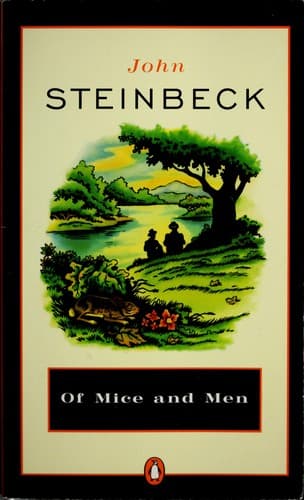
Of Mice and Men
John Steinbeck·1937·Covici Friede·Literature
Reading level: Ages 13+ (YA) · 3-hour read · Beginner difficulty.
- Reading time
- 3h
- Difficulty
- Beginner
- Recommended age
- Ages 13+ (YA)
- Guide read
- 5min
- Editor's rating
- 4.5 / 5
- steinbeck
- american-literature
- great-depression
- friendship
- tragedy
- novella
- school-staple
- california
— In one sentence —
One hundred pages. The ending has been prepared from the first paragraph. Steinbeck does not waste a sentence.
§ 01 · WHY READ
Why read
John Steinbeck wrote Of Mice and Men in 1936 and published it in 1937. He wrote it twice: once as a novella, once as a stage play, and the two versions are so close that the novella was performed without adaptation the year it was published. He said he had been thinking about it since working alongside migrant farm laborers as a young man in California's Salinas Valley. Lennie — the large, childlike man at the novel's center — was based on a real person he had seen.
The setup is simple: George Milton and Lennie Small are itinerant farm workers in Depression-era California, traveling together toward a shared dream of owning a small piece of land. George is small, quick, and sharp; Lennie is enormous, tremendously strong, and intellectually disabled. George has been looking after Lennie since Lennie's Aunt Clara died. They have arrived at a new ranch after leaving the last one fast, for reasons that will become clear.
The novella's formal achievement is its compression. Steinbeck prepared every detail. The opening scene — Lennie stroking a dead mouse in his pocket because he likes soft things — tells the reader everything about what will happen, if the reader is paying attention. The ending, which arrives in one hundred pages, has been announced from the first paragraph. Nothing in the book is accidental, and the economy creates a kind of inevitability that most longer novels never achieve.
It has been assigned in American schools since the 1960s and has been challenged or banned from curricula regularly — for its language, its frank treatment of racism, its mercy killing at the end. The fact that it has been challenged by people who wanted to protect students from it and also by people who thought its treatment of race was inadequate is a sign that it continues to touch something real.
§ 02 · CHARACTERS
Characters
George Milton — small, quick, sharp. He has been looking after Lennie long enough that the relationship is habitual — he complains about it regularly, with a venom that is affectionate and genuine simultaneously. What George gives Lennie that Lennie cannot provide for himself is narrative: the repeated story of the farm they will one day own, the rabbits Lennie will tend, the place where they will belong. George knows the story may not come true. He tells it anyway.
Lennie Small — enormous, childlike, with no control over his strength and no stable understanding of consequence. He loves soft things — mice, puppies, soft hair — and his love destroys what he holds because he cannot control how tightly he holds it. He is not malicious; he is incapable of malice. He is also incapable of surviving in the world the novel presents without George, and the novel makes the reader understand this completely before it reaches its conclusion.
Candy — the old ranch hand who has lost a hand and clings to the dream of joining George and Lennie's farm as a way of not being thrown away when he's no longer useful. His old dog — kept alive past usefulness, eventually shot by another ranch hand because the dog smells and can barely walk — is the novel's foreshadowing in its plainest form.
Curley — the ranch boss's aggressive young son, who picks fights with larger men to prove something. His wife — unnamed throughout — is lonely, bored, and uses the attention of the ranch hands to feel real.
Curley's wife — unnamed throughout. She is the novel's loneliest character and the one the other characters read most reductively. She has dreams Curley hasn't bothered to understand. Her scene with Lennie is the novel's most tender before it becomes its most terrible.
Crooks — the Black stable hand, kept in a separate room by segregation, who appears briefly and speaks with more precision about the impossibility of the dream than anyone else. He has seen men come through with the same dream; none of them made it.
§ 03 · HIGHLIGHTS
Three highlights
No. 1 · Candy's dog. One of the other ranch hands, Carlson, decides the old dog needs to be put down — it's suffering, it smells, it's not useful anymore. Candy resists, then gives in, and the dog is taken out and shot. Slim gives Candy a puppy afterward. The scene takes three pages and is the novel's thesis: what happens to those who are no longer useful, who are loved but not valued, and the difference between mercy and efficiency that the novel refuses to separate cleanly.
No. 2 · Curley's wife and Lennie. Curley's wife finds Lennie alone in the barn. She lets him stroke her hair — she wants contact, she wants to be seen — and Lennie's grip tightens because he loves soft things and cannot stop. The scene is written with such care that the reader sees it coming long before it arrives and cannot look away. Steinbeck gives Curley's wife a paragraph of interior life — the dreams she gave up, the life she didn't have — immediately before the end. It is the novel's most compassionate passage and its most terrible.
No. 3 · The ending. George brings Lennie to a clearing by the river — the same clearing from the opening — and tells him the story of the farm one last time. While Lennie is looking at the other bank, imagining the rabbits, George shoots him. The mercy killing has been prepared from the moment Candy's dog is taken outside. Steinbeck does not editorialize; he lets the preparation do the work. The reader understands what George is doing and why before George does it, and the novel ends almost immediately after. There is nothing to add.
§ 04 · EDITIONS
Recommended editions
| Edition | Why pick it |
|---|---|
| Penguin Modern Classics | Clean text; the most widely available edition. |
| Penguin (with Cannery Row and Tortilla Flat) | For readers who want more Steinbeck in the same vein. |
| Audiobook (Gary Sinise) | Sinise directed and starred in the 1992 film; his reading is unsentimental and exactly right. |
The 1992 film (directed by Gary Sinise, starring John Malkovich as Lennie and Sinise as George) is the best adaptation. Malkovich's Lennie is the performance against which all others are measured. The 1939 film (Burgess Meredith, Lon Chaney Jr.) is also good and worth watching for a different interpretation.
§ 05 · FIT
Who it's for / not for
Read this if you are…
- Any reader who read it in school and is ready to read it without the curriculum. The adult reading is different.
- Anyone interested in what compressed, plotted fiction can do that longer novels cannot.
- Readers who want American Depression-era fiction that is not romanticized.
- Anyone interested in friendship between people who cannot ultimately protect each other.
Skip it if you are…
- Looking for a happy ending or for the dream to come true. The title is from a Burns poem: "The best-laid schemes o' mice an' men / Gang aft agley." Steinbeck is not optimistic.
- Sensitive to violence against animals or to the specific kind of violence at the end.
§ 06 · TIPS
Reading tips
- The first scene is the whole novel. Read it carefully before proceeding — Lennie's pocket mouse, George's irritation, the repetition of the farm story. Everything that follows is already here.
- Candy's dog is the template. When the dog is shot, note who does it and why. Then note how the novel echoes that decision at the end.
- Curley's wife gets one paragraph of interiority. Find it. It changes how you read every scene she's in before it.
- Crooks' speech about the dream — that he has seen men come through with the same dream and none of them made it — is easy to skip. Don't. He is the most honest character in the novel.
§ 07 · COMPARE
Read alongside
- John Steinbeck — The Grapes of Wrath (1939). The longer companion: the same Depression California, the same dispossessed workers, the same loss. Grapes of Wrath is the full version of what Of Mice and Men compresses into a hundred pages.
- Ernest Hemingway — The Old Man and the Sea (1952). The other canonical American novella: simple prose, compressed structure, an ending prepared from the beginning. The comparison illuminates what each author is doing with minimal form.
- Carson McCullers — The Heart Is a Lonely Hunter (1940). Another Depression-era American novel about loneliness and the impossibility of communication: a deaf-mute at the center of a web of isolated characters who project onto him what they need.
- Faulkner — The Sound and the Fury (1929). Another novel with an intellectually disabled character at its center, handled with complete seriousness. Completely different formally; worth reading alongside for the comparison.
- Robert Burns — "To a Mouse" (1785). Steinbeck's title comes from it. Read the poem first; the last stanza is the novel's thesis.
§ 08 · DISCUSSION
Discussion questions
- The novel's title comes from Burns: "The best-laid schemes o' mice an' men / Gang aft agley." Steinbeck chose it deliberately. What does it say about whether the dream was ever possible?
- George complains about Lennie constantly — the burden of looking after him, all the things he could do without him. Does the novel give you a clear sense of why George stays? What does Lennie give George?
- Candy's dog is shot by another ranch hand, not by Candy himself. George shoots Lennie himself. What is the difference, and why does it matter?
- Crooks tells Lennie that men who have the dream never make it — that he has seen them come through before. He is the novel's most honest voice. Why is the novel's most honest character also its most isolated one?
- Curley's wife is never named. What does this choice do? Does the novel treat her fairly despite it?
- The ending is prepared so carefully that most readers see it coming well before it happens. Does this preparation make it more or less devastating?
- The novel's violence is against the vulnerable: mice, puppies, the dog, Curley's wife, Lennie. Is there a pattern? What is Steinbeck arguing?
- Of Mice and Men is both a novella and a play — Steinbeck wrote both versions. What does this dual form suggest about what he was trying to achieve? What is lost or gained in each version?
One line to remember
“Guys like us, that work on ranches, are the loneliest guys in the world. They got no family. They don't belong no place. With us it ain't like that.”— George Milton — Chapter 1
Appears in collections
Reading lists featuring this book
7 books
The Best Books for People Who Don't Read
Seven short books that earn the first hour and reward the next two.
Open list →
6 books
Best Books About Grief and Loss
Six different kinds of grief — romantic, existential, maternal, historical, friendship, childhood.
Open list →
7 books
The Best Books About Fatherhood and Loss
Seven novels about fathers and sons, fathers who fail, fathers who carry the boy on the road — the grief specific to fatherhood.
Open list →
5 books
Books for People Who Stopped Reading
Five books under 200 pages. No prerequisites. No homework.
Open list →
6 books
Books That Will Make You Cry
Direct about what hits and why — no sentimentality, just the moments that break through.
Open list →
6 books
Books to Read After a Breakup
Six books that sit with you in the loss — and quietly help you rebuild.
Open list →
8 books
Books You Can Read in One Sitting
Sorted by length — from two hours to a full afternoon. Each one built for continuous reading.
Open list →
7 books
Short Classics High Schoolers Actually Finish
Short, gripping, English-class acceptable — for the student who will not finish a four-hundred-page novel.
Open list →
10 books
Short and Devastating: Ten Classics You Can Read in a Weekend
The most efficient literature ever written. None longer than 200 pages. All of them permanent.
Open list →
You might also like
Read next
John Steinbeck · 1939
The Grapes of Wrath
The Joads lost their farm to drought and banks. What happened to them is happening now.
Read · 7 min
John Steinbeck · 1952
East of Eden
Steinbeck's great American Genesis: two families, a valley in California, and the question of whether goodness is possible.
Read · 7 min
John Steinbeck · 1945
Cannery Row
Monterey's sardine canneries are gone. Steinbeck's portrait of who lived in their shadow survives everything.
Read · 5 min