Editor-reviewed
Cannery Row
John Steinbeck·1945·The Viking Press·Literature
- Reading time
- 5h
- Difficulty
- Beginner
- Guide read
- 5min
- Editor's rating
- 4.4 / 5
- steinbeck
- american-literature
- california
- classic
- short
- community
- monterey
— In one sentence —
Monterey's sardine canneries are gone. Steinbeck's portrait of who lived in their shadow survives everything.
§ 01 · WHY READ
Why read
Steinbeck wrote Cannery Row in 1944 while his friend Ed Ricketts — the marine biologist who appears in the novel as Doc — was still alive. He called it a "poisoned cream puff," a gentle and loving portrait of the people who lived on the margins of the Monterey sardine industry: the men who did not work, the women who worked in ways the respectable world did not acknowledge, the marine biologist who did science for the love of it, the Chinese grocer who saw everything and minded nothing.
The sardine canneries of Monterey are gone now — overfishing collapsed the industry in the early 1950s, just after the novel was published. What Steinbeck captured was already disappearing when he wrote it. The novel is an elegy dressed as a comedy.
This is Steinbeck at his most affectionate. There is no corporate villain, no structural analysis, no political argument. There is Mack and the boys, who live in a converted fish meal boiler and conduct a life of magnificent idleness. There is Dora Flood's Bear Flag Restaurant, where the working girls pay their taxes and donate to every community drive and are excluded from every community function. There is Doc, who listens to Monteverdi while he pickles octopi and reads poetry to the girls from the Bear Flag. There is the frog hunt, the first party, the second party, and the sound of the Pacific on Cannery Row at four in the morning.
At 120 pages, it is the easiest Steinbeck to read and one of the easiest American novels to love.
§ 02 · CHARACTERS
Characters
Doc (Ed Ricketts) — the marine biologist who runs Western Biological Laboratory. He buys specimens from the Row's inhabitants, plays classical music through his open windows, reads widely, thinks carefully, and is the community's center of gravity. Steinbeck dedicated the novel to Ricketts. The portrait is one of the most loving in American fiction.
Mack and the boys — the five men who live in the Palace Flophouse and Grill, a converted fish meal boiler behind Lee Chong's grocery. They are not failures; they have made a considered choice against the working world. Mack is the group's philosopher and strategist: he understands people with a precision he has never tried to monetize.
Lee Chong — the Chinese grocer who is technically the owner of the Palace Flophouse and practically the community's banker and credit system. He gives credit he knows will not be repaid, trades for goods of dubious provenance, and maintains an equanimity about the Row that is the novel's closest thing to wisdom.
Dora Flood — the madam of the Bear Flag Restaurant, who runs the most orderly and generous establishment on the Row. Her women nurse the sick during an outbreak of illness; her establishment is the community's social center; she is excluded from every respectable community event. Steinbeck's portrait is affectionate and clear-eyed: he sees the hypocrisy without belaboring it.
§ 03 · HIGHLIGHTS
Three highlights
No. 1 · The frog hunt. Mack and the boys decide to give Doc a party. To fund it, they go to the Carmel Valley to catch frogs, which Doc will buy. The frog hunt — the negotiation to use a rancher's pond, the rancher's unexpected friendliness, the all-night frogging — is the novel's funniest sequence and its most affectionate portrait of Mack's genius for improvised persuasion.
No. 2 · The first party. The party gets out of hand before Doc arrives. By the time Doc gets home, his laboratory is destroyed, the frogs have escaped, and the Row is unconscious. What follows — Doc's silent assessment of the damage, his response, what he does not say — is the novel in miniature: the way people who care about each other manage catastrophe without judgment.
No. 3 · Doc collecting in the tide pools. The novel's most lyrical passage: Doc alone in the tide pools south of the lab at night, collecting octopi, thinking about beauty and the pull of the sea, reading the "Black Marigolds" — an ancient Indian poem — to an octopus. This scene is what Steinbeck is actually writing about: a particular quality of attention to the living world, achievable in Cannery Row in ways it is not achievable elsewhere.
§ 04 · EDITIONS
Recommended editions
| Edition | Why pick it |
|---|---|
| Penguin Classics (paperback) | The standard edition; often bound with Sweet Thursday (1954), the sequel, which is worth reading if you love the first. |
| Centennial Edition (Penguin/Viking) | Includes photographs of the actual Cannery Row, Ed Ricketts, and the Western Biological Laboratory as they appeared in the 1940s. |
| Audiobook (Gary Sinise) | Sinise grew up reading Steinbeck; his reading of Cannery Row is one of the warmest audio performances in the American literary canon. |
§ 05 · FIT
Who it's for / not for
Read this if you are…
- Any reader new to Steinbeck. This is the best entry point: short, funny, emotionally accessible, a complete portrait of a world.
- Readers who want a novel about community and friendship rather than conflict and plot.
- Anyone who has been to Monterey and wants to understand what the place was before it became a tourist attraction.
Skip it if you are…
- Expecting the social scale of The Grapes of Wrath or the moral ambition of East of Eden. Cannery Row is deliberately small.
- Looking for conventional plot. There is no arc, no villain, no resolution in the traditional sense. The novel is more like a series of photographs of a place and its people.
§ 06 · TIPS
How to read it
Read it in two sittings at most. The novel's warmth is cumulative but not demanding; it earns nothing by being stretched out. The intercalary chapters — brief vignettes between the main narrative chapters — work like the tide pools Doc collects in: small complete worlds that illuminate the larger one.
Pay attention to what Doc reads aloud. The poetry he reads, the music he plays — Steinbeck is characterizing a quality of attention to beauty that is the novel's argument about what matters.
§ 07 · COMPARE
Read alongside
- John Steinbeck — Sweet Thursday (1954). The sequel, set on the Row after the war. Lighter and more romantic; Doc falls in love. Worth reading after if you are not ready to leave the Row.
- John Steinbeck — Ed Ricketts: Breaking Through (1951, essay). Steinbeck's memoir of Ricketts, written after his death. The non-fiction companion to the fictional portrait.
- Charles Bukowski — Post Office (1971). A different register entirely — harder, angrier — but the same interest in people who have opted out of respectability and built a life on their own terms.
§ 08 · DISCUSSION
Discussion questions
- Steinbeck opens the novel with its famous first line about "whores, pimps, gamblers, and sons of bitches" — meaning everybody. What is the novel's argument about respectability?
- Mack and the boys are presented as people who have made a considered choice against conventional work. Is this a romantic idealization or an honest portrait? What evidence does the novel offer?
- Dora Flood's girls nurse the sick and donate to community causes but are excluded from the community's social events. How does the novel handle this hypocrisy? Does it handle it adequately?
- Doc is the novel's center, but he is also somewhat idealized. What cracks appear in the portrait? What does the novel conceal about him?
- The sardine industry that gave the Row its existence is almost entirely off-page. What does Steinbeck gain by keeping the economic system that makes the Row possible largely invisible?
- The novel ends with a return to stasis after the second party. What has changed, if anything? Is this a satisfying ending or an evasion?
One line to remember
“Its inhabitants are, as the man once said, 'whores, pimps, gamblers, and sons of bitches,' by which he meant Everybody.”— Chapter 1
You might also like
Read next
John Steinbeck · 1939
The Grapes of Wrath
The Joads lost their farm to drought and banks. What happened to them is happening now.
Read · 7 min
John Steinbeck · 1952
East of Eden
Steinbeck's great American Genesis: two families, a valley in California, and the question of whether goodness is possible.
Read · 7 min
John Steinbeck · 1937
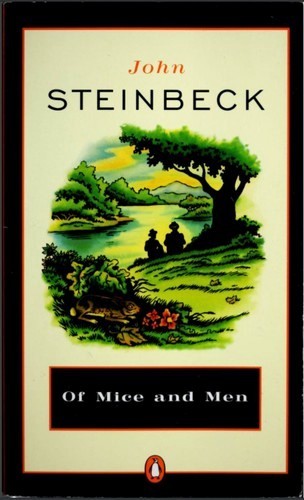
Of Mice and Men
One hundred pages. The ending has been prepared from the first paragraph. Steinbeck does not waste a sentence.
Read · 5 min