Editor-reviewed
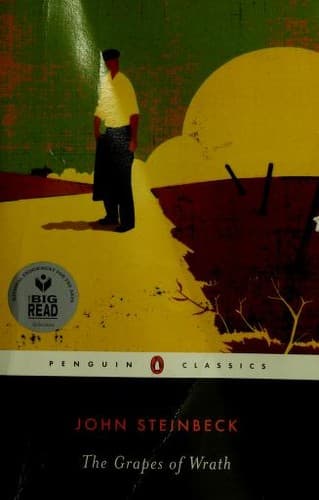
The Grapes of Wrath
John Steinbeck·1939·The Viking Press·Literature
Reading level: Ages 14+ (YA) · 16-hour read · Intermediate difficulty.
- Reading time
- 16h
- Difficulty
- Intermediate
- Recommended age
- Ages 14+ (YA)
- Guide read
- 7min
- Editor's rating
- 4.8 / 5
- steinbeck
- american-literature
- depression-era
- migration
- classic
- pulitzer
- social-realism
— In one sentence —
The Joads lost their farm to drought and banks. What happened to them is happening now.
§ 01 · WHY READ
Why read
The Grapes of Wrath won the Pulitzer Prize in 1940 and helped Steinbeck win the Nobel in 1962. It was condemned in Congress, burned in Kern County, California, and called communist propaganda by the Associated Farmers of California — the corporate agricultural lobby whose practices it documented. All of this tells you it was working.
The Joads are an Oklahoma tenant farming family displaced first by drought and then by the banks that hold their mortgages. They load onto a truck and head to California, where leaflets promise agricultural work at decent wages. The leaflets lie. What they find is a labor market deliberately flooded with desperate workers so that wages can be suppressed to starvation levels. The novel was not a metaphor in 1939. It is not a metaphor now.
This is still about now. The mechanisms are unchanged: corporate agriculture consolidating landholdings, wage suppression through surplus labor, migrants demonized by the populations whose economies their labor sustains, labor organizing met with violence funded by growers. The specific crops are different. The specific road is different. The structure is identical.
Steinbeck spent 1937 and 1938 in the California migrant camps gathering material. He drove Route 66 with the migrants, lived in the camps, met Tom Collins, the camp manager who would become the basis for the government camp sequences. He knew what he was describing. The novel's power is the power of journalism transmuted into fiction: the specific detail, the earned anger, the refusal to sentimentalize the people while refusing to deny their suffering.
§ 02 · CHARACTERS
Characters
Tom Joad — the eldest son, just paroled from McAlester after killing a man in a brawl. He has no ideology at the novel's start; by the end he has one, forged in what he watches happen. His final speech to Ma — "I'll be all around in the dark. I'll be ever'where" — is the novel's political and moral climax.
Ma Joad — the family's center of gravity. Pa is the nominal patriarch; Ma is the one who keeps them moving. Steinbeck's portrait of her is among American fiction's finest depictions of practical courage: she does not collapse, she does not idealize, she solves the next problem and then the next one.
Jim Casy — a former preacher who has lost his faith in organized religion but not in people. He becomes the novel's labor organizer and its Christ figure. His initials are not accidental. He is killed by strike-breakers midway through the novel; his death is what completes Tom's education.
Rose of Sharon — Tom's pregnant sister, whose husband Connie deserts the family. The novel ends with her. Her final act — nursing a dying stranger with the milk meant for her stillborn child — is either the novel's transcendence or its sentimentality, depending on your reading. It is both.
§ 03 · HIGHLIGHTS
Three highlights
No. 1 · The intercalary chapters. Steinbeck structures the novel in alternating chapters: the Joad narrative and shorter, lyrical intercalary chapters that zoom out to describe the larger forces — the dust, the tractors, the used car dealers, the California growers, the movement of people across the land. The intercalary chapters are the documentary record that contextualizes the family story. They are also some of the finest prose Steinbeck wrote. Chapter 25 — the fruit rotting on the trees while people starve — is the novel's indictment of corporate agriculture in three pages.
No. 2 · The turtle crossing the road. Chapter 3, the first intercalary chapter, describes a turtle crossing a highway: vehicles swerve to avoid it, one swerves to hit it, it keeps moving. The chapter is three pages. It is the entire novel. Read it knowing what comes next and you will see how completely Steinbeck has embedded his argument in what looks like nature description.
No. 3 · Tom's farewell. Ma finds Tom hiding after the killing of a deputy. He is leaving — he will be caught if he stays. She asks if she will see him again. He gives her the speech: wherever there is a fight against hungry people being fed, he will be there. Wherever there is a cop beating up a guy, he will be there. The speech could be maudlin. It is not. It earns its emotion through 400 pages of Tom watching and learning.
§ 04 · EDITIONS
Recommended editions
| Edition | Why pick it |
|---|---|
| Penguin Classics (paperback) | Includes Robert DeMott's excellent introduction and notes. DeMott is the leading Steinbeck scholar; his contextual notes on the migrant camp conditions are worth having. |
| Centennial Edition (Viking/Penguin) | Features Susan Shillinglaw's introduction and archival photographs from the Farm Security Administration — Dorothea Lange, Arthur Rothstein. The photographs are the journalistic record Steinbeck was fictionalizing. |
| Audiobook (Dylan Baker) | Baker handles the Oklahoma dialect with care. A long listen at 24+ hours but a rewarding one. |
§ 05 · FIT
Who it's for / not for
Read this if you are…
- Anyone who wants to understand American economic history from the inside. The Dust Bowl migration is the largest internal displacement in American history before Katrina; this is the account of what it felt like.
- Readers interested in documentary fiction — how a novel can function simultaneously as art and as political argument.
- Anyone experiencing or witnessing economic displacement, housing insecurity, or labor exploitation. The specific names change. The structure does not.
Skip it if you are…
- Looking for subtlety in characterization. The Joads are individuals, but the growers are rendered as a class, not as people. Steinbeck is not interested in the humanity of the exploiters.
- Put off by the intercalary chapters. Some readers experience them as interruptions; they are the method. If you skip them, you are reading a different book.
§ 06 · TIPS
How to read it
Read the intercalary chapters. Do not skip them. Chapter 25 — "In the souls of the people" — gives the novel its title and its argument. The turtle chapter is the novel in miniature. These are not atmospheric padding; they are structural.
The Oklahoma dialect is consistent and readable within a few pages. The rhythm of Ma Joad's speech in particular becomes natural quickly.
Read the final scene without irony. Steinbeck is asking you to accept Rose of Sharon's act as both realistic and transcendent. He earns it.
§ 07 · COMPARE
Read alongside
- John Dos Passos — U.S.A. trilogy (1930–1936). The documentary novel as political form: Dos Passos invented the newsreel and biopic intercalary method that Steinbeck adapted. Longer and harder, but the predecessor.
- Dorothea Lange and Paul Schuster Taylor — An American Exodus (1939). The FSA photographic record published the same year: Lange's photographs with Taylor's sociological text. The visual companion.
- Barbara Ehrenreich — Nickel and Dimed (2001). The contemporary equivalent: the low-wage labor market in early 2000s America. The Joads, updated, with a middle-class journalist doing the looking.
§ 08 · DISCUSSION
Discussion questions
- The intercalary chapters describe forces — the dust, the banks, the market — that the Joads cannot see or name. What is gained by alternating between the Joad narrative and the larger documentary view?
- Jim Casy is the novel's Christ figure. How does Steinbeck handle the parallel without making it schematic? Does the parallel illuminate or reduce Casy?
- Steinbeck humanizes the Joads and renders the growers as a faceless class. Is this a flaw in the novel's moral vision, or is it the argument?
- Ma Joad is the center of the family. The novel is nominally about Tom. What does giving Ma the center accomplish that centering Tom could not?
- Rose of Sharon's final act is the novel's last image. Does it earn its transcendence? What would be lost if the novel ended differently?
- The novel was burned and condemned as communist propaganda. What, specifically, were its critics afraid of? Were they right to be afraid?
One line to remember
“In the souls of the people the grapes of wrath are filling and growing heavy, growing heavy for the vintage.”— Chapter 25
Appears in collections
Reading lists featuring this book
You might also like
Read next
John Steinbeck · 1952
East of Eden
Steinbeck's great American Genesis: two families, a valley in California, and the question of whether goodness is possible.
Read · 7 min
John Steinbeck · 1937
Of Mice and Men
One hundred pages. The ending has been prepared from the first paragraph. Steinbeck does not waste a sentence.
Read · 5 min
John Steinbeck · 1945
Cannery Row
Monterey's sardine canneries are gone. Steinbeck's portrait of who lived in their shadow survives everything.
Read · 5 min