Editor-reviewed
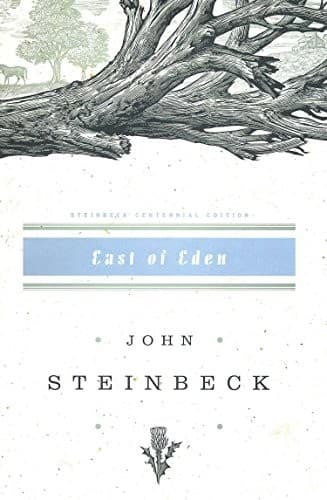
East of Eden
John Steinbeck·1952·The Viking Press·Literature
Reading level: Ages 14+ (adult) · 22-hour read · Intermediate difficulty.
- Reading time
- 22h
- Difficulty
- Intermediate
- Recommended age
- Ages 14+
- Guide read
- 7min
- Editor's rating
- 4.7 / 5
- steinbeck
- american-literature
- california
- classic
- epic
- good-and-evil
— In one sentence —
Steinbeck's great American Genesis: two families, a valley in California, and the question of whether goodness is possible.
§ 01 · WHY READ
Why read
Steinbeck called East of Eden the book he had been working toward his whole life. He wrote it in 1951, addressing it in his journal (later published as Journal of a Novel) to his sons Thom and John, who were four and three years old. He wanted to leave them something that explained what he understood about life and evil and the possibility of choosing otherwise.
The novel is a retelling of the Cain and Abel story across two generations, set in the Salinas Valley of California from the Civil War era to the First World War. The Hamilton family — Steinbeck's own mother's family — is threaded through the narrative: real people, given real names, doing things Steinbeck learned from family stories. The Trask family is fictional: two generations of brothers, two generations of the same original choice between love and resentment.
The novel's hinge is a single Hebrew word. In the story of Cain and Abel, God tells Cain that sin "coucheth at the door" and then says something — a verb — whose translation has been disputed for centuries. The King James renders it "thou shalt rule over it" (a promise). The American Standard renders it "do thou rule over it" (a command). The Chinese character Lee, one of the novel's greatest characters, convenes a group of Chinese scholars who spend years learning Hebrew to settle the question. Their answer — timshel, "thou mayest" — is the novel's argument: that the choice to overcome sin is neither promised nor commanded but possible.
This is a big novel that earns its size.
§ 02 · CHARACTERS
Characters
Adam Trask — the second generation's Abel figure, a man of such fundamental decency that he cannot read evil in others. His fatal mistake is marrying Cathy Ames and believing she is what he wants her to be.
Cathy Ames (Kate) — one of American fiction's most disturbing characters: a woman Steinbeck describes as a human being without the full complement of human emotions, a monster who passes as normal. She abandons Adam and their twin sons, shoots Adam in the shoulder on her way out, and builds a brothel in Salinas. The novel refuses to explain her except to say that such people exist and that failing to recognize them is a form of innocence that has consequences.
Lee — Adam's Chinese cook and, in practice, the family's intellectual center. He is the most educated person in the novel, speaks several languages, raises the Trask twins, and is the one who does the Hebrew scholarship that produces timshel. Steinbeck's treatment of Lee — a Chinese character given interior depth, philosophical authority, and the novel's central insight — is remarkable for 1952.
Sam Hamilton — Steinbeck's grandfather, rendered with warmth and precision: an Irishman of enormous intelligence and inventiveness who is too generous and too dreamy to accumulate wealth, who is loved by everyone, who does not succeed in the conventional sense and does not care. The Hamilton sequences are the novel's most autobiographically grounded and often its most affectionate.
Cal and Aron Trask — the second generation: Cal, dark and self-aware, who knows his own capacity for cruelty; Aron, fair and idealistic, who cannot survive knowing what his mother is. The Cain-Abel story again, and Steinbeck does not simplify it.
§ 03 · HIGHLIGHTS
Three highlights
No. 1 · The timshel discussion. Lee, Adam, and Sam Hamilton discuss the Hebrew word for three years of reading. The payoff — "thou mayest" as opposed to "thou shalt" or "do thou" — is the novel's argument about free will and moral responsibility rendered as a textual argument. It is also one of the most satisfying intellectual set pieces in American fiction.
No. 2 · Cathy in the brothel. The scenes of Cathy running the Salinas brothel — her methodical collection of evidence to blackmail her clients, her management of the other women, her eventual acquisition of the business through the same methods — are Steinbeck at his most coldly precise. He is not interested in her psychology; he is interested in the damage a person without conscience inflicts. The restraint makes it more disturbing, not less.
No. 3 · Cal and the lettuce. Cal, trying to make a gift to his father, buys commodity futures on the East Coast lettuce market while the East is at war and California's crop is the only source. He makes $15,000 — a fortune in 1917. Adam refuses the gift because he considers the profit war profiteering, made off soldiers' food. Cal's response — his devastation, his cruelty to Aron — is the novel's moral center: what happens when the child who tried chooses cruelty instead.
§ 04 · EDITIONS
Recommended editions
| Edition | Why pick it |
|---|---|
| Penguin Classics (paperback) | The standard edition; includes an introduction by David Wyatt. Clean text, portable. |
| Centennial Edition (Penguin) | Includes Steinbeck's Journal of a Novel, written alongside the book as daily letters to his editor. Reading the journal alongside the novel is the closest you can get to watching a major novel being written. |
| Audiobook (Richard Poe) | A long listen at 46 hours, but Poe handles the range of characters — Lee's different register, the Hamiltons' Irish lilt, Cathy's flatness — with real skill. |
§ 05 · FIT
Who it's for / not for
Read this if you are…
- Readers who want a large American novel that is genuinely ambitious in its ideas, not just in its length. Steinbeck is asking the oldest question — can people choose to be good? — and taking 600 pages to answer it honestly.
- Anyone who has read The Grapes of Wrath and wants to see what Steinbeck could do when freed from documentary constraints.
- Readers interested in the Salinas Valley as a literary landscape.
Skip it if you are…
- Expecting the taut economy of the early Steinbeck. This is a generous, digressive novel. The Hamilton family sequences meander in the most pleasurable way. If you need a plot tightly controlled, you will find the digressions frustrating.
- Put off by explicit moral allegory. The Cain-Abel parallel is not subtle. Steinbeck wanted you to see it.
§ 06 · TIPS
How to read it
Accept the Hamilton digressions. They are not interruptions; they are the novel's warmth. The Trask story is dark and structured; the Hamilton story is loose and affectionate. Steinbeck needs both.
The Cathy-Kate sections are cold by design. Do not look for explanation or sympathy; Steinbeck is not offering either. Read them as observation of what such a person does, not as psychology of how they became that way.
Track the timshel thread. It appears early, disappears for long stretches, and returns with full weight at the novel's end. Adam's last word — the last word of the novel — earns its power from the 600 pages before it.
§ 07 · COMPARE
Read alongside
- John Steinbeck — Journal of a Novel (1969). The daily letters to his editor written while composing East of Eden. Essential companion.
- Fyodor Dostoevsky — The Brothers Karamazov (1880). The predecessor in generational moral fiction: brothers as philosophical archetypes, the same question about free will and goodness, a grander and stranger novel but the closest structural analog.
- Flannery O'Connor — The Complete Stories (1971). American fiction's other great reckoning with grace and violence: O'Connor's view of evil is darker and more theological, but the conversation between them is illuminating.
§ 08 · DISCUSSION
Discussion questions
- Timshel — "thou mayest" — is the novel's central argument. Does the novel prove it? Does Cal's story demonstrate that the choice to overcome sin is genuinely possible?
- Steinbeck describes Cathy as a monster — a human being without the full range of human feeling. Is this a failure of imagination or a deliberate moral choice? What does it accomplish that a more psychologically complex Cathy would not?
- Lee is the most educated and philosophically sophisticated character in the novel. He is also Chinese and plays the role of a servant. How does Steinbeck handle this tension? Does he handle it adequately?
- Adam Trask's decency is repeatedly shown to be a failure — his inability to read Cathy, his refusal of Cal's gift. Is decency a virtue in the novel, or is it another form of blindness?
- The Hamilton family is based on Steinbeck's own family. What does weaving autobiography into the allegorical framework accomplish that pure fiction could not?
- Adam's last word is "timshel." Is this earned? What would have to be true for it to be earned?
One line to remember
“Timshel — thou mayest.”— Chapter 24
Appears in collections
Reading lists featuring this book
7 books
The Best Book Gifts for Father's Day
Seven books that take fathers, fatherhood, and decision-making seriously.
Open list →
7 books
The Best Books About Fatherhood and Loss
Seven novels about fathers and sons, fathers who fail, fathers who carry the boy on the road — the grief specific to fatherhood.
Open list →
You might also like
Read next
John Steinbeck · 1939
The Grapes of Wrath
The Joads lost their farm to drought and banks. What happened to them is happening now.
Read · 7 min
John Steinbeck · 1937
Of Mice and Men
One hundred pages. The ending has been prepared from the first paragraph. Steinbeck does not waste a sentence.
Read · 5 min
John Steinbeck · 1945
Cannery Row
Monterey's sardine canneries are gone. Steinbeck's portrait of who lived in their shadow survives everything.
Read · 5 min