Editor-reviewed
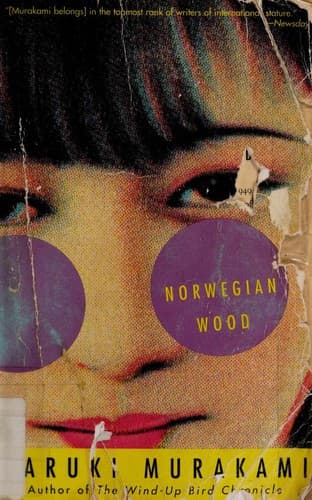
Norwegian Wood
Haruki Murakami·1987·Kodansha (Japanese); Vintage (English)·Literature
Reading level: Ages 16+ (adult) · 9-hour read · Beginner difficulty.
- Reading time
- 9h
- Difficulty
- Beginner
- Recommended age
- Ages 16+
- Guide read
- 4min
- Editor's rating
- 4.5 / 5
- haruki-murakami
- japanese-literature
- coming-of-age
- grief
- 1960s
- tokyo
- loss
- realist
— In one sentence —
Murakami's breakout novel. No magic, no parallel worlds — just Tokyo in the late 1960s, two girls, grief, and the specific sadness of being young and not knowing how to save the people you love.
§ 01 · WHY READ
Why read
Haruki Murakami published Norwegian Wood in Japan in 1987. It sold 4 million copies in Japan within a year — a phenomenon that made Murakami famous and uncomfortable. He had not intended to write a realistic novel; he had been writing the surrealist fiction that would become his signature. But he was living in Greece and wanted to write about memory and grief and what it feels like to be young in Tokyo in the late 1960s, and the material required realism.
The novel is atypical Murakami: there is no magic, no detective, no parallel world, no well. There are just three young people — Toru Watanabe, Naoko, and Midori — and the death of a friend that happened before the novel begins, and the grief that follows people who were close to that death.
The premise: Toru Watanabe is a university student in late-1960s Tokyo. His best friend Kizuki died by suicide two years earlier. Kizuki's girlfriend Naoko is beautiful, fragile, and unable to integrate Kizuki's death. Toru is in love with Naoko and also being pursued by Midori — alive, practical, funny, wanting a future. The novel is the story of those two loves and what he chooses.
It is Murakami's argument about what it means to keep living after those you love have chosen not to.
§ 02 · CHARACTERS
Characters
Toru Watanabe — the narrator, reserved, a careful reader, a good listener. He is the person people tell things to; his passivity is the novel's most debated quality. He does not drive events; he responds to them. Murakami has said this is deliberate: Toru is the person who lives, and living sometimes means being the one who watches.
Naoko — Kizuki's girlfriend, who is beautiful and damaged and cannot be saved by love alone. She is not a manic pixie figure; she is a woman with serious depression who needs more help than a boyfriend can provide. Murakami is honest about this. Toru loves her; his love is not enough.
Midori — the opposite: vivid, funny, practical, wanting to be alive. She is one of Murakami's best characters, in any novel: a woman who has survived her own losses without becoming frozen by them.
Reiko — Naoko's roommate at the sanatorium, a pianist in her forties who has her own story of breakdown and recovery. She is the novel's adult wisdom figure, and her role in the final pages is the most debated scene Murakami has written.
§ 03 · HIGHLIGHTS
Three highlights
No. 1 · The sanatorium. Naoko retreats to a mountain sanatorium, and Toru visits her there twice. The sanatorium is Murakami's most carefully described place: self-contained, deliberately removed from the world, organized around small tasks and rhythms. It is not a utopia; it is a place for people who cannot survive in the ordinary world, tended by people who understand this without judgment.
No. 2 · Midori's speech about what she wants. Midori tells Toru what she wants from a relationship: complete attention, someone who will tell her she is the most important thing in the world. The speech is direct in a way Murakami's fiction rarely allows itself, and it is the clearest statement in the novel of what being alive requires — not perfection, not rescue, but presence and attention.
No. 3 · The ending. Toru calls Midori from a phone booth. He tells her he needs her. She asks where he is. He doesn't know — he is in the middle of somewhere, calling from nowhere specific. The ending is inconclusive, which is the point: grief does not resolve cleanly, the living keep living imprecisely, and Murakami refuses to give the novel the completion that Toru cannot honestly claim.
§ 04 · EDITIONS
Recommended editions
| Edition | Why pick it |
|---|---|
| Vintage International (Jay Rubin translation) | The standard English edition; Rubin's translation is the current standard. Start here. |
| Original Kodansha translation (Alfred Birnbaum) | The first English translation; looser than Rubin's but captures a different quality of the original. Some readers prefer it. |
| Audiobook (John Chancer) | The standard audiobook; Chancer's reading is appropriate for the material. |
§ 05 · FIT
Who it's for / not for
Read this if you are…
- A reader who has not read Murakami and wants an entry point without the surrealism: this is the least strange Murakami novel.
- Anyone who has experienced grief that doesn't resolve — the kind that stays alongside you rather than lifting.
- Readers interested in Japanese literature: this is the novel that introduced Murakami to Western readers.
Skip it if you are…
- Wanting the Murakami of Kafka on the Shore or The Wind-Up Bird Chronicle. Those novels have magic and mystery; this one is realistic and quiet.
§ 06 · TIPS
Reading tips
- Midori is the novel's energy. When she appears, the prose changes; she is the counterweight to the novel's tendency toward melancholy.
- Naoko's illness is not romantic. Murakami is careful about this. Her depression and fragility are not beautiful things; they are things she needs help for.
- The ending is not a failure. Toru's "I don't know where I am" is honest rather than evasive: the novel earns this inconclusion.
§ 07 · COMPARE
Read alongside
- Haruki Murakami — Kafka on the Shore (2002). The opposite Murakami: surreal, mythic, formally complex. Reading both shows the full range.
- Yasunari Kawabata — Snow Country (1956). The Japanese predecessor in melancholy and emotional restraint; Murakami was formed by Kawabata.
- J. D. Salinger — The Catcher in the Rye (1951). Murakami cited Salinger as an influence; the comparison between Holden and Toru — both narrators of a specific kind of adolescent grief — is productive.
§ 08 · DISCUSSION
Discussion questions
- Toru loves Naoko but cannot save her. Murakami is explicit that love is not sufficient. What does the novel argue love can and cannot do?
- Midori is everything Naoko is not: alive, demanding, looking forward. Is Toru's movement toward Midori a betrayal or a choice to live?
- Naoko's illness is serious and ultimately fatal. Does the novel romanticize it, or treat it honestly?
- The ending: Toru doesn't know where he is. Is this failure, or the honest condition of someone who is still in the process of grief?
- The Beatles song that gives the novel its title is about loss and distance. How does the song function in the novel beyond being a title?
One line to remember
“If you only read the books that everyone else is reading, you can only think what everyone else is thinking.”— Nagasawa — Chapter 3
Appears in collections
Reading lists featuring this book
7 books
The Best Book Gifts for Graduation
Seven novels for a reader leaving one chapter and starting another.
Open list →
5 books
Books About Addiction and Recovery
Five books that name what compulsion actually feels like from inside it.
Open list →
6 books
Books About Being an Outsider
Six novels about people who cannot find a world that will accept them whole.
Open list →
6 books
Best Books About Grief and Loss
Six different kinds of grief — romantic, existential, maternal, historical, friendship, childhood.
Open list →
7 books
Books About Identity and Belonging
Seven novels about the self that society refuses, and the self that refuses society.
Open list →
5 books
Books Set in Japan
Five Murakami novels and the Japan only he can see.
Open list →
6 books
Books That Will Make You Cry
Direct about what hits and why — no sentimentality, just the moments that break through.
Open list →
6 books
Books to Read After a Breakup
Six books that sit with you in the loss — and quietly help you rebuild.
Open list →
7 books
Books to Read in Your 20s
Seven novels for the decade when you're figuring out who you're going to be.
Open list →
7 books
Best Coming of Age Novels
Six novels about the specific moment of becoming — organized by protagonist age and what each book says about that moment.
Open list →
5 books
First Time Reading Murakami? These Five Books, in This Order.
The most-asked question in contemporary fiction. Here is the honest answer.
Open list →
7 books
What to Read After Murakami
Seven novels for when you finish Norwegian Wood and don't know where to go next.
Open list →
You might also like
Read next
Haruki Murakami · 1994
The Wind-Up Bird Chronicle
A man's cat goes missing. Then his wife goes missing. He sits at the bottom of a dry well and waits. This is where Murakami's powers reach their full extension.
Read · 5 min
Haruki Murakami · 2002
Kafka on the Shore
Fish rain from the sky. Cats can talk. A fifteen-year-old boy runs away to a library. A simple old man walks into the forest and the world bends around him. Murakami at his most mythic.
Read · 5 min
Haruki Murakami · 1993
The Elephant Vanishes
The collection that introduced Murakami's short fiction to Western readers. Seventeen stories about ordinary Japanese life where something has quietly, irrevocably gone wrong.
Read · 4 min