Editor-reviewed
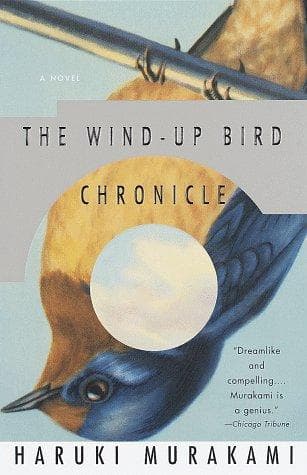
The Wind-Up Bird Chronicle
Haruki Murakami·1994·Shinchosha (Japanese); Knopf (English)·Literature
Reading level: Ages 16+ (adult) · 22-hour read · Intermediate difficulty.
- Reading time
- 22h
- Difficulty
- Intermediate
- Recommended age
- Ages 16+
- Guide read
- 5min
- Editor's rating
- 4.8 / 5
- haruki-murakami
- japanese-literature
- magical-realism
- war
- identity
- long-reads
- wells
- mystery
— In one sentence —
A man's cat goes missing. Then his wife goes missing. He sits at the bottom of a dry well and waits. This is where Murakami's powers reach their full extension.
§ 01 · WHY READ
Why read
Haruki Murakami published The Wind-Up Bird Chronicle in Japan in three volumes between 1994 and 1995. Jay Rubin's English translation appeared in 1997. Murakami revised the novel for the English edition — the published English version is approximately 600 pages, compared to a longer Japanese version that included material he subsequently cut. Both versions exist; the English version is the canonical one for English readers.
This is Murakami at full extension. It is the longest of his novels, the most densely plotted, and the most explicitly political: the novel braids Toru Okada's search for his missing wife with stories of Japanese military atrocities in Manchuria in the 1930s and 1940s, and the connection between the personal and the historical is the novel's deepest argument.
The premise: Toru Okada is an ordinary thirty-year-old man who has recently quit his job. His cat goes missing; he searches for it. His wife Kumiko goes missing; he searches for her. He meets a series of extraordinary people — psychic sisters, a strange teenage girl, a veteran who survived the Mongolian front, a powerful politician — and gradually understands that what is happening to him is connected to something vast and old.
The well: Toru descends into a dry well in a neighbor's yard, sitting in complete darkness for hours. The well is the novel's central image — the place where the surface world and the underworld connect, where Toru can travel between them. It is not metaphor; in the logic of the novel, it is literal.
§ 02 · CHARACTERS
Characters
Toru Okada — the narrator, passive in a productive way: the events of the novel come to him, and his job is to wait and be present enough to receive them. He is Murakami's most complete version of the passive-protagonist: someone who changes the world around him not by acting but by being.
Kumiko — his wife, whose disappearance is the novel's engine. She is not simply absent; her absence is constructed, her letters and communications from after her disappearance are part of the mystery. Her brother Noboru Wataya is the antagonist.
Malta and Creta Kano — the psychic sisters. Malta is the elder, who communicates in her precise way about the nature of what is happening. Creta is the younger, who has been destroyed and remade by contact with Noboru Wataya and who becomes one of the novel's most affecting figures.
May Kasahara — the teenage girl next door, who talks to Toru at length about death and the wind-up bird. She is one of Murakami's finest creations: funny, strange, philosophically curious in the way of adolescents who haven't been taught yet what they're not supposed to think about.
Lieutenant Mamiya — a veteran of the Mongolian campaign who tells Toru the novel's most harrowing embedded story: his time as a prisoner of Soviet forces after Japan's defeat in Mongolia. The historical violence of the Mamiya sections is the real-world anchor for the novel's surrealism.
§ 03 · HIGHLIGHTS
Three highlights
No. 1 · The well. Toru descends into the dry well in Nutmeg's garden and sits in total darkness. In the darkness, he can travel — to a hotel corridor, to other places and times. The well is the place where his consciousness becomes permeable, where the past and the present overlap. Murakami renders the well experience with enough physical specificity (the darkness, the cold, the rope) that it reads as real while also clearly being something else.
No. 2 · Lieutenant Mamiya's story. Mamiya tells Toru about the Nomonhan Incident of 1939: the forgotten battle between Japan and the Soviet Union in Mongolia, where Japanese forces were devastated. His account includes skinning — a method of execution — and his own time in a well in the Mongolian desert, left to die by Soviet forces, where he saw something in the darkness. The Mamiya sections are the novel's most harrowing and most important: they ground the surrealism in specific historical atrocity.
No. 3 · Noboru Wataya. The antagonist is a television personality and politician — glib, empty, with a specific kind of charisma that has no substance behind it. He is Murakami's portrait of what media politics produces: a man who can say anything and mean nothing, who gets power from people's need to be told something. The novel's climax involves Toru confronting Wataya in the well-world; what happens there is both an act of violence and an act of consciousness.
§ 04 · EDITIONS
Recommended editions
| Edition | Why pick it |
|---|---|
| Vintage International (Jay Rubin translation) | The standard English edition; Rubin's translation is definitive. Start here. |
| Audiobook (Rupert Degas) | Degas reads all 22 hours; his reading is controlled and appropriate for the material. |
§ 05 · FIT
Who it's for / not for
Read this if you are…
- A Murakami reader who has started with the shorter novels and is ready for the full version.
- Anyone interested in how Murakami uses the surreal to talk about real history — specifically Japanese wartime violence.
- Readers who like novels that give them space to wonder: The Wind-Up Bird Chronicle doesn't explain everything and trusts the reader to live with what it doesn't explain.
Skip it if you are…
- Starting with Murakami. The shorter novels are better entry points; this one assumes a familiarity with Murakami's methods.
- Averse to violence. The Mamiya sections describe atrocities in specific detail.
§ 06 · TIPS
Reading tips
- The Mamiya sections are not digressions. They are the novel's historical argument. Read them as carefully as the Toru sections.
- The well is literal. In the logic of the novel, Toru actually travels through the well to a hotel corridor where things happen. This is not dream; it is the novel's physics.
- May Kasahara's letters are worth reading slowly. She disappears from the novel and writes Toru letters from a hair-loss research institute; her letters are some of the most precise writing in the book.
- Noboru Wataya is the real antagonist. He is present mostly at the edges of the narrative for much of the novel; when he becomes central, everything that preceded him retroactively makes sense.
§ 08 · DISCUSSION
Discussion questions
- Toru descends into a well and can travel from it to other places and times. Is this literal in the novel's physics, or something else? Does it matter which?
- Lieutenant Mamiya's account of Mongolian atrocity is the most historically specific material in the novel. Why does Murakami embed Japanese wartime history inside this surrealist contemporary narrative? What is the connection he's making?
- Noboru Wataya is a media politician — all surface, no substance, successfully attracting followers. What is Murakami saying about this type?
- Toru is passive: events come to him and he responds. Is this a failure of characterization, or Murakami's argument about how certain kinds of power work?
- May Kasahara talks to Toru about death with adolescent directness. What function does she serve in the novel? What does she understand that the adult characters don't?
- The novel has multiple embedded stories that don't resolve cleanly. Does this feel like incompleteness or the honest shape of experience?
One line to remember
“Curiosity is not a sin. But one must exercise caution with certain kinds of curiosity.”— May Kasahara — Chapter 12
Appears in collections
Reading lists featuring this book
7 books
The Best Books for a Long Flight
Seven books substantial enough to disappear into for ten hours in a metal tube.
Open list →
5 books
Books Like Infinite Jest
For readers who finished Wallace and want more — long, demanding, formally ambitious novels with footnotes and the kitchen sink.
Open list →
5 books
Books Set in Japan
Five Murakami novels and the Japan only he can see.
Open list →
8 books
Best Mind-Bending Sci-Fi Books
Eight books that destabilize reality, consciousness, time, or the self — and know exactly what that destabilization is for.
Open list →
6 books
Most Immersive Books
Six books that require full surrender — and pay for it.
Open list →
5 books
First Time Reading Murakami? These Five Books, in This Order.
The most-asked question in contemporary fiction. Here is the honest answer.
Open list →
5 books
Novels Where the City Feels Like a Psychological Maze
Five novels where streets, neighborhoods, weather, and architecture do not just hold the plot — they alter the mind moving through them.
Open list →
7 books
What to Read After Murakami
Seven novels for when you finish Norwegian Wood and don't know where to go next.
Open list →
You might also like
Read next
Haruki Murakami · 2002
Kafka on the Shore
Fish rain from the sky. Cats can talk. A fifteen-year-old boy runs away to a library. A simple old man walks into the forest and the world bends around him. Murakami at his most mythic.
Read · 5 min
Haruki Murakami · 1987
Norwegian Wood
Murakami's breakout novel. No magic, no parallel worlds — just Tokyo in the late 1960s, two girls, grief, and the specific sadness of being young and not knowing how to save the people you love.
Read · 4 min
Haruki Murakami · 1993
The Elephant Vanishes
The collection that introduced Murakami's short fiction to Western readers. Seventeen stories about ordinary Japanese life where something has quietly, irrevocably gone wrong.
Read · 4 min