Book list · Editor's pick·Vol. 001·Fiction
Best Coming of Age Novels
Six novels about the specific moment of becoming — organized by protagonist age and what each book says about that moment.
- Books
- 7
- coming-of-age
- young-adult
- literary-fiction
- identity
Updated 2026-05-23
— Why read this list —
Coming of age stories aren't about childhood. They're about the first time you understand that the world was not designed with you in mind.
The arc of the collection
The books here are loosely ordered by protagonist age: from Milo's ten years (The Phantom Tollbooth) through Toru Watanabe's late teens (Norwegian Wood). This is not arbitrary. Coming of age means something different at each stage, and these books are each precise about which transition they're depicting.
Juster's Milo is discovering that the world is interesting — the earliest form of the transition. Le Guin's Ged is discovering that he is capable of harm, which is the next stage. Rowling's Harry is discovering belonging. Pullman's Lyra is discovering that institutional authority lies. Lee's Scout is discovering injustice. Golding's boys are discovering what happens when there is no authority at all. And Murakami's Toru is discovering that the people you love can disappear and that you continue regardless — which is the last and hardest lesson.
What makes a coming-of-age novel last
The books that remain in circulation are the ones that are honest about what the transition costs. The sentimental version of coming of age says: you grow up and you become yourself. The honest version says: you grow up and you learn what you are capable of and what you cannot do, and you live with both. Le Guin, Golding, Murakami, and Lee all understand that the knowledge acquired in adolescence is not purely liberating. Rowling and Pullman allow more wonder, but both of their books are also, underneath, about the acquisition of a knowledge that makes innocence impossible.
The Phantom Tollbooth is the exception — it ends in genuine possibility. That is why it's the right book to start with.
The 7 books
In publication order
Book 1·Wonder as a practice
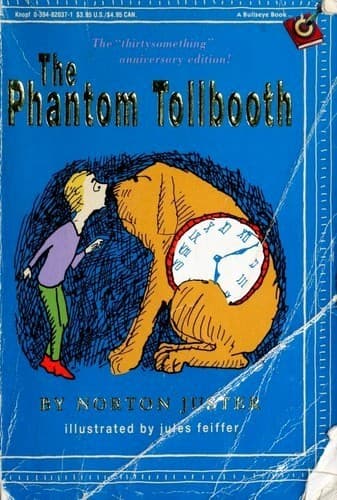
The Phantom Tollbooth
Norton Juster·1961
Protagonist age: roughly ten. What it says about becoming: boredom is not a neutral state but a failure of attention, and the world becomes interesting the moment you decide to pay attention to it. Milo, who finds everything dull, drives through a magic tollbooth and discovers a world that rewards curiosity with more curiosity. Juster's insight — that the imagination is not a retreat from the real world but a way of actually seeing it — is the core of every educational philosophy worth having. Children read it as adventure; adults read it as argument.
Book 2·The shadow you make yourself
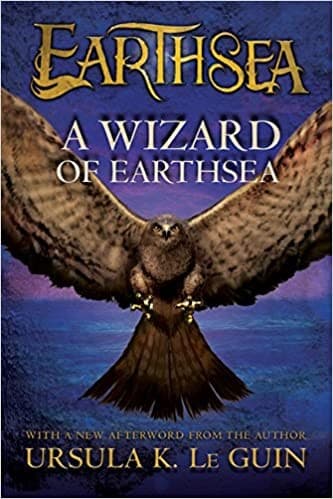
A Wizard of Earthsea
Ursula K. Le Guin·1968
Protagonist age: early teens. What it says about becoming: the thing you run from is the thing you must turn and face, and it turns out to be you. Ged's shadow — the darkness he releases through pride — is the central image, and Le Guin takes it seriously enough that the resolution is not a battle but an act of self-recognition. She also wrote the first major fantasy protagonist who was explicitly not white, in 1968, without making a point of it. The book is the point.
Book 3·Finding your people
Harry Potter and the Philosopher's Stone
J.K. Rowling·1997
Protagonist age: eleven. What it says about becoming: finding your people changes what you are. Harry's discovery of the wizarding world is less about magic than about belonging — the specific relief of a child who has always felt wrong suddenly finding a place where his particular qualities are assets rather than liabilities. Rowling's formal achievement in this book is making the world-building and the emotional arc work simultaneously; the wonder of Hogwarts and the warmth of Harry's friendships are not separate things.
Book 4·Innocence as a specific state
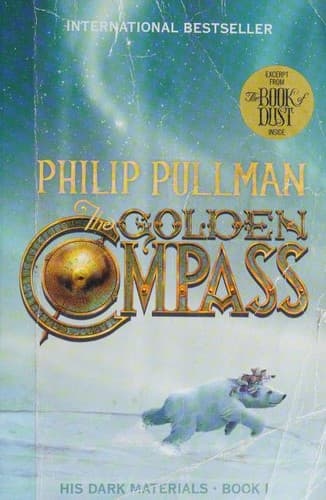
The Golden Compass
Philip Pullman·1995
Protagonist age: eleven to twelve. What it says about becoming: innocence is not ignorance, and its loss is not simply corruption — it is the acquisition of a certain kind of knowledge that changes the nature of your relationship to the world. Pullman's daemon mythology is a precise external representation of interior psychological development: the daemons settle into fixed forms at adolescence, which is exactly when the question of who you are becomes pressingly urgent. His critique of institutional authority is embedded in the adventure, not separate from it.
Book 5·The gap between innocence and truth
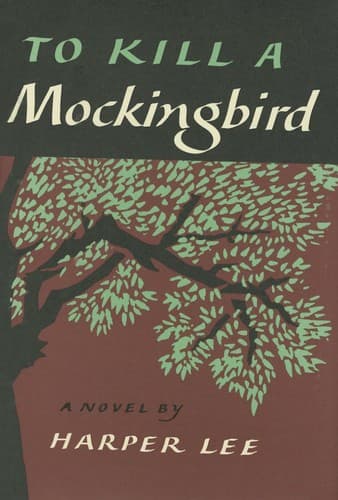
To Kill a Mockingbird
Harper Lee·1960
Protagonist age: six to eight, looking back from adulthood. What it says about becoming: the moment you understand that the world is unjust, and that the adults you trusted have made compromises with that injustice, is the moment childhood ends. Scout doesn't fully understand the Tom Robinson trial; neither does the reader, through her eyes. Lee uses the gap between what Scout sees and what we understand as the novel's central technique. The coming-of-age here is not Scout's — it's the reader's.
Book 6·Civilization as a choice
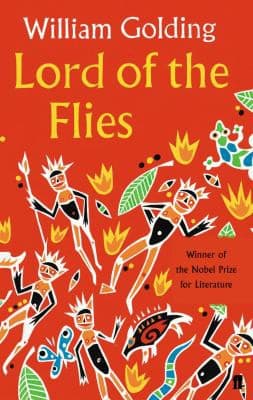
Lord of the Flies
William Golding·1954
Protagonist age: six to twelve. What it says about becoming: civilization is not something you inherit automatically; it is something that must be maintained by choice, and children given the choice will not always maintain it. Golding's answer to the optimistic English children's adventure novel is a direct refutation — he gives children exactly the freedom those novels imagined and shows what they do with it. It is the darkest coming-of-age story on this list and the most explicit about what it thinks human nature is.
Book 7·Grief as formation
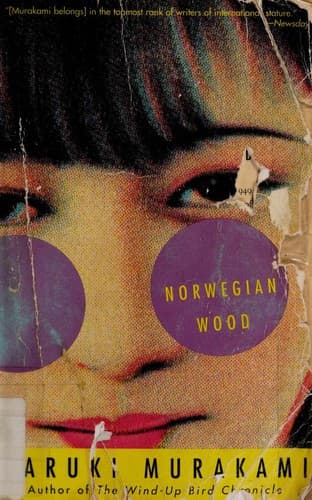
Norwegian Wood
Haruki Murakami·1987
Protagonist age: eighteen to twenty. What it says about becoming: grief and desire are not separate experiences in early adulthood, and the process of forming an adult identity happens in and through loss. Toru Watanabe is surrounded by people who don't survive their own adolescence, and his coming-of-age is defined by what he learns from their inability to do what he, barely, manages. Murakami's most realist novel is also his most emotionally direct; it has no magical objects, only the ordinary strangeness of being young and incomplete.