Editor-reviewed
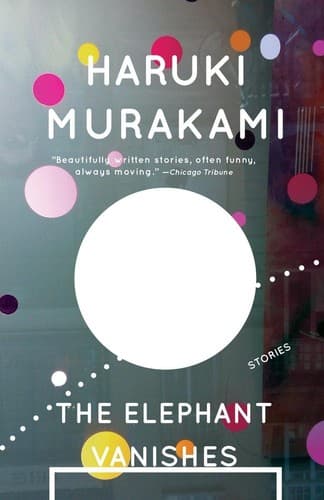
The Elephant Vanishes
Haruki Murakami·1993·Kodansha (Japanese); Knopf (English)·Literature
Reading level: Ages 16+ (adult) · 8-hour read · Beginner difficulty.
- Reading time
- 8h
- Difficulty
- Beginner
- Recommended age
- Ages 16+
- Guide read
- 4min
- Editor's rating
- 4.5 / 5
- haruki-murakami
- japanese-literature
- short-stories
- magical-realism
- tokyo
- alienation
- 1980s
— In one sentence —
The collection that introduced Murakami's short fiction to Western readers. Seventeen stories about ordinary Japanese life where something has quietly, irrevocably gone wrong.
§ 01 · WHY READ
Why read
The Elephant Vanishes (1993) collects seventeen Murakami stories published in Japanese literary magazines between 1980 and 1991. It was the first substantial collection of his short fiction to appear in English, translated by Jay Rubin and Alfred Birnbaum, and it introduced the short-form Murakami to Western readers who had encountered him through Norwegian Wood or A Wild Sheep Chase.
The stories in this collection are not dark in the way that most dark fiction is dark. They are quiet. A man loses a TV and his wife loses something harder to name. An elephant kept by a town disappears along with its keeper, and no one can explain it. A man begins to see the seams of everyday life — the places where reality is stitched together with something less solid than reason. Things go slightly, permanently wrong, and people adjust to the wrongness, and this adjustment is Murakami's subject.
What Murakami does in short fiction: the compression of the story form suits his particular kind of uncanny. A novel needs 600 pages to fully inhabit the world where ordinary life is haunted; a short story can do it in 20 pages by establishing one specific wrongness and following it far enough to be felt. The short stories are how Murakami tests his methods; the novels are where he extends them.
§ 02 · ESSENTIAL STORIES
Essential stories
"The Wind-Up Bird and Tuesday's Women" — the story that became the seed of The Wind-Up Bird Chronicle: a man searching for his cat, the sounds of the wind-up bird, the beginning of the novel's logic.
"The Elephant Vanishes" — a municipal elephant disappears along with its keeper. The narrator, who had watched the elephant regularly and noticed something about the relationship between the elephant and the keeper, is the only person who has a theory. His theory cannot be confirmed. The story ends with the wrongness of the absence being absorbed into ordinary life.
"Sleep" — a woman stops sleeping. She lies awake every night for weeks; she is not tired; she reads and drinks brandy and drives at night. Her insomnia is not distressing — it is liberating, then slowly frightening. The story is seventeen days of sleeplessness and what accumulates in the extra hours.
"The Second Bakery Attack" — a newlywed couple is hungry at 2 AM. The husband confesses he once robbed a bakery with a friend; the baker gave them bread in exchange for listening to Wagner. The husband feels this has left a curse; the wife decides they must rob a bakery to lift it. They do. It is one of Murakami's funniest stories and also, in retrospect, about something more serious.
"Barn Burning" — a man meets a woman and then her older boyfriend, who tells him that he burns abandoned barns as a hobby. He watches for a barn to burn in his neighborhood; he never sees one burn. The story is the most Carver-esque Murakami wrote and also his most disturbing: the possible explanation is terrible, and the story withholds certainty.
§ 04 · EDITIONS
Recommended editions
| Edition | Why pick it |
|---|---|
| Vintage International (Rubin and Birnbaum translations) | The standard English edition; the two translators bring different qualities to different stories. |
| Audiobook (various readers) | The audio collection uses different readers for different stories; quality varies; the print version is preferred. |
Start with the short fiction before the novels if you are new to Murakami: the stories test whether his methods work for you in 20 pages before you commit to 600.
§ 05 · FIT
Who it's for / not for
Read this if you are…
- New to Murakami and wanting to sample before committing to a novel: three or four stories will tell you whether this is your kind of fiction.
- A reader of short fiction looking for work in the literary uncanny register.
- Anyone interested in Japanese suburban life in the 1980s rendered by its most characteristic literary voice.
Skip it if you are…
- Looking for plot resolution. Murakami's short stories characteristically end without resolving what they've opened. If this is the wrong kind of incompleteness for you, the novels are better structured.
§ 06 · TIPS
Reading tips
- Start with "The Second Bakery Attack" — it's funny and accessible and introduces Murakami's tone quickly.
- "Sleep" is the collection's best argument for what short fiction can do that novels can't: the seventeen sleepless nights accumulate inside twenty pages in a way that sustained immersion in a novel would dilute.
- "Barn Burning" is the darkest. Read it last; it stays with you.
- The stories are standalone. Read in any order; there is no continuity between them except the atmosphere.
§ 07 · COMPARE
Read alongside
- Haruki Murakami — Norwegian Wood (1987). The novel for readers who want the realist Murakami extended.
- Raymond Carver — What We Talk About When We Talk About Love (1981). Murakami's most direct American influence; the comparison between Carver's minimalism and Murakami's is illuminating for "Barn Burning" specifically.
- Yasunari Kawabata — Snow Country (1956) and Palm-of-the-Hand Stories (1988). Kawabata's palm-of-the-hand stories are the Japanese short-fiction tradition Murakami emerged from.
§ 08 · DISCUSSION
Discussion questions
- In "The Elephant Vanishes," the narrator has a theory about why the elephant disappeared. He never confirms it; no one believes it. What is Murakami arguing about inexplicable things and the explanations we construct for them?
- "Sleep" is about a woman who stops sleeping and gains seventeen extra hours per night. Why does liberation become frightening? What is she discovering about the self she has when no one needs anything from her?
- "Barn Burning" withholds the most important information. What is the boyfriend doing? Does the story want you to decide?
- "The Second Bakery Attack" is funny. It is also about something. What is the husband's original failure, and does the solution they invent actually solve it?
- The collection's stories consistently feature a wrongness that gets absorbed into ordinary life. Is Murakami arguing that this is how people actually live — that we accommodate the strange — or is he troubled by it?
- If you've read Murakami's novels, how do the stories relate to them? Do they feel like tests of methods that became novels, or do they do something the novels cannot?
One line to remember
“The world is a metaphor, Kafka.”— Haruki Murakami
Appears in collections
Reading lists featuring this book
5 books
Books Set in Japan
Five Murakami novels and the Japan only he can see.
Open list →
5 books
First Time Reading Murakami? These Five Books, in This Order.
The most-asked question in contemporary fiction. Here is the honest answer.
Open list →
7 books
What to Read After Murakami
Seven novels for when you finish Norwegian Wood and don't know where to go next.
Open list →
You might also like
Read next
Haruki Murakami · 1994
The Wind-Up Bird Chronicle
A man's cat goes missing. Then his wife goes missing. He sits at the bottom of a dry well and waits. This is where Murakami's powers reach their full extension.
Read · 5 min
Haruki Murakami · 2002
Kafka on the Shore
Fish rain from the sky. Cats can talk. A fifteen-year-old boy runs away to a library. A simple old man walks into the forest and the world bends around him. Murakami at his most mythic.
Read · 5 min
Haruki Murakami · 1987
Norwegian Wood
Murakami's breakout novel. No magic, no parallel worlds — just Tokyo in the late 1960s, two girls, grief, and the specific sadness of being young and not knowing how to save the people you love.
Read · 4 min