Editor-reviewed
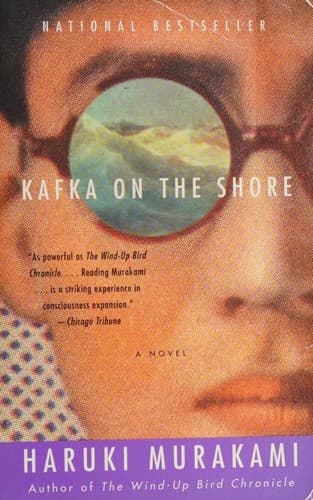
Kafka on the Shore
Haruki Murakami·2002·Shinchosha (Japanese); Knopf (English)·Literature
Reading level: Ages 16+ (adult) · 16-hour read · Intermediate difficulty.
- Reading time
- 16h
- Difficulty
- Intermediate
- Recommended age
- Ages 16+
- Guide read
- 5min
- Editor's rating
- 4.7 / 5
- haruki-murakami
- japanese-literature
- magical-realism
- mythology
- oedipus
- kafka
- dream
- duality
— In one sentence —
Fish rain from the sky. Cats can talk. A fifteen-year-old boy runs away to a library. A simple old man walks into the forest and the world bends around him. Murakami at his most mythic.
§ 01 · WHY READ
Why read
Haruki Murakami published Kafka on the Shore in Japanese in 2002; Philip Gabriel's English translation appeared in 2005. It is Murakami's most mythologically dense novel: a deliberate collision between the Oedipus myth and the Japanese folk tradition, between Kafka (the writer) and a fifteen-year-old boy who calls himself Kafka, between two narrative strands that converge in a forest no one can quite reach.
The structure: two alternating narratives. The first follows Kafka Tamura, fifteen years old, who runs away from his father's house in Tokyo to Takamatsu, Shikoku, where he finds a private library and its strange keepers. His father has told him he will fulfill an Oedipal prophecy: he will kill his father and sleep with his mother and sister. The second narrative follows Nakata, an old man in Tokyo who lost his memories and intelligence in a childhood incident and who can now talk to cats. He walks southwest, not knowing why.
The two narratives converge slowly and obliquely. Neither character fully understands what is happening to them. The reader understands before they do.
What Murakami is doing: the novel uses the Oedipus myth not as a plot skeleton but as an understructure — a set of gravitational forces that pull the characters toward fates they cannot entirely escape. The Kafka of the title refers both to the boy and to the writer whose stories operate on the same dream-logic the novel uses: things happen that cannot happen, and their impossibility is not a problem to be solved but an atmosphere to be inhabited.
§ 02 · CHARACTERS
Characters
Kafka Tamura — fifteen years old, physically strong, running from a prophecy. He has chosen the name Kafka because, he says, it means crow in Czech. He is accompanied by a voice he calls "the boy named Crow" — possibly his better self, possibly an external presence. He is the kind of Murakami protagonist who experiences more than he understands, and who understands enough.
Nakata — the old man who talks to cats and cannot read. He is the novel's most beloved character: gentle, precise in his way, fundamentally innocent. He has no memory of who he was before the childhood incident that emptied him; he has been refilled with different qualities.
Miss Saeki — the librarian, who wrote a famous song in her youth and who has been waiting for something since. Her relationship to Kafka is the novel's most ambiguous element, and Murakami is not going to resolve it.
Oshima — the library's assistant, a transgender man who manages the collection and becomes Kafka's friend. He is the novel's most intelligent voice: precise, well-read, kind.
Hoshino — a young trucker who befriends Nakata and becomes, improbably, his companion and protector. He is not the kind of person who reads books or thinks deeply about things; his encounter with Nakata changes this.
§ 03 · HIGHLIGHTS
Three highlights
No. 1 · Fish raining from the sky. Nakata causes fish (and later leeches and sardines) to rain from the sky. It simply happens; Murakami offers no mechanism. The scene is handled with documentary precision — the characters note what has fallen, try to understand it, give up trying. This is the novel's central formal move: the impossible is rendered matter-of-factly, and the matter-of-factness is not a failure of imagination but a different kind of imagination.
No. 2 · The forest. Oshima brings Kafka to a deep forest in the mountains during a crisis. There is a point in the forest beyond which time and space begin to behave differently; two old soldiers from World War II have been living there since the war, unable to return. The forest is the underworld, or something like it. Kafka walks in and comes back changed.
No. 3 · The Oedipal convergence. Murakami allows the prophecy's elements to converge in ways that are ambiguous enough to avoid simple resolution but clear enough that the reader understands the shape of what has happened. The novel refuses to answer its own questions directly; it is satisfied with their weight.
§ 04 · EDITIONS
Recommended editions
| Edition | Why pick it |
|---|---|
| Vintage International (Philip Gabriel translation) | The standard English edition; Gabriel's translation is authoritative. Start here. |
| Audiobook (Sean Barrett) | Barrett reads both Kafka's and Nakata's sections; his differentiation between the voices is skilled. |
§ 05 · FIT
Who it's for / not for
Read this if you are…
- A reader of Murakami who wants his most mythologically ambitious work.
- Anyone interested in Japanese mythology and how it operates in contemporary fiction.
- Readers comfortable with narrative ambiguity: many things in this novel are not explained, and the inexplanation is part of the experience.
Skip it if you are…
- Starting with Murakami. Begin with Norwegian Wood for the realist Murakami or The Wind-Up Bird Chronicle for the surrealist Murakami at full stretch. Kafka on the Shore assumes a reader already comfortable with Murakami's register.
§ 06 · TIPS
Reading tips
- The two narratives converge slowly. Don't rush to find the connection; let it arrive.
- Nakata's sections are the emotional center. His chapters are calmer, warmer, and ultimately more important than they initially appear.
- The Oedipal myth is the understructure, not the plot. Murakami is not retelling Oedipus; he is using the myth as a set of gravitational forces. The prophecy will be fulfilled in some sense; the question is what sense.
- The ending does not explain. Murakami's endings in the surrealist mode tend not to resolve; they tend to arrive at a different kind of stillness.
§ 08 · DISCUSSION
Discussion questions
- Fish rain from the sky. Leeches rain from the sky. Nakata causes this, imperfectly understanding why. What is Murakami doing by rendering the impossible as matter-of-fact?
- Kafka has been told he will fulfill an Oedipal prophecy. Does he? In what sense? Does the novel want the reader to decide?
- Nakata talks to cats and lost his intelligence and memory in a childhood incident. He is presented as empty of the ordinary self but full of something else. What is he full of?
- The forest contains people who cannot return to the normal world. What does the forest represent? What is Kafka finding there?
- Miss Saeki has been waiting for decades for something or someone. What is she waiting for? Does she get it?
- Oshima is a transgender man in 2002 Japan. How does Murakami handle this? Is his characterization full?
- The novel converges its two narratives but does not explain how they are connected. Is this a failure or a formal decision? What would a clean explanation cost the novel?
One line to remember
“And once the storm is over you won't remember how you made it through, how you managed to survive. But one thing is certain. When you come out of the storm you won't be the same person who walked in.”— Chapter 1
Appears in collections
Reading lists featuring this book
5 books
Books Set in Japan
Five Murakami novels and the Japan only he can see.
Open list →
5 books
First Time Reading Murakami? These Five Books, in This Order.
The most-asked question in contemporary fiction. Here is the honest answer.
Open list →
7 books
What to Read After Murakami
Seven novels for when you finish Norwegian Wood and don't know where to go next.
Open list →
You might also like
Read next
Haruki Murakami · 1994
The Wind-Up Bird Chronicle
A man's cat goes missing. Then his wife goes missing. He sits at the bottom of a dry well and waits. This is where Murakami's powers reach their full extension.
Read · 5 min
Haruki Murakami · 1987
Norwegian Wood
Murakami's breakout novel. No magic, no parallel worlds — just Tokyo in the late 1960s, two girls, grief, and the specific sadness of being young and not knowing how to save the people you love.
Read · 4 min
Haruki Murakami · 1993
The Elephant Vanishes
The collection that introduced Murakami's short fiction to Western readers. Seventeen stories about ordinary Japanese life where something has quietly, irrevocably gone wrong.
Read · 4 min