Book list · Editor's pick·Vol. 001·Fiction
First Time Reading Murakami? These Five Books, in This Order.
The most-asked question in contemporary fiction. Here is the honest answer.
- Books
- 5
- Total reading
- 90h
- Authors
- 1
- Translators
- 3
- Time span
- 1987–2009
- murakami
- haruki-murakami
- where-to-start
- japanese-literature
- magical-realism
- reading-order
- contemporary-fiction
Updated 2026-05-21
— Why read this list —
Where you start with Murakami determines whether you love him or don't understand what anyone's talking about.
The most-asked question in contemporary fiction
"Where do I start with Murakami?" has no universally correct answer, which is why so many list articles give different ones. This guide gives an opinionated answer with the reasoning behind it. If you disagree with the reasoning, you'll know which path is right for you anyway.
The disagreement in most Murakami entry-point recommendations comes down to two camps:
Camp 1 — Start with what he's known for: Norwegian Wood is not representative. Begin with The Wind-Up Bird Chronicle or Kafka on the Shore, which are the books that made Murakami an international literary phenomenon, and which represent his mature style fully.
Camp 2 — Start with what's accessible: Norwegian Wood has no magical elements and is therefore the best entry for readers who have been told Murakami is strange. The magical realism of the later books is less disorienting if you've already been inside his prose for eight hours.
We are in Camp 2, with a caveat: the Camp 1 argument is correct that Norwegian Wood is atypical. This is exactly why it belongs first. You need the prose before you need the magic, and Norwegian Wood gives you the prose cleanly.
What Murakami is actually doing
Murakami is a writer of loss — specifically, the kind of loss that doesn't have a clear event attached to it. His narrators are men (almost always men) who feel that something has gone missing from their lives that they cannot name precisely. The disappearances that drive his plots (cats, wives, elephants, women who never quite existed) are externalizations of this feeling.
The jazz records, the beer and whisky and pasta cooked with precise attention, the long runs, the easy sex with strangers — these are not incidental details. They are the texture of a life being maintained carefully in the absence of the thing that should make it meaningful. Murakami's realism and his magical realism are in service of the same project: to describe what it feels like when the center holds, barely, over a void.
Once you understand this, the question "is the cat real?" becomes the wrong question. The cat was real. It left.
A note on translations
Murakami's primary translators into English are Jay Rubin and Philip Gabriel, who split the work with him across his major novels. Alfred Birnbaum translated the early works. All three translations are reliable. The differences between translators are subtle enough that you don't need to compare editions; buy whatever the library has.
The notable choice is 1Q84, which is translated collaboratively by Rubin (Books 1 and 2) and Gabriel (Book 3) — this is intentional, as the two translators have slightly different registers, and the tonal shift between Book 3 and the earlier books is partly real and partly an artifact of the handoff.
What to read after these five
After 1Q84, most readers divide. Some find The Stranger Library (short fiction) the right next move; others go back to the early novels — A Wild Sheep Chase, Dance Dance Dance — that preceded Norwegian Wood in Murakami's career. Colorless Tsukuru Tazaki and His Years of Pilgrimage (2013) is the most accessible of the recent novels. Killing Commendatore (2017) is the most ambitious.
There is no wrong answer after the first five. By that point, you know whether Murakami is your writer.
The five entries follow.
Reading paths
Three orders. Pick one before you start.
The path that works for most readers
Norwegian Wood → Wind-Up Bird Chronicle → Kafka on the Shore → 1Q84 → Elephant Vanishes. The sequence moves from most accessible to most ambitious, giving you the tools for each book before you need them. If you read only the first two before deciding whether Murakami is for you, that's enough information to decide.
Book 1›Book 2›Book 3›Book 4›Book 5
If you want to try Murakami in two hours before committing
Elephant Vanishes (any three stories) → Norwegian Wood → Wind-Up Bird Chronicle. Read 'Sleep,' 'The Elephant Vanishes,' and 'TV People' from the story collection — that's 90 minutes and a complete introduction to his mode. If those three stories do something to you, read Norwegian Wood next. If not, Murakami is probably not your writer, and you've saved yourself 22 hours.
Book 5›Book 1›Book 2
For readers who only read novels
Norwegian Wood → Wind-Up Bird Chronicle → Kafka on the Shore → 1Q84. The four novels in order of length and ambition. Skip the story collection if you prefer sustained narrative; the four novels are complete on their own.
Book 1›Book 2›Book 3›Book 4
The 5 books
In publication order
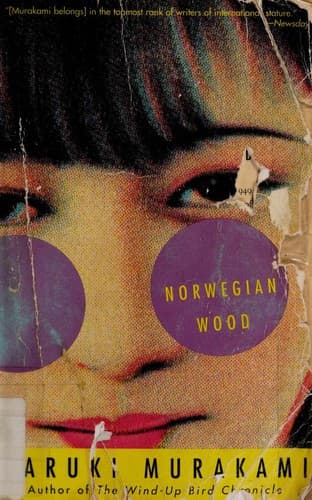
Book 1·Start here — always
Norwegian Wood
Haruki Murakami·1987·trans. Jay Rubin (2000)
The right first book. Norwegian Wood is Murakami's only fully realistic novel — no talking cats, no disappearing women who become metaphors, no jazz clubs that exist in some intermediate state between memory and the present. It's a grief novel: a young man in 1960s Tokyo processes the suicide of his best friend and falls in love with the dead man's girlfriend. The prose is the same as the rest of Murakami (the jazz record descriptions, the simple meals cooked with care, the narrator's precise emotional remove), but the world is recognizably the world. This matters because: if you read Norwegian Wood first and love it, you'll find the magical elements of the later books an extension of the same voice rather than a disorienting new mode. And if you don't love Norwegian Wood, at least you know quickly.
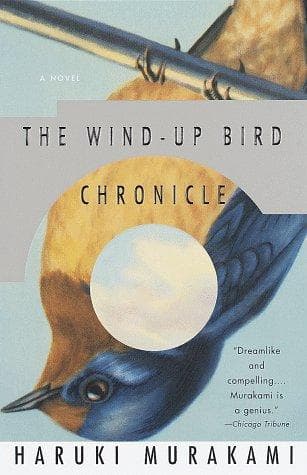
Book 2·The full Murakami experience
The Wind-Up Bird Chronicle
Haruki Murakami·1994·trans. Jay Rubin (1997)
The second book, and the one that represents everything Murakami does at full power. A man's cat disappears; then his wife disappears; he spends the rest of the novel descending into a dry well in his neighborhood to think. The novel contains: the war in Manchuria, a woman who seduces men through telephone calls, a psychic who reads history in people's bodies, an immense corporate villain who may be literally soulless, and one of the strangest sequences in contemporary fiction — a man in a dry well in the dark, waiting for something he cannot name. It is not a mystery with a solution. It is an investigation into what happens when the structures of an ordinary life collapse and something else comes through. The longest book on this list and the right second read.
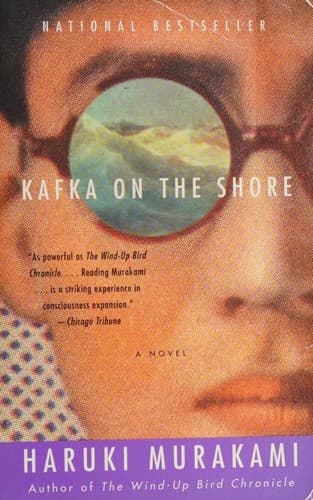
Book 3·The formally ambitious one
Kafka on the Shore
Haruki Murakami·2002·trans. Philip Gabriel (2005)
Two alternating narratives: a fifteen-year-old boy who runs away from home to escape a prophecy, and an old man who cannot read but can speak to cats and cause fish to fall from the sky. The two stories approach each other obliquely throughout the novel and intersect in ways that are not fully resolved — which is the point. Murakami said that Kafka on the Shore is his attempt to write a novel that exists entirely in the space between the rational and the irrational, where both are given equal credibility. The result is the most formally accomplished thing he's written: a novel in which the supernatural is treated with the same matter-of-fact precision as the everyday, and neither cancels the other out.
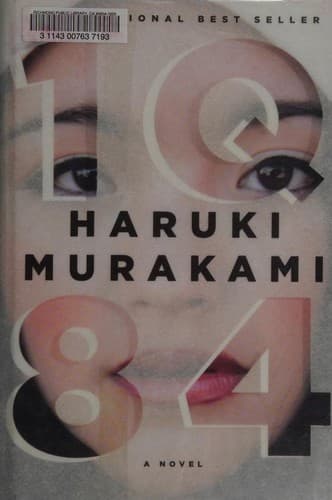
Book 4·The big one
1Q84
Haruki Murakami·2009·trans. Jay Rubin & Philip Gabriel (2011)
A woman climbs down an emergency staircase from an expressway and enters a world that is almost but not quite the world she left: this one has two moons. A man is hired to ghostwrite a fantasy novel written by a teenage girl, and the world of the novel begins to bleed into the world of the ghostwriter. Murakami's most ambitious novel in scope and one of the most divisive among his readers — it is 1,000 pages, it takes a long time to resolve, and the resolution is more romantic than metaphysical. Read this after you've read three other Murakamis. The two moons are earned.
Book 5·The full range in miniature
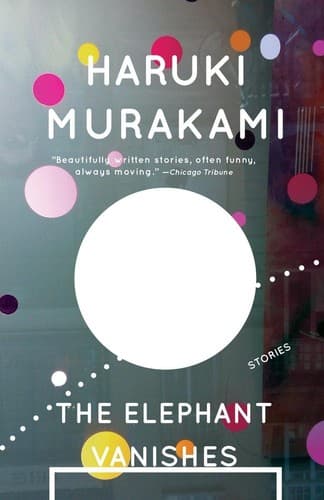
The Elephant Vanishes
Haruki Murakami·1993·trans. Alfred Birnbaum & Jay Rubin (1993)
The short story collection. Seventeen stories, most of them short enough to read in thirty minutes, that show Murakami's range more efficiently than any single novel. 'The Elephant Vanishes' (a municipal elephant disappears with its keeper), 'Sleep' (a woman stops needing to sleep and uses the extra hours to read Anna Karenina), 'TV People' (small people install a television in a man's apartment and he can't get anyone to acknowledge they were there). The stories are the best entry point for readers who want to understand what Murakami is doing formally, without committing to 800 pages of novel. Read this fifth rather than first — the stories are richer when you've already lived inside his longer world.