Editor-reviewed
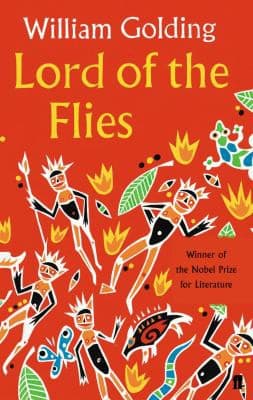
Lord of the Flies
William Golding·1954·Faber & Faber·Literature
Reading level: Ages 13+ (YA) · 6-hour read · Beginner difficulty.
- Reading time
- 6h
- Difficulty
- Beginner
- Recommended age
- Ages 13+ (YA)
- Guide read
- 5min
- Editor's rating
- 4.5 / 5
- dystopia
- coming-of-age
- british-literature
- allegory
- school-staple
- nobel
- survival
— In one sentence —
Twenty-one publishers rejected it. The ones who accepted it gave Golding a Nobel Prize. The argument it makes about human nature has not been settled.
§ 01 · WHY READ
Why read
William Golding submitted Lord of the Flies to twenty-one publishers between 1953 and 1954. All of them rejected it. The reader's report at Jonathan Cape, which turned it down, called it "an absurd and uninteresting fantasy." Faber accepted it on the intervention of Charles Monteith, a new editor who pulled it from the rejection pile, and it became one of the most assigned novels in the English-speaking world.
The premise is almost ludicrously simple: a group of British schoolboys, evacuated during a nuclear war, are stranded on an uninhabited island. No adults. Coconuts, pigs, a lagoon. What happens next is Golding's answer to the optimist tradition of the castaway novel — The Swiss Family Robinson, Coral Island (which Golding explicitly takes as his ironic counter-text) — which assumed that well-bred boys, given natural resources and British pluck, would build a functional society.
Golding's schoolboys do not build a functional society. They build two competing factions, a murder, a ritual killing, and a manhunt. The speed of the descent is the argument: these are not bad children; they are ordinary children in conditions that remove the structures that make ordinary children behave. Remove adult authority, shared consequence, and the social enforcement of norms, and what emerges is not civilization lite — it is something older.
The counterargument exists and is worth taking seriously: the novel's pessimism is historically specific (Golding was a naval officer in the Second World War and had a darker view of human nature than the pre-war tradition he was arguing against), and recent research on actual shipwrecked children suggests they behave considerably better than his novel imagines. Read the counterargument. Then reread the book and decide whether the argument is really about children.
§ 02 · CHARACTERS
Characters
Golding's characters are deliberately typed — they function as positions in a philosophical argument more than as individuals, which is a structural choice, not a failure of craft.
Ralph — elected leader, stands for democratic order, civilization, the signal fire as collective project. His authority is always contingent on others choosing to support it. When the others stop choosing, the authority dissolves. This is Golding's point about democratic legitimacy: it is a choice, and choices can be unmade.
Piggy — intellectual, physically vulnerable, the only one consistently reasoning clearly. He is also consistently dismissed: too fat, too asthmatic, the wrong accent, the wrong background. The relationship between intelligence and power in the novel runs through Piggy — he has the former and is never permitted the latter, until both are taken from him simultaneously.
Jack — the one who doesn't need to be elected. Jack's authority is charismatic, not rational: he offers the boys meat, paint, release from the inhibitions of their school-world. His tribe asks less of its members than Ralph's — no fire duties, no meetings, no thinking about rescue — and in return offers hunting, the war-mask, the excitement of belonging to something powerful. The offer is not nothing. That's the point.
Simon — the novel's mystic, who understands what the "beast" actually is and tries to tell the others. He doesn't get to finish the sentence. His scene with the Lord of the Flies — the pig's head on a stick — is the novel's philosophical climax: the beast is not external, and Simon's understanding of this makes him the most dangerous person on the island to Jack's mythology.
Roger — the one who was always going to do what he does. Even before the social structures collapse, Roger throws stones near the littluns — close enough to frighten, not close enough to hit, because the ghost of adult prohibition still restrains him. Watch when the ghost stops restraining him.
§ 03 · HIGHLIGHTS
Three highlights
No. 1 · The signal fire. The signal fire is Ralph's central project — the one thing that might get them rescued. It is also the novel's central irony: the boys who abandon it for hunting are the same boys who, at the novel's end, start a fire large enough to attract a passing ship. The rescue fire is unintentional, destructive, meant to kill rather than signal. Golding's structure is precise: civilization is saved by the same impulse that destroys it.
No. 2 · Simon and the Lord of the Flies. Simon, alone in the forest, hallucinates a conversation with the pig's head — the Lord of the Flies of the title — which tells him the beast is not a creature on the mountain but something inside the boys themselves. The scene is the novel's theological centre: Simon is the only one with a correct diagnosis, which is why he must be silenced. His subsequent attempt to bring the truth to the beach is mistaken for the beast and ends in his death. What truth requires courage to tell, and what happens to the people who try to tell it: this is Golding's darkest observation.
No. 3 · Ralph's weeping at the end. The naval officer who rescues the boys is embarrassed by their condition — he expected better of British boys — and turns away to give Ralph time to compose himself. Ralph weeps "for the end of innocence, the darkness of man's heart, and the fall through the air of the true, wise friend called Piggy." This is one of the most carefully written final passages in English fiction: it earns the large abstractions ("darkness of man's heart") by placing them inside a specific boy's specific grief, and the naval officer's embarrassed turning-away implicates the adult world — at war, just offstage — in exactly what it finds shameful in the children.
§ 04 · EDITIONS
Recommended editions
| Edition | Why pick it |
|---|---|
| Faber & Faber (standard paperback) | The canonical edition; clean text, good introduction. |
| Penguin Modern Classics | Well-annotated; includes Golding's Nobel acceptance speech. Worth reading alongside. |
| Perigee / Penguin (US) | Standard US edition; identical text. |
| Audible (narrated by various) | Several good audiobook versions; the text is short enough to work well in audio. |
The 1963 film (Peter Brook) is stark and effective — filmed in black and white on location, using non-professional child actors. It captures the novel's atmosphere better than the 1990 American remake, which updated the setting but lost the allegorical precision.
§ 05 · FIT
Who it's for / not for
Read this if you are…
- Anyone who has been assigned it and read it only for the plot. The plot is the least of it.
- Readers interested in the post-war British literature of disillusionment: Golding alongside Burgess, Osborne, Amis.
- Anyone who wants to think about what structures actually hold civil behaviour together and what happens when they fail.
- A parent whose teenager is reading it — worth reading in parallel to have the conversation afterward.
Skip it if you are…
- Looking for moral complexity in the characterization. The boys are types, and Golding intends this.
- Persuaded by the optimistic counterargument: if you believe the 2020 study of the Tongan castaways who built a functional community proves Golding wrong, the book will feel polemical rather than true.
§ 06 · TIPS
Reading tips
- Read Coral Island (R. M. Ballantyne, 1857) first if you can, or at least know its outline: three British boys stranded on an island who build an orderly, cheerful society. Golding directly names its characters (Ralph, Jack, Simon appear in both) to make clear he is writing the dark inverse.
- Pay attention to Roger. His arc is the novel's most precise moral argument; the detail about the thrown stones is there for a reason.
- The beast is not the point — what the beast represents is. Every time the boys discuss the beast, ask what they're actually afraid of and whether they can name it.
- The naval officer at the end is not a rescue from outside the novel's world. He is part of it.
§ 07 · COMPARE
Read alongside
- R. M. Ballantyne — Coral Island (1857). The optimist original; Golding's explicit counter-text. Short and worth reading.
- Joseph Conrad — Heart of Darkness (1899). The colonial-era version of the same argument: what civilization covers over, and what surfaces when the cover is removed.
- Aldous Huxley — Brave New World (1932). The opposite mechanism: civilization maintained not by removing control but by maximizing it. Read together, the two novels triangulate the space between freedom and order.
- Anthony Burgess — A Clockwork Orange (1962). Violence, adolescence, and the relationship between conditioning and choice. Golding's argument made more stylistically extreme.
- Hannah Arendt — Eichmann in Jerusalem (1963). The historical complement: the "banality of evil" thesis — that ordinary people in systems that sanction violence will commit it — supports Golding's fictional argument from the documentary record.
§ 08 · DISCUSSION
Discussion questions
- Ralph is elected leader because of his physical presence and the conch — not because of any demonstrated leadership ability. What does this say about how authority is actually established?
- Piggy is right about almost everything throughout the novel. What prevents his intelligence from becoming authority? Is the obstacle specific to this island or more general?
- Jack's tribe offers freedom from rules and the pleasure of belonging to something powerful. Is the offer entirely without value? What is Golding saying about the appeal of authoritarian movements?
- Simon understands the nature of the beast. Can you translate his understanding into plain language? Why can't he communicate it to the other boys?
- Roger's stone-throwing is carefully staged: he throws near, not at, the littluns because "the taboo of old life" still restrains him. Trace the subsequent steps by which that taboo is removed. What removes it?
- The naval officer says he expected better from British boys. He arrives in a warship. What is Golding doing with this juxtaposition?
- Is the novel's argument that civilization is a thin veneer over innate violence, or that specific conditions — the absence of adult authority, resource competition, group dynamics — produce violence in otherwise ordinary people? Is there a difference between these claims?
- Golding's 1983 Nobel lecture, "My belief," is partly a meditation on what this novel was responding to. If you can find it, read it after finishing the book. Does it change your reading?
One line to remember
“The thing is — fear can't hurt you any more than a dream.”— Jack — Chapter 2
Appears in collections
Reading lists featuring this book
7 books
Banned Books That Are Actually Great
Seven books banned for ideas that turned out to be exactly the ideas that needed saying.
Open list →
8 books
The Best Books for Teens
What high schoolers actually want to read — not what they're assigned.
Open list →
6 books
Books About Being an Outsider
Six novels about people who cannot find a world that will accept them whole.
Open list →
5 books
Books About Human Nature
Five books, five different verdicts on what people are.
Open list →
6 books
The Best Books About Survival
Six novels about people who have to keep going when everything says they shouldn't.
Open list →
7 books
Read the Book Before the Movie
Seven books where the adaptation is good — but the book contains something the screen can't hold.
Open list →
7 books
Books to Read in Your 20s
Seven novels for the decade when you're figuring out who you're going to be.
Open list →
5 books
Books to Understand Democracy
Five novels that name what goes wrong before it does.
Open list →
7 books
Best Coming of Age Novels
Six novels about the specific moment of becoming — organized by protagonist age and what each book says about that moment.
Open list →
8 books
Eight Dystopian Novels Beyond 1984
Orwell's masterpiece gets all the attention. These eight books are asking harder questions.
Open list →
8 books
Nobel Prize Winning Novels Worth Reading
Eight novels by Nobel laureates in Literature — chosen not because the prize certifies them, but because they are the ones a first-time reader of Nobel fiction can actually get inside.
Open list →
You might also like
Read next
William Faulkner · 1936
Absalom, Absalom!
Four narrators reconstruct a man who destroyed his family. The story keeps changing. That is the point.
Read · 7 min
Toni Morrison · 1987
Beloved
Toni Morrison said she wrote this novel to give voice to the sixty million. It won the Pulitzer, the Nobel, and is the greatest American novel of the second half of the twentieth century.
Read · 6 min
Leo Tolstoy · 1878
Anna Karenina
Not just a love story. Two parallel lives — Anna's destruction, Levin's salvation — ask the same question: how should a person live?
Read · 6 min