Editor-reviewed
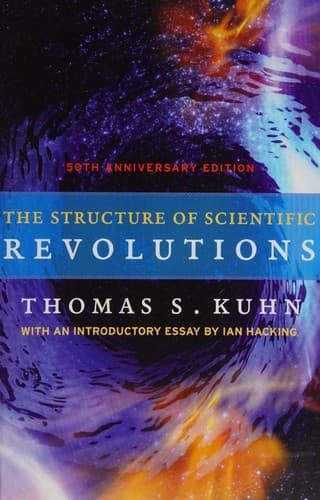
The Structure of Scientific Revolutions
Thomas S. Kuhn·1962·University of Chicago Press·non-fiction
Reading level: Ages 16+ (adult) · 7-hour read · Intermediate difficulty.
- Reading time
- 7h
- Difficulty
- Intermediate
- Recommended age
- Ages 16+
- Guide read
- 5min
- Editor's rating
- 4.7 / 5
- kuhn
- philosophy-of-science
- history-of-science
- paradigm
- scientific-revolution
- epistemology
- non-fiction
— In one sentence —
Kuhn introduced the word 'paradigm' to the general vocabulary in 1962. This is the book that made science studies possible — and the one scientists still argue about.
§ 01 · WHY READ
Why read
Thomas Kuhn published The Structure of Scientific Revolutions in 1962 as a monograph in the International Encyclopedia of Unified Science. It was a slim academic volume; no one predicted it would sell over one million copies and introduce a word into general use. The word is "paradigm." Before Kuhn, "paradigm" was a technical term in linguistics. After Kuhn, it is the word you reach for when you want to describe a framework so pervasive it isn't noticed until it breaks.
Kuhn was a physicist who became a historian of science. The book began with a puzzle: he had been reading the history of Aristotelian physics and was struck by how wrong Aristotle seemed to his modern eyes — and by how obvious the errors were. But Aristotle was not stupid; he was the greatest scientific mind of his era. How could someone so intelligent have been so wrong about things that seem obvious now? Kuhn's answer changed how we think about scientific knowledge.
The argument: Science does not progress through the smooth accumulation of facts. It progresses through periods of "normal science" — in which a community of scientists works within an agreed framework (a paradigm) solving puzzles — punctuated by crises and revolutions, in which the paradigm is overthrown and replaced by a new one. The replacement is not simply the addition of more facts; it is a shift in what counts as a legitimate question, what counts as an acceptable answer, and sometimes what counts as evidence.
The book is short — 172 pages in the original edition — and dense. It changed the philosophy of science, the sociology of science, the history of science, and the general vocabulary. It is cited in fields from literary criticism to management theory, often by people who have not read it.
§ 02 · KEY CONCEPTS
Key concepts
Paradigm — the framework of assumptions, methods, and standards shared by a scientific community. A paradigm defines what questions are worth asking, what methods are acceptable, what results are significant, and what anomalies can be set aside. Scientists working within a paradigm don't question it; they work within it. The paradigm is not a theory — it is the framework within which theories are formulated and tested.
Normal science — the routine work of science under an established paradigm. Kuhn's characterization is deliberately unflattering: normal science "does not aim at novelty but at clearing up the residue." It is puzzle-solving within rules the puzzle-solvers don't question. This is not a criticism — normal science is how knowledge accumulates — but it is a description of its limits.
Anomaly — a result that doesn't fit the paradigm. Normal science handles anomalies by setting them aside, attributing them to experimental error, or adding special-case explanations. A paradigm is not abandoned because of anomalies; it is abandoned when anomalies accumulate to the point of crisis and an alternative paradigm becomes available.
Scientific revolution — the replacement of one paradigm by another. Kuhn argues that revolutions are not triggered by disconfirming evidence alone; they require both a crisis (accumulated anomalies that the dominant paradigm cannot absorb) and the availability of an alternative. The Copernican revolution, the Newtonian revolution, the Einsteinian revolution: each of these is a paradigm shift, not a correction.
Incommensurability — the claim that successive paradigms are not simply better versions of their predecessors but different in kind: they answer different questions, use different standards, and cannot be directly compared. This is Kuhn's most contested idea; it implies that Aristotle's physics is not simply wrong by Newtonian standards but is doing something different.
§ 03 · HIGHLIGHTS
Three highlights
No. 1 · The duck-rabbit. Kuhn uses the Gestalt duck-rabbit figure — the image that can be seen as either a duck or a rabbit depending on how you perceive it — as an analogy for paradigm shifts. When you see the rabbit, you cannot simultaneously see the duck; to see the duck, you must switch your whole perceptual framework. This is what happens in scientific revolutions: scientists "see" the world differently afterward, not because the data has changed but because the interpretive framework has.
No. 2 · The Copernican revolution as paradigm shift. Kuhn's extended analysis of the transition from Ptolemaic to Copernican astronomy shows that the shift was not primarily driven by better data. Ptolemy's system could be made to fit the data by adding epicycles; it was more accurate than Copernicus's original heliocentric model in some respects. The shift happened because of accumulating complexity, the elegance of the alternative, and eventually better data — but "better data" alone would not have triggered the revolution without a community ready to see the new paradigm.
No. 3 · Progress without a goal. Kuhn ends with a challenge to the idea that scientific progress is directed toward truth. He compares science to Darwinian evolution: evolution does not progress toward a goal; it changes in directions shaped by the environment. Similarly, science does not progress toward a final picture of reality; it moves away from previous paradigms, not toward anything in particular. This is the book's most uncomfortable claim, and Kuhn doesn't fully resolve it.
§ 04 · EDITIONS
Recommended editions
| Edition | Why pick it |
|---|---|
| University of Chicago Press (50th anniversary, 2012) | The definitive edition; includes Kuhn's 1969 postscript in which he responds to critics and clarifies his arguments. The postscript is essential — read it after the main text. |
| Original 1962 edition (if you can find it) | Historically interesting; shorter than the revised edition, without the postscript. |
The secondary literature on Kuhn is vast. For orientation: David Hollinger's introduction to the 50th anniversary edition is excellent. For the other side of the debate, Imre Lakatos's "Falsification and the Methodology of Scientific Research Programmes" is the most rigorous response.
§ 05 · FIT
Who it's for / not for
Read this if you are…
- Anyone who wants to understand how knowledge changes — not just what science has discovered but how scientific communities actually work.
- Readers interested in the philosophy or history of science: this is the book from which all subsequent discussion proceeds.
- Programmers and engineers who want a framework for thinking about technological paradigm shifts: Kuhn's analysis of normal science maps well onto technology ecosystems.
- Anyone who has encountered "paradigm shift" in business or management writing and wants to read the original.
Skip it if you are…
- Looking for a narrative. The Structure is an argument; its pleasures are analytic rather than narrative.
- Expecting a simple validation of scientific progress. Kuhn is more complicated than "science works, here's how." The incommensurability claim in particular is philosophically demanding.
§ 06 · TIPS
Reading tips
- Read the 1969 postscript. Kuhn responds to critics and clarifies what he did and didn't mean by "paradigm" (he had used the word in twenty-two different senses in the first edition, by one count) and by "incommensurability." The postscript is as important as the book.
- The historical examples are the argument. Kuhn is making a philosophical claim through historical case studies. Don't read past the examples; they are the evidence.
- Incommensurability is the hardest part. If you find yourself confused about whether Kuhn is saying that scientific change is irrational, read Chapter XII and the postscript together. He is not saying science is irrational; he is questioning the naive view that it is purely rational.
- Note what Kuhn is not saying. He is not saying that paradigms are arbitrary, that revolutions are pure sociology, or that there is no progress. He is saying the mechanism of progress is more complex than the simple accumulation of confirmed hypotheses.
§ 07 · COMPARE
Read alongside
- Karl Popper — The Logic of Scientific Discovery (1934, translated 1959). The alternative epistemology: Popper argues science progresses through falsification. Kuhn's book is partly a response to Popper. Read them together.
- Imre Lakatos and Alan Musgrave, eds. — Criticism and the Growth of Knowledge (1970). The direct response to Kuhn; includes Lakatos, Feyerabend, and others. The best single-volume debate about Kuhn's claims.
- Daniel Kahneman — Thinking, Fast and Slow (2011). An unexpected companion: Kahneman's account of how human judgment departs from rational norms, read alongside Kuhn's account of how scientific communities depart from rationalist models, produces a richer picture of how knowledge actually works.
- Steven Weinberg — To Explain the World (2015). The scientist's response: a Nobel Prize-winning physicist who thinks Kuhn's relativism misrepresents how science works. A useful corrective.
§ 08 · DISCUSSION
Discussion questions
- Kuhn distinguishes "normal science" (puzzle-solving within a paradigm) from revolutionary science (paradigm replacement). Is this distinction clean? Can you identify cases where it breaks down?
- The concept of incommensurability — that successive paradigms cannot be directly compared — is Kuhn's most contested claim. Is it coherent? Does it imply that scientific progress is impossible?
- Kuhn argues that scientists work within paradigms without questioning them. Is this a criticism of scientists, a description of how productive research actually works, or both?
- The duck-rabbit analogy: when you see the rabbit, you cannot simultaneously see the duck. Is this a good analogy for paradigm shifts? Where does the analogy break down?
- Kuhn compares scientific progress to Darwinian evolution — progress away from, not toward. Does this undermine the idea that science is converging on truth? How should we think about scientific progress without a goal?
- The book has been cited in management consulting, literary criticism, and technology strategy. Is "paradigm shift" a useful concept outside the history of science, or has it been diluted to meaninglessness by overuse?
- Kuhn was a physicist writing about physics. Does his framework apply equally to the biological sciences, the social sciences, and the humanities?
One line to remember
“Normal science does not aim at novelty but at clearing up the residue left over from previous work.”— Chapter III
Appears in collections
Reading lists featuring this book
6 books
The Best Books About Innovation
Six books about how new things actually come into being — the patterns of invention, the mechanics of disruption, and the people who see what others miss.
Open list →
6 books
The Best Books About Risk and Uncertainty
Six books on the one problem every decision shares — that the future is unknown and you have to act anyway — from how the mind misjudges odds to how institutions, founders, and strategists operate when the answer can't be known in advance.
Open list →
6 books
Books for Engineers
Six books engineers actually read — none of them about engineering.
Open list →
8 books
Best Books for Entrepreneurs
What to read before, during, and after starting a company.
Open list →
8 books
Best Books for Managers
The reading list for people who lead other people.
Open list →
7 books
Books That Changed History
Seven books whose ideas or accounts reshaped how the world thought, organized, or fought.
Open list →
6 books
Books That Changed How I Think
Six books that installed a new mental model — specific, not vague.
Open list →
10 books
Ten Books Every Programmer Should Read That Have Nothing to Do With Code
The books that change how you think, not what you type.
Open list →
You might also like
Read next
Daniel Kahneman · 2011
Thinking, Fast and Slow
A Nobel Prize winner's life work in one book. The two systems that govern human thought — and why we are wrong more often, and more predictably, than we believe.
Read · 5 min
Clayton M. Christensen · 1997
The Innovator's Dilemma
Why good companies fail. Christensen's answer — that they fail precisely because they are well-managed — is the most uncomfortable idea in business literature.
Read · 4 min
Sun Tzu · -500
The Art of War
2,500 years old. Thirteen chapters. Applied to every domain from military strategy to product management. Most citations misquote it. Most readers haven't read it. It takes two hours.
Read · 4 min