Editor-reviewed
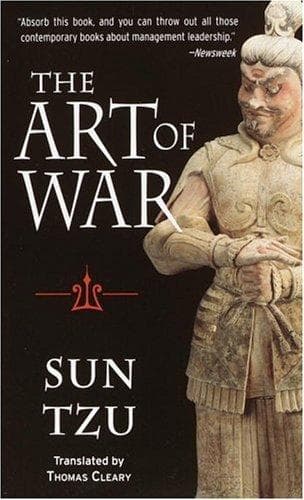
The Art of War
Sun Tzu·-500·Various (ancient text)·non-fiction
Reading level: Ages 14+ (adult) · 2-hour read · Beginner difficulty.
- Reading time
- 2h
- Difficulty
- Beginner
- Recommended age
- Ages 14+
- Guide read
- 4min
- Editor's rating
- 4.4 / 5
- sun-tzu
- strategy
- military
- philosophy
- ancient
- china
- non-fiction
- canonical
— In one sentence —
2,500 years old. Thirteen chapters. Applied to every domain from military strategy to product management. Most citations misquote it. Most readers haven't read it. It takes two hours.
§ 01 · WHY READ
Why read
The Art of War is attributed to Sun Tzu, a military strategist who may have lived during the Spring and Autumn period of Chinese history (roughly 5th century BCE). The text as it exists today was compiled, edited, and transmitted over centuries; the precise relationship between the historical Sun Tzu and the text bearing his name is uncertain. What is certain: the text has been continuously studied for 2,500 years, by Chinese military commanders, Mao Zedong, Napoleon (who reportedly kept a copy), and since the 1980s by business schools and management consultants.
The business-school application is mostly nonsense. The text is specifically about military strategy — the management of armies, the conditions of battle, the use of intelligence and deception to gain advantage over an enemy who is trying to do the same to you. The analogies to product strategy and corporate competition are strained.
Read as what it is — an ancient text on military strategy — it is more interesting than its business-book reputation. Its central insight: the best generals avoid battle rather than seeking it. Victory achieved without battle is superior to victory achieved through fighting. The aim is not to defeat the enemy in combat but to make combat unnecessary by arranging conditions so the enemy cannot win before the battle begins. This is a profoundly counterintuitive argument for a military text.
The text is thirteen short chapters, aphoristic in style, dense with specific advice about terrain, intelligence, logistics, and morale. Read slowly; each chapter rewards more time than it seems to require.
§ 02 · KEY CONCEPTS
Key concepts
Supreme excellence without fighting — the text's central paradox: the highest form of military achievement is winning without battle. If you have arranged things correctly — terrain, intelligence, morale, logistics — the battle should already be decided before it begins.
Know yourself and know your enemy — the famous formulation: "If you know the enemy and know yourself, you need not fear the result of a hundred battles." The emphasis on intelligence — specific, accurate knowledge of your own forces and the enemy's — is consistent throughout the text.
Deception — "All warfare is based on deception." The text's most quoted line, and genuinely central to the strategy: the aim is to appear strong when weak, weak when strong, far when near, near when far. Deceiving the enemy about your position and intent is a prerequisite for strategy.
Terrain and conditions — a significant portion of the text is devoted to the use of terrain, weather, and physical conditions. The commander who chooses his ground well has already made most of the strategic decisions; the commander who allows his enemy to choose the ground has already lost much of the advantage.
§ 03 · HIGHLIGHTS
Three highlights
No. 1 · Chapter III: Attack by Stratagem. The chapter containing "Supreme excellence consists in breaking the enemy's resistance without fighting." The argument is that attacking cities and engaging in pitched battle are the worst options; undermining the enemy's strategy and disrupting his alliances are superior. This chapter is the text's philosophical center.
No. 2 · Chapter XIII: The Use of Spies. The final chapter and one of the most specific: an argument for the investment in intelligence as the foundation of all strategy. Sun Tzu identifies five types of spies and their uses. The chapter's argument — that the commander who has superior intelligence has already won — completes the text's central theme.
No. 3 · The water metaphor. The text's most evocative image: water has no constant form — it takes the shape of whatever contains it. Tactics should be like water: take the shape required by the enemy's dispositions rather than having a fixed form the enemy can predict and exploit. This is one of the few moments when the text moves from prescription to imagery.
§ 04 · EDITIONS
Recommended editions
Translation is important.
| Translation | Why pick it |
|---|---|
| Roger T. Ames (Ballantine, 1993) | The most scholarly modern translation; includes extensive commentary on the Chinese text. |
| Lionel Giles (1910, public domain) | The first major English translation; still readable; the version most often cited in business books. |
| Thomas Cleary (Shambhala, 1988) | Readable and concise; the translation most often recommended as an entry point. |
| Victor H. Mair (Columbia, 2007) | Based on the older Sunzi text discovered at Yinqueshan in 1972; closest to the earliest available version. |
The text is approximately 6,000 Chinese characters in the original — two hours in any translation. Read an edition with good commentary.
§ 05 · FIT
Who it's for / not for
Read this if you are…
- Anyone who has seen this text cited extensively and wants to read what it actually says.
- Readers interested in classical Chinese philosophy and military thought.
- Anyone interested in strategy at its most distilled: the text rewards re-reading at different moments in life.
Skip it if you are…
- Looking for business strategy. The text was written for generals fighting armies in ancient China; the analogies to corporate competition are stretched at best.
§ 06 · TIPS
Reading tips
- Read slowly. Each chapter is short; the aphoristic style rewards pausing at each idea rather than reading for pace.
- Read with a commentary. The text is ancient and assumes a context most modern readers don't have. A good edition with commentary doubles the value.
- Notice what the text is not. It is not about courage, heroism, or glory. It is about intelligence, preparation, and avoiding unnecessary combat. This is counterintuitive for a military text.
§ 07 · COMPARE
Read alongside
- Miyamoto Musashi — The Book of Five Rings (c. 1645). The Japanese counterpart: a swordsman's strategic philosophy. Where Sun Tzu is about armies, Musashi is about individual combat. The comparison is illuminating.
- Carl von Clausewitz — On War (1832). The Western tradition: the Prussian theorist's argument that war is the continuation of politics by other means. More systematic and more pessimistic than Sun Tzu.
- Thomas S. Kuhn — The Structure of Scientific Revolutions (1962). An unexpected companion: both texts are about how dominant frameworks are defeated not by direct assault but by undermining their assumptions.
§ 08 · DISCUSSION
Discussion questions
- "Supreme excellence consists in breaking the enemy's resistance without fighting." Is this possible in the domains you work in? What would it look like to win without direct confrontation?
- "All warfare is based on deception." Is this claim morally neutral, or does it imply something about the ethics of strategy?
- The text emphasizes intelligence — knowing the enemy and yourself — as the foundation of strategy. What does systematic ignorance cost in the domains where you apply strategy?
- Sun Tzu advises commanders to adapt to conditions rather than impose a fixed plan. What are the limits of this advice? When does flexibility become indecision?
- The business-book application of Sun Tzu is widespread. Is it valid? What is lost in the translation from military to corporate strategy?
- The text is 2,500 years old. Which of its arguments still apply without modification? Which require the most translation to modern contexts?
One line to remember
“Supreme excellence consists in breaking the enemy's resistance without fighting.”— Chapter III — Attack by Stratagem
Appears in collections
Reading lists featuring this book
6 books
The Best Books About Risk and Uncertainty
Six books on the one problem every decision shares — that the future is unknown and you have to act anyway — from how the mind misjudges odds to how institutions, founders, and strategists operate when the answer can't be known in advance.
Open list →
8 books
Best Books for Entrepreneurs
What to read before, during, and after starting a company.
Open list →
7 books
Books That Changed History
Seven books whose ideas or accounts reshaped how the world thought, organized, or fought.
Open list →
5 books
Books That Teach Strategy
Five books on how to think before you act.
Open list →
8 books
Books You Can Read in One Sitting
Sorted by length — from two hours to a full afternoon. Each one built for continuous reading.
Open list →
10 books
Ten Books Every Programmer Should Read That Have Nothing to Do With Code
The books that change how you think, not what you type.
Open list →
You might also like
Read next
Thomas S. Kuhn · 1962
The Structure of Scientific Revolutions
Kuhn introduced the word 'paradigm' to the general vocabulary in 1962. This is the book that made science studies possible — and the one scientists still argue about.
Read · 5 min
Daniel Kahneman · 2011
Thinking, Fast and Slow
A Nobel Prize winner's life work in one book. The two systems that govern human thought — and why we are wrong more often, and more predictably, than we believe.
Read · 5 min
Clayton M. Christensen · 1997
The Innovator's Dilemma
Why good companies fail. Christensen's answer — that they fail precisely because they are well-managed — is the most uncomfortable idea in business literature.
Read · 4 min