Editor-reviewed
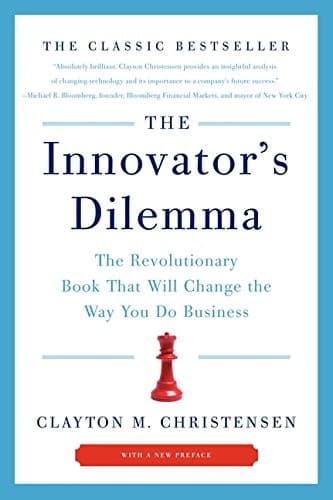
The Innovator's Dilemma
Clayton M. Christensen·1997·Harvard Business School Press·non-fiction
Reading level: Ages 16+ (adult) · 8-hour read · Intermediate difficulty.
- Reading time
- 8h
- Difficulty
- Intermediate
- Recommended age
- Ages 16+
- Guide read
- 4min
- Editor's rating
- 4.5 / 5
- christensen
- disruption
- business
- innovation
- technology
- management
- non-fiction
— In one sentence —
Why good companies fail. Christensen's answer — that they fail precisely because they are well-managed — is the most uncomfortable idea in business literature.
§ 01 · WHY READ
Why read
Clayton Christensen published The Innovator's Dilemma in 1997, based on his doctoral research at Harvard Business School on the disk drive industry. The book introduced the concept of "disruptive innovation" — one of the handful of ideas from academic management research that entered general use. Steve Jobs cited it. Jeff Bezos cited it. Andy Grove said it was one of the most important business books he had ever read. It has been wrong in specific ways, overapplied in many contexts, and misused in nearly all of them — and it contains a genuine insight that holds.
The insight: well-managed companies fail not because of bad management but because of good management. Successful companies listen to their best customers, allocate resources to highest-margin products, improve their products along the dimensions their customers value most, and make rational decisions at every step. These rational decisions make them vulnerable to disruption.
Disruptive innovations — Christensen's term for a specific thing, not for innovation in general — begin by serving a market segment that incumbents don't care about (too small, too low-margin, too unsophisticated). They are worse than the incumbent's product on the dimensions established customers value, but better on dimensions those customers don't care about (cheaper, simpler, more convenient). As the disruptive product improves, it eventually reaches the quality threshold of the incumbent's market — and by that time, the disruptor has manufacturing scale, distribution relationships, and brand recognition the incumbent cannot quickly replicate.
The disk drive case: each generation of drives that disrupted the previous generation came from a new entrant, not the incumbent. The incumbents didn't miss the new technology; they chose not to pursue it because their customers didn't want it and the margins were too low. This was the correct decision at the time. It was also the decision that killed them.
§ 02 · KEY CONCEPTS
Key concepts
Sustaining innovation — improvements to existing products along dimensions that existing customers value. Incumbents are very good at sustaining innovation.
Disruptive innovation — new products that are initially worse than existing products on established metrics but better on metrics established customers don't care about. Incumbents are structurally unable to pursue disruptive innovation: their customers don't want it, their sales force can't sell it at the right margins, their cost structures are too high for the market it serves.
The innovator's dilemma — the specific bind: if you listen to your customers and allocate resources rationally, you will fail to pursue disruptive innovations that eventually destroy you. If you pursue disruptive innovations, you will make irrational decisions by your own current metrics.
The solution Christensen proposes — create a separate organization, independent of the parent company's resource allocation processes, to pursue disruptive innovations. The parent company cannot be the vehicle because its processes and values are precisely calibrated for the existing market.
§ 03 · HIGHLIGHTS
Three highlights
No. 1 · The disk drive case. The disk drive industry is the book's primary case study and its strongest evidence: each generation of disk drive architecture was introduced by new entrants, not incumbents. The incumbents had the technology and chose not to pursue it. Christensen's documentation of this pattern — with specific data on when incumbents first saw the new technology, what their customers wanted, and when they lost — is the book's most convincing section.
No. 2 · Rational managers making fatal decisions. The book's most counterintuitive claim, stated precisely: the managers who made the decisions that led to failure were not incompetent, not corrupt, not insufficiently innovative. They were doing their jobs correctly by the metrics available to them. The dilemma is that correct management of an existing business is structurally incompatible with pursuing disruptive innovation.
No. 3 · The proposed solution. Christensen's prescription — create an autonomous organization to pursue the disruption — has been critiqued as easier to describe than to execute. The book acknowledges this; the problem is that incumbents cannot spin off a successful disruptive business without cannibalizing existing margins. His later work (The Innovator's Solution, 2003) develops the prescription further.
§ 04 · EDITIONS
Recommended editions
| Edition | Why pick it |
|---|---|
| Harvard Business School Press (revised and updated edition) | Includes a new preface in which Christensen responds to critics. The correct edition to read. |
| HarperBusiness (paperback) | The widely available edition; same text. |
Caution on "disruption": the word has been so thoroughly misused in venture capital and tech press that it now means any novel product. Christensen was precise about what disruption means; reading the book against the popular usage of the term is clarifying.
§ 05 · FIT
Who it's for / not for
Read this if you are…
- Anyone working in a market that has been disrupted or could be: the framework is useful for identifying where disruption is most likely to come from.
- Readers interested in business history: the disk drive cases are excellent history independent of the theoretical framework.
- Managers in large organizations who want to understand why large organizations are structurally resistant to certain kinds of change.
Skip it if you are…
- Already familiar with the framework and looking for implementation guidance. Read The Innovator's Solution (2003) for more practical material.
- Not interested in management. The book is business research; it is readable but requires some interest in how companies work.
§ 06 · TIPS
Reading tips
- Read Part I carefully. The disk drive cases establish the empirical foundation for everything else. The later chapters (on different industries) are extensions; the foundation is in Part I.
- Notice Christensen's precision about what "disruptive" means. It does not mean "innovative" or "novel." It means a specific pattern of market entry and improvement trajectory. Much of the misuse of his work comes from ignoring this precision.
- Read the preface to the updated edition. He addresses critics and clarifies which aspects of the original argument he considers strongest and which he has refined.
§ 07 · COMPARE
Read alongside
- Clayton Christensen — The Innovator's Solution (2003). The sequel: more practical guidance on how to respond to the dilemma.
- Geoffrey Moore — Crossing the Chasm (1991). The complementary framework: how new technologies cross from early adopters to mainstream markets. Useful alongside Christensen.
- Thomas Kuhn — The Structure of Scientific Revolutions (1962). An unexpected companion: Kuhn's argument about how paradigms change and incumbents resist change applies to markets as well as science.
§ 08 · DISCUSSION
Discussion questions
- Christensen argues that good managers making rational decisions are the ones who lead companies to failure during disruption. Is this convincing? Can you think of counterexamples?
- The disk drive cases show that incumbents had access to the new technology and chose not to pursue it. Were they wrong? What would have been the right decision at the time?
- Christensen's proposed solution — create an autonomous organization — is hard to execute. Why? What organizational incentives work against it?
- "Disruptive innovation" has been misused to mean any new product or startup. What is the cost of this misuse for thinking about strategy?
- Which industries today look most like the disk drive industry did in the early stages of disruption? Where is the disruptive entrant serving a market the incumbent doesn't care about?
- The book was published in 1997. Which of its cases and predictions have held up? Which have not?
One line to remember
“The reason why so many companies fail when confronted with disruptive technologies is not because they are bad managers, but because they are good managers.”— Introduction
Appears in collections
Reading lists featuring this book
5 books
Best Books About Capitalism
Five books — two novels and three business books — that take capitalism seriously enough to argue with it from inside and outside.
Open list →
6 books
The Best Books About Innovation
Six books about how new things actually come into being — the patterns of invention, the mechanics of disruption, and the people who see what others miss.
Open list →
6 books
The Best Books About Risk and Uncertainty
Six books on the one problem every decision shares — that the future is unknown and you have to act anyway — from how the mind misjudges odds to how institutions, founders, and strategists operate when the answer can't be known in advance.
Open list →
8 books
Best Books for Entrepreneurs
What to read before, during, and after starting a company.
Open list →
8 books
Best Books for Managers
The reading list for people who lead other people.
Open list →
5 books
Books That Teach Strategy
Five books on how to think before you act.
Open list →
10 books
Ten Books Every Programmer Should Read That Have Nothing to Do With Code
The books that change how you think, not what you type.
Open list →
You might also like
Read next
Thomas S. Kuhn · 1962
The Structure of Scientific Revolutions
Kuhn introduced the word 'paradigm' to the general vocabulary in 1962. This is the book that made science studies possible — and the one scientists still argue about.
Read · 5 min
Daniel Kahneman · 2011
Thinking, Fast and Slow
A Nobel Prize winner's life work in one book. The two systems that govern human thought — and why we are wrong more often, and more predictably, than we believe.
Read · 5 min
Sun Tzu · -500
The Art of War
2,500 years old. Thirteen chapters. Applied to every domain from military strategy to product management. Most citations misquote it. Most readers haven't read it. It takes two hours.
Read · 4 min