Editor-reviewed
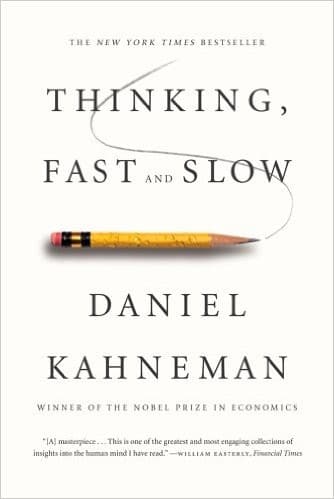
Thinking, Fast and Slow
Daniel Kahneman·2011·Farrar, Straus and Giroux·non-fiction
Reading level: Ages 16+ (adult) · 15-hour read · Intermediate difficulty.
- Reading time
- 15h
- Difficulty
- Intermediate
- Recommended age
- Ages 16+
- Guide read
- 5min
- Editor's rating
- 4.6 / 5
- kahneman
- psychology
- behavioral-economics
- decision-making
- cognitive-bias
- nobel
- non-fiction
— In one sentence —
A Nobel Prize winner's life work in one book. The two systems that govern human thought — and why we are wrong more often, and more predictably, than we believe.
§ 01 · WHY READ
Why read
Daniel Kahneman won the Nobel Prize in Economics in 2002, despite being a psychologist. He won it for the work he had done with Amos Tversky over two decades: a systematic mapping of how human judgment departs from the predictions of classical economic theory, which assumed that people make decisions rationally. Thinking, Fast and Slow (2011) is the synthesis — the book in which Kahneman, then seventy-seven, organized decades of research into a framework accessible to general readers.
The central distinction: the brain operates with two modes of processing that Kahneman calls System 1 and System 2. System 1 is fast, automatic, emotional, effortless — it is the system that reads faces, notices danger, and generates intuitive judgments. System 2 is slow, deliberate, effortful, and lazy — it is the system you use when multiplying large numbers or deciding how to allocate a budget. The problem is that System 2 is expensive to run and System 1 is persuasive. We rely on System 1 far more than we know, and System 1 makes systematic, predictable errors.
What the book does that other popular psychology books don't: Kahneman is a scientist, and he shows his work. Each claim comes with the experiments behind it. The findings are specific: the anchoring effect, the availability heuristic, the planning fallacy, loss aversion, the peak-end rule, the focusing illusion. These are not metaphors; they are documented phenomena with magnitudes and confidence intervals. The book is popular science at its most rigorous.
Kahneman later acknowledged that several replication studies found some of his research (particularly on priming and ego depletion) did not replicate. He was one of the first prominent scientists to engage seriously with the replication crisis rather than dismissing it. Readers should hold the specific findings with appropriate uncertainty while trusting the book's central framework, which rests on much more robust experimental evidence.
§ 02 · KEY CONCEPTS
Key concepts
System 1 and System 2 — the two modes of mental processing. The names are functional: they describe how the brain operates, not where in the brain it operates. Most of what you believe you are deciding deliberately is actually System 1 running under the surface and System 2 ratifying afterward.
Cognitive biases — the systematic errors that System 1 makes. They are systematic because the same mechanisms that make System 1 fast (pattern-matching, reliance on available examples, anchoring on initial information) also make it wrong in predictable ways. Kahneman's catalog of biases is not a list of random failures; each bias has a cause.
Prospect theory — developed with Tversky, the description of how people actually make decisions under uncertainty. Key finding: losses feel roughly twice as painful as equivalent gains feel pleasurable. This asymmetry explains many behaviors that classical economics calls irrational.
The experiencing self vs. the remembering self — Kahneman's late discovery: the person who lives through an experience and the person who remembers it are different. The memory of an experience is dominated by its peak and its end (the peak-end rule), not by its average quality. We make decisions based on the remembering self's preferences, which are often at odds with what would make the experiencing self happier.
§ 03 · HIGHLIGHTS
Three highlights
No. 1 · The planning fallacy. People consistently underestimate how long their projects will take and overestimate how good the results will be — even when they have direct experience of having been wrong on previous similar projects. The cure is "reference class forecasting": instead of imagining how your project will go, look at the distribution of outcomes for similar projects by other people. Kahneman's single most practical finding.
No. 2 · Loss aversion. The pain of losing $100 is psychologically more intense than the pleasure of gaining $100 — roughly twice as intense, in experimental terms. This asymmetry underlies endowment effects (we value things more once we own them), the sunk cost fallacy (we keep investing in failing projects because we've already invested), and many negotiation failures. It also explains why people take certain kinds of terrible risks to avoid losses they couldn't tolerate.
No. 3 · The experiencing self and the remembering self. In an experiment, participants held their hand in painfully cold water for sixty seconds. They were then asked to hold it in cold water again, but this time the water was warmed slightly in the final thirty seconds (still cold, but less cold). Most participants preferred the longer experience to the shorter one — because the improved ending dominated their memory. The remembering self, which makes the choices, does not care about the integral of pain over time; it cares about peak and end.
§ 04 · EDITIONS
Recommended editions
| Edition | Why pick it |
|---|---|
| Farrar, Straus and Giroux (hardcover / paperback) | The standard edition; all printings contain the same text. |
| Penguin Books (UK) | The UK edition; same text, slightly different design. |
| Audiobook (Patrick Egan) | Egan's reading is clear and well-paced; the book's structure is easy to follow in audio. |
On the replication crisis: Read Michael Lewis's The Undoing Project (2016) — a biography of Kahneman and Tversky — as a companion. And for Kahneman's own acknowledgment of which findings have not replicated, he has discussed this publicly in interviews and essays since 2012.
§ 05 · FIT
Who it's for / not for
Read this if you are…
- Anyone who makes decisions — which is everyone, and the point.
- Readers interested in behavioral economics, decision science, or cognitive psychology.
- Anyone who has found themselves doing things they don't understand in retrospect — making bad financial decisions, underestimating project timelines, giving too much weight to vivid anecdotes.
- Programmers and engineers interested in how human judgment works (and fails): this is the book the tech industry assigned itself in the 2010s, for good reasons.
Skip it if you are…
- Looking for a short book. At 400 pages it is thorough; skim the later sections on economic applications if those don't interest you.
- Satisfied with a quick summary. The value is in the experimental evidence, not the conclusions. A summary of the findings is much less useful than reading how they were established.
§ 06 · TIPS
Reading tips
- Part I (System 1 and System 2) is the foundation. Read it carefully; everything else builds on it.
- The experiments are the content. When Kahneman describes a study, read it — don't skip to the conclusion. The finding is only as interesting as the setup that produces it.
- Hold specific findings loosely. The priming research (Part II) has not replicated as cleanly as other sections. The central framework (System 1/System 2, prospect theory, the experiencing/remembering self) is on much firmer ground.
- The last section (on well-being) is worth reading twice. The experiencing vs. remembering self is the book's most personal argument and its most practically significant for life decisions.
§ 07 · COMPARE
Read alongside
- Richard Thaler and Cass Sunstein — Nudge (2008). The policy application: how institutional design can use knowledge of cognitive biases to help people make better decisions without restricting choice.
- Michael Lewis — The Undoing Project (2016). The biography of Kahneman and Tversky: how the friendship and collaboration that produced this work actually happened. An excellent companion.
- Nassim Nicholas Taleb — Antifragile (2012). Taleb's relationship with Kahneman is contentious; they agree that human judgment is unreliable under uncertainty and disagree about what to do about it. Reading both is useful.
- Philip Tetlock — Superforecasting (2015). The optimistic response to Thinking, Fast and Slow: some people, using specific techniques, are measurably better at prediction than others. A necessary complement.
§ 08 · DISCUSSION
Discussion questions
- System 1 makes fast, automatic judgments that are often right and systematically wrong in predictable ways. Can you identify three decisions you made recently where System 1 was driving and System 2 wasn't checking?
- The planning fallacy means we consistently underestimate project timelines, even when we know we've been wrong before. Why doesn't past experience correct the bias? What would actually correct it?
- Loss aversion: losses feel roughly twice as painful as equivalent gains. Identify a recent decision where loss aversion shaped your choice. Was the outcome better or worse than the alternative would have been?
- The experiencing self and the remembering self prefer different things, and we make decisions based on the remembering self's preferences. Is this irrational? Which self's preferences should guide decisions?
- Some of Kahneman's specific findings (on priming) have not replicated cleanly. How should this change how you read the book? Does it undermine the central framework?
- Kahneman argues that experts are often overconfident — that intuitive expertise in complex fields (finance, political prediction) is unreliable. In what fields do you think expert intuition is actually reliable? What makes those fields different?
- The focusing illusion: "Nothing in life is as important as you think it is, while you are thinking about it." Give an example from your own experience. What would correcting for the focusing illusion look like in practice?
One line to remember
“Nothing in life is as important as you think it is, while you are thinking about it.”— Chapter 26 — The Focusing Illusion
Appears in collections
Reading lists featuring this book
7 books
Best Book Club Books for Discussion
Seven books that generate real conversation — not just summaries.
Open list →
5 books
Books About Human Nature
Five books, five different verdicts on what people are.
Open list →
6 books
The Best Books About Risk and Uncertainty
Six books on the one problem every decision shares — that the future is unknown and you have to act anyway — from how the mind misjudges odds to how institutions, founders, and strategists operate when the answer can't be known in advance.
Open list →
8 books
Best Books for Entrepreneurs
What to read before, during, and after starting a company.
Open list →
8 books
Best Books for Managers
The reading list for people who lead other people.
Open list →
6 books
Books That Changed How I Think
Six books that installed a new mental model — specific, not vague.
Open list →
5 books
Books That Teach Strategy
Five books on how to think before you act.
Open list →
10 books
Ten Books Every Programmer Should Read That Have Nothing to Do With Code
The books that change how you think, not what you type.
Open list →
You might also like
Read next
Thomas S. Kuhn · 1962
The Structure of Scientific Revolutions
Kuhn introduced the word 'paradigm' to the general vocabulary in 1962. This is the book that made science studies possible — and the one scientists still argue about.
Read · 5 min
Clayton M. Christensen · 1997
The Innovator's Dilemma
Why good companies fail. Christensen's answer — that they fail precisely because they are well-managed — is the most uncomfortable idea in business literature.
Read · 4 min
Sun Tzu · -500
The Art of War
2,500 years old. Thirteen chapters. Applied to every domain from military strategy to product management. Most citations misquote it. Most readers haven't read it. It takes two hours.
Read · 4 min