Editor-reviewed
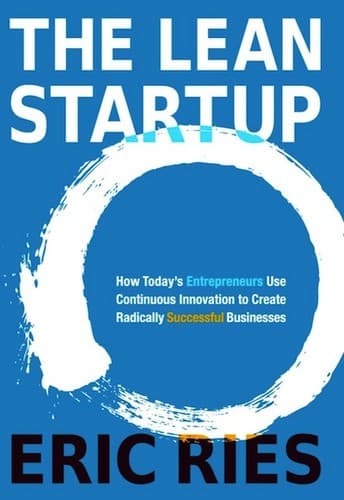
The Lean Startup
Eric Ries·2011·Crown Business·non-fiction
Reading level: Ages 16+ (adult) · 8-hour read · Beginner difficulty.
- Reading time
- 8h
- Difficulty
- Beginner
- Recommended age
- Ages 16+
- Guide read
- 4min
- Editor's rating
- 4.1 / 5
- eric-ries
- startups
- entrepreneurship
- product-management
- mvp
- business
- non-fiction
- silicon-valley
— In one sentence —
Build, Measure, Learn. The methodology that redefined how startups work in the 2010s — and the book every founder was told to read.
§ 01 · WHY READ
Why read
Eric Ries published The Lean Startup in 2011. It became the defining methodology document of Silicon Valley entrepreneurship in the 2010s, recommended in every accelerator and cited in every pitch deck. It introduced "minimum viable product" and "pivot" to the general business vocabulary, and it gave a generation of founders a framework for thinking about product development that was genuinely different from what had preceded it.
The core argument: most startup failure is preventable waste — not bad execution of a plan, but execution of the wrong plan. Startups typically make assumptions about what customers want, build products based on those assumptions, and discover at launch that the assumptions were wrong. The Lean Startup methodology proposes a different loop: build the minimum version of the product that can test the core assumption (the MVP — minimum viable product), measure whether customers behave as expected, and learn from the data. Then iterate.
The model is borrowed from lean manufacturing (specifically Toyota's production system), from Steve Blank's customer development methodology, and from the scientific method: treat assumptions as hypotheses, design tests to validate or invalidate them, change based on evidence rather than plan.
What it changed: before Lean Startup, the dominant model for software product development was the waterfall model — design the complete product, build it, launch it. The Lean Startup argument is that this approach delays learning. The faster you can test assumptions against real customer behavior, the faster you can correct course before building the wrong thing at full scale.
What it didn't fully resolve: the MVP concept has been widely misapplied — used to justify shipping low-quality products rather than as a disciplined test of specific assumptions. Ries addressed this in later work, but the misapplication has been pervasive.
§ 02 · KEY CONCEPTS
Key concepts
Build-Measure-Learn loop — the fundamental cycle: build the smallest thing that can test a core assumption, measure what happens when real customers encounter it, learn from the measurement, and decide whether to persist or pivot.
Minimum Viable Product (MVP) — a version of a product with just enough features to test a specific hypothesis with real customers. Not the smallest possible product; the smallest product that validates or invalidates the assumption that matters most.
Validated learning — learning that comes from empirical measurement rather than customer surveys or intuition. The claim is not that customers said they wanted X, but that customers did X when offered it.
Pivot — a structured course correction based on what has been learned. A pivot changes one fundamental assumption while keeping others constant. It is not the same as abandoning the idea; it is a focused change of direction based on evidence.
Innovation accounting — a set of metrics for measuring progress in conditions where traditional accounting metrics are not yet meaningful.
§ 03 · HIGHLIGHTS
Three highlights
No. 1 · The IMVU case. Ries tells the story of IMVU, his first company, where he spent months building features nobody used. His retrospective analysis — that he had treated assumptions as facts and built on top of unvalidated foundations — is the book's central origin story and its most honest self-criticism.
No. 2 · The Zappos MVP. Ries describes how Zappos began: Nick Swinmurn photographed shoes at local stores and listed them online without buying inventory. When someone ordered, he bought the shoes at retail, shipped them, and lost money on each transaction. The point was not profit; it was to test the assumption that people would buy shoes online without trying them on. They did. Validated. Then build the inventory model.
No. 3 · The pivot stories. The book's most useful chapters document real pivots: YouTube (started as a video dating site), Instagram (started as Burbn, a location-sharing app), Twitter (started as Odeo, a podcasting platform). Each pivot was a focused change of one assumption while keeping the team and some assets constant.
§ 04 · EDITIONS
Recommended editions
| Edition | Why pick it |
|---|---|
| Crown Business (hardcover / paperback) | The standard edition; all printings contain the same text. |
| Audiobook (Eric Ries reading) | Ries reads his own book; the reading is good and his voice fits the conversational prose style. |
§ 05 · FIT
Who it's for / not for
Read this if you are…
- Starting or working in a startup or early-stage product team.
- A product manager who wants the foundational framework for why MVPs exist.
- Anyone interested in how Silicon Valley entrepreneurship culture was codified in the 2010s.
Skip it if you are…
- Working in a context where the methodology is already assumed: if everyone around you already uses this vocabulary, the book may be more foundational history than useful instruction.
- Looking for the nuanced version. The Lean Startup is deliberately simple and occasionally reductive. For more sophisticated treatment of product development under uncertainty, read Steve Blank's The Four Steps to the Epiphany or Marty Cagan's Inspired.
§ 06 · TIPS
Reading tips
- The MVP concept is the key. Read carefully how Ries defines it, not just the popular definition. An MVP is a test of a specific assumption, not "the smallest product we can ship."
- The pivot concept is overused. Ries's pivots are structured, specific changes to one assumption. The word has been diluted to mean any change of direction. Know the original meaning.
- The case studies are the value. The conceptual framework is simple; the interest is in how specific companies applied it and what they learned.
§ 07 · COMPARE
Read alongside
- Steve Blank — The Four Steps to the Epiphany (2005). Blank's customer development methodology is the source of much of what Ries developed. More rigorous and more demanding than The Lean Startup.
- Clayton Christensen — The Innovator's Dilemma (1997). The companion framework: Christensen explains why large companies fail to innovate; Ries offers a methodology for how small companies can avoid the same failure modes.
- Marty Cagan — Inspired (2008). For product managers: more specific guidance on how to build products in the Lean tradition, with more nuance about what MVP really means.
§ 08 · DISCUSSION
Discussion questions
- The MVP concept has been widely misapplied — used to justify shipping low-quality products. What is the correct definition? How can you tell the difference between a proper MVP and a shortcut rationalized as an MVP?
- "Pivot" has been diluted to mean any change. What does Ries specifically mean? Give an example of a real pivot vs. an undirected change of direction.
- The Build-Measure-Learn loop assumes you can design experiments that actually tell you something. What are the failure modes? When does measurement mislead?
- Ries argues that most startup failure is preventable waste. Is this convincing? What kinds of startup failure does the methodology not prevent?
- The methodology was developed in a Silicon Valley software context. Does it apply equally to hardware, biotech, or non-tech businesses? Where does it break down?
- "The only way to win is to learn faster than anyone else." Is this true? What is the alternative claim?
One line to remember
“The only way to win is to learn faster than anyone else.”— Chapter 3
Appears in collections
Reading lists featuring this book
5 books
Best Books About Capitalism
Five books — two novels and three business books — that take capitalism seriously enough to argue with it from inside and outside.
Open list →
6 books
The Best Books About Innovation
Six books about how new things actually come into being — the patterns of invention, the mechanics of disruption, and the people who see what others miss.
Open list →
6 books
The Best Books About Risk and Uncertainty
Six books on the one problem every decision shares — that the future is unknown and you have to act anyway — from how the mind misjudges odds to how institutions, founders, and strategists operate when the answer can't be known in advance.
Open list →
6 books
Books for Engineers
Six books engineers actually read — none of them about engineering.
Open list →
8 books
Best Books for Entrepreneurs
What to read before, during, and after starting a company.
Open list →
10 books
Ten Books Every Programmer Should Read That Have Nothing to Do With Code
The books that change how you think, not what you type.
Open list →
You might also like
Read next
Thomas S. Kuhn · 1962
The Structure of Scientific Revolutions
Kuhn introduced the word 'paradigm' to the general vocabulary in 1962. This is the book that made science studies possible — and the one scientists still argue about.
Read · 5 min
Daniel Kahneman · 2011
Thinking, Fast and Slow
A Nobel Prize winner's life work in one book. The two systems that govern human thought — and why we are wrong more often, and more predictably, than we believe.
Read · 5 min
Clayton M. Christensen · 1997
The Innovator's Dilemma
Why good companies fail. Christensen's answer — that they fail precisely because they are well-managed — is the most uncomfortable idea in business literature.
Read · 4 min