Book list · Editor's pick·nonfiction
Best Books About Capitalism
Five books — two novels and three business books — that take capitalism seriously enough to argue with it from inside and outside.
- Books
- 5
- capitalism
- business
- economics
- literary-fiction
- political-fiction
bibliotecas editorial
Updated 2026-05-24
— Why read this list —
The honest way to read about capitalism is to read both the novels that show what the system does to people and the operating manuals written by people who run companies inside it. The disagreement between them is where the actual subject lives.
A note on the mix
This is a hybrid list and the mix is deliberate. Three of the books are business or economics nonfiction written by people who have worked inside the system and have a stake in some version of it continuing. Two are novels written by people who watched the system at close range and were not flattered by what they saw. The argument the list is making is that you cannot understand capitalism by reading only one side of that line.
Read only the novels and you get a critique that is morally clarifying but operationally vague — you finish Gatsby with a sharper sense of what wealth does to character and no clearer sense of how a firm actually runs. Read only the business books and you get a set of internal manuals that are operationally precise but rarely step back to ask what the entire enterprise is for. The interesting reading happens where the two kinds of book disagree. Christensen and Ries are writing for participants. Fitzgerald and Orwell are writing for witnesses. Taleb is trying to do both at once, with mixed results, and his attempt is what makes him the right book to end on.
How to use this list
The five books are short enough together to read in a month of evenings. Take them in order: Gatsby first because it is the most concentrated, Animal Farm second because it widens the political frame, Christensen and Ries in the middle because the operating perspective is most useful after you have the literary one, Taleb last because his argumentative style is easier to handle once you have the prior four to push back with.
What none of these books does, and what no list this short could do, is settle the question of what to think about capitalism as a whole system. That is the point. The five books here will give you the components of a more honest argument than the one most people walk around with — an argument that takes the system's productive capacity seriously, takes its human costs seriously, and refuses the lazy version where one of those things is allowed to disappear behind the other.
The 5 books
In publication order

Book 1·The American myth, observed
The Great Gatsby
F. Scott Fitzgerald·1925
Start with the novel that contains the most concise diagnosis in American literature of what money does to the people who acquire it and the people who inherit it. Fitzgerald's argument is not that wealth corrupts — that is too easy. His argument is that the system produces Gatsbys, who believe the lie of self-invention, and Buchanans, who do not have to. The two-class structure is the whole novel, and the green light at the end of the dock is the closest American fiction has come to a one-image summary of the promise the system runs on.

Book 2·Power converges, regardless of system
Animal Farm
George Orwell·1945
Orwell's allegory is usually read as a critique of Soviet communism, which it is. It is also a more general argument about how power consolidates once a revolutionary project becomes an administrative one — an argument that applies to any system, including the capitalist one the pigs end up indistinguishable from. The final scene of the pigs and the humans drinking together is the most efficient image in twentieth-century fiction of how rival economic systems can converge on the same elite. Place it second because it widens the frame.

Book 3·The internal logic of firms
The Innovator's Dilemma
Clayton M. Christensen·1997
The first of the operating manuals. Christensen's book is the most influential serious analysis of why successful capitalist firms predictably fail to adapt — they are not stupid, they are doing exactly what their customers and shareholders ask them to do, and that is the reason. Read it because it is the cleanest available demonstration that the system has internal logics that produce predictable outcomes, and that those outcomes are not always the ones the people inside the system want. It is also the rare business book that has held up.
Book 4·The contemporary playbook
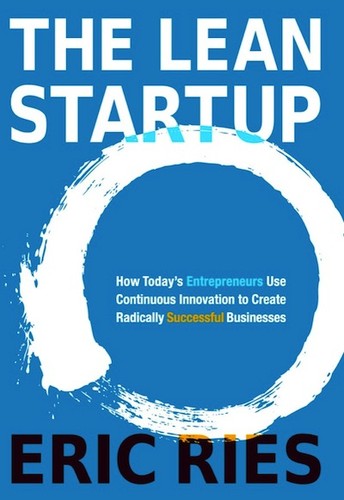
The Lean Startup
Eric Ries·2011
Ries is the operating manual for the contemporary venture-backed economy. The book itself is methodological — build, measure, learn — but its real value on this list is as a document of how a generation of founders were taught to think about capital, customers, and the velocity of decisions. Read it alongside Christensen and Fitzgerald and the argument the three of them make together is more honest than any of them makes alone: the system runs on stories that participants have to believe in order for the stories to work.

Book 5·The framework for arguing
Antifragile
Nassim Nicholas Taleb·2012
Close the list with the most argumentative book in the group. Taleb's central claim — that some systems gain from disorder while others are merely fragile and merely robust — cuts across the previous four books in a useful way. He is sympathetic to small-scale capitalism, hostile to too-big-to-fail capitalism, and contemptuous of the academic apparatus that defends the second by pretending it is the first. The book is uneven and overlong and the prose can be self-satisfied, but the framework it builds is one of the most useful tools available for thinking about which parts of the system we have are worth defending.