Editor-reviewed
The Great Gatsby
F. Scott Fitzgerald·1925·Scribner·Literature
Reading level: Ages 14+ (YA) · 5-hour read · Intermediate difficulty.
- Reading time
- 5h
- Difficulty
- Intermediate
- Recommended age
- Ages 14+ (YA)
- Guide read
- 5min
- Editor's rating
- 4.6 / 5
- american-literature
- 1920s
- class
- illusion
- unreliable-narrator
- jazz-age
- school-staple
— In one sentence —
The novel everyone reads in high school and almost no one reads correctly — because it's not a love story.
§ 01 · WHY READ
Why read
F. Scott Fitzgerald wrote The Great Gatsby in four months in 1924, in a rented villa on the French Riviera, while working on a third novel he never finished. He was 28. He thought it was his best work. The critical response was mixed, the sales were modest (less than 25,000 copies before his death in 1940), and it was only the Second World War — the armed forces wanted cheap paperbacks for soldiers — that revived it and began the process of installing it as the central American novel of the twentieth century.
The installation has created a problem. The Great Gatsby is so thoroughly overread in school — symbol-hunted, theme-extracted, final-paragraph annotated — that most people who have "read" it have not read it. They've completed an assignment about a book they weren't asked to inhabit.
What you find when you actually inhabit it: Fitzgerald is not writing a love story. He is writing an anatomy of how Americans understand success — the belief that the future can redeem the past, that money can launder origin, that the green light across the bay is always reachable if you want it badly enough. Gatsby's love for Daisy is a vehicle for this argument, not its content. The love story is what Gatsby tells himself; Fitzgerald is watching him tell it.
The prose is the other thing. Fitzgerald at 28 had a sentence-level precision that few writers in English have managed at any age. The famous final paragraph — six sentences that contain the entire novel — is the proof: reread it after finishing and count how many of the book's meanings are folded into it.
§ 02 · CHARACTERS
Characters
The cast is deliberately small — seven principal characters who each embody a position in the novel's argument about class and desire in America.
Nick Carraway — the narrator who is not neutral Nick is the most important decision in the novel and the one most often misread. He presents himself as honest and reserved, an observer from the Midwest watching the East's corruption. He is not honest. He is deeply implicated: he facilitates Gatsby's affair, enables Tom's, and withholds judgment in ways that are not honesty but complicity. The novel's reliability problem — what to trust in a narrator who keeps telling you he's trustworthy — is its richest formal element.
Jay Gatsby — the invention Born James Gatz, reinvented as Jay Gatsby, owner of a Long Island mansion purchased with money whose origins he evades. His whole existence is a performance, and the performance's object is to return to a past he cannot reach. He is the most sympathetic character in the book and the most deluded: he has built everything on a misunderstanding of what Daisy is.
Daisy Buchanan — the not-quite-real Daisy is what Gatsby imagines and not what she is. She is careless, not light; her charm is genuine but her commitments are not. The famous voice "full of money" line is Nick's formulation — Gatsby would never say it, which is why Nick saying it is the novel's most truthful moment.
Tom Buchanan — the thing money actually buys: impunity. Racist, violent, unfaithful, and protected from all consequences by old money and physical size.
Jordan Baker — the novel's third dishonest character, whose dishonesty is presented as a kind of honesty: she cheats at golf because she refuses to play by rules that don't serve her. Nick is attracted to this. Draw your own conclusions.
Myrtle and George Wilson — Tom's mistress and her husband, who live in the Valley of Ashes between the parties and the city. Their story is the novel's account of what actually happens to people outside the green-light dreamers.
§ 03 · HIGHLIGHTS
Three highlights
No. 1 · The eyes of Doctor T. J. Eckleburg. On the road between West Egg and New York, a billboard shows a pair of enormous eyes behind spectacles. The sign is for an oculist whose business has closed; the eyes watch the Valley of Ashes below. Fitzgerald presents them without comment. Critics have extracted God, moral judgment, the death of the American Dream, and commercial culture from them. All of these readings are available; the image is strong enough to hold them all. Don't over-explain it to yourself — let it accumulate.
No. 2 · The shirts. Gatsby shows Daisy his wardrobe — an absurd collection of imported shirts — and she starts crying. "They're such beautiful shirts," she says. Critics have exhausted the symbolism; what matters in the room is simpler: a man who has built everything on the belief that having enough beautiful things will recover the past shows his things to the person he built them for, and she weeps. Whether she's weeping for the shirts, for Gatsby, for herself, or for the impossibility of the whole situation is deliberately unresolvable.
No. 3 · The final paragraph. "So we beat on, boats against the current, borne back ceaselessly into the past." Six sentences. Every theme in the novel compressed into one image. The novel is not about Gatsby specifically — the "we" in the final paragraph opens the argument to everyone, including the reader. The past is not recoverable. The current is indifferent. The beating on, regardless: that is the American condition Fitzgerald is describing, and it doesn't end in the 1920s.
§ 04 · EDITIONS
Recommended editions
| Edition | Why pick it |
|---|---|
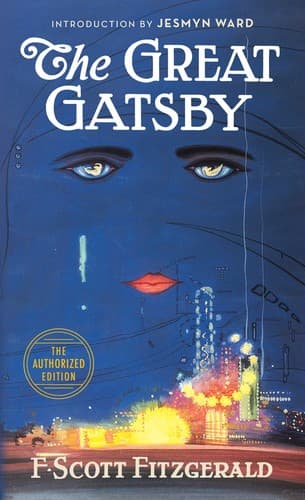
| Scribner paperback (standard edition) | The edition in print since 1953; contains Fitzgerald's original cover by Francis Cugat (a disembodied face over the lights). |
| Scribner Illustrated edition (2013) | New illustrations by Leslea Tash; handsome gift edition. |
| Cambridge University Press scholarly edition | For serious readers; includes textual variants, manuscript notes, Fitzgerald's letters about the book. |
| Audiobook (Tim Robbins, 2006) | Robbins captures Nick's unreliability better than most readers — the voice is warm and slightly off-center in exactly the right way. |
The 1974 film (Jack Clayton, Robert Redford, Mia Farrow) is beautiful and faithful and removes most of the novel's irony. The 2013 film (Baz Luhrmann) is spectacular and removes most of the novel's subtlety. Neither is the book. Read the book.
§ 05 · FIT
Who it's for / not for
Read this if you are…
- A reader who encountered it in school and wants to know what it's actually doing.
- Anyone thinking about the relationship between money, origin, and identity in America — the novel's argument is permanent, not period.
- A writer: the sentence-level craft is worth studying in isolation from the plot.
- Anyone who knows the phrase "so we beat on, boats against the current" and wants to know what it means in context.
Skip it if you are…
- Looking for a plot-driven novel. Almost nothing happens, slowly, in five chapters.
- Reading it for the romance. There is no romance — there is a man's projection of a romance, and the woman it's projected onto is not quite who he imagines.
§ 06 · TIPS
Reading tips
- Reread the first chapter. Fitzgerald puts everything in it: the social geography, the narrator's self-presentation, the first hints that Nick is not as objective as he claims. Most readers rush through it on a first read.
- Pay attention to Tom. He is easier to dismiss than he is to understand. The novel does not dismiss him: he wins. That's the point.
- Track the heat. The novel's action occurs in summer; the heat is not atmosphere but argument. The party scene in which Gatsby and Tom confront each other happens in a stifling New York hotel room in July. The temperature is a character.
- Read the final paragraph three times: once at the end, once with the whole novel in mind, once with yourself in mind.
§ 07 · COMPARE
Read alongside
- Sinclair Lewis — Babbitt (1922). The other great 1920s American novel about self-invention and its costs; where Fitzgerald is elegiac, Lewis is satirical.
- Theodore Dreiser — The Great American Novel (1925) / An American Tragedy (1925). The Clyde Griffiths story: a man who also tries to will himself into a higher class and is destroyed by the attempt.
- Edith Wharton — The Age of Innocence (1920). The Gilded Age version of the same argument: money as social armor, and what it costs to wear it.
- Don DeLillo — Americana (1971). The 1970s heir: another protagonist constructing himself through objects and image, another ironic narrator watching the construction.
- Tom Wolfe — The Bonfire of the Vanities (1987). The 1980s Wall Street version of Gatsby: money's ability to provide immunity until suddenly it doesn't.
§ 08 · DISCUSSION
Discussion questions
- Nick tells us early that he is "one of the few honest people" he has ever known. Does the novel support this claim? What evidence cuts against it?
- Daisy is frequently called an unsympathetic character. Is she? What would a fully sympathetic reading of Daisy look like?
- Gatsby throws parties but is never seen enjoying them. What are the parties actually for?
- The Valley of Ashes sits between the parties and the city. What does it represent? Who lives there and what happens to them?
- Tom is racist, violent, and unfaithful, yet he retains wealth, position, and Daisy by the novel's end. What is Fitzgerald saying about the relationship between character and consequence in America?
- The novel is set in 1922. Re-read the final paragraph: "So we beat on, boats against the current, borne back ceaselessly into the past." Is this a specifically 1920s American condition, or something more permanent?
- Fitzgerald chose Nick as narrator rather than using third-person omniscient. What does the choice cost the reader? What does it give?
- The green light at the end of Daisy's dock is the novel's most famous symbol. By the end, do you think Gatsby ever really wanted Daisy, or only the light?
One line to remember
“So we beat on, boats against the current, borne back ceaselessly into the past.”— Nick Carraway — final paragraph
Appears in collections
Reading lists featuring this book
7 books
Best Book Club Books for Discussion
Seven books that generate real conversation — not just summaries.
Open list →
7 books
The Best Book Gifts for Graduation
Seven novels for a reader leaving one chapter and starting another.
Open list →
8 books
The Best Books for Teens
What high schoolers actually want to read — not what they're assigned.
Open list →
5 books
Best Books About Capitalism
Five books — two novels and three business books — that take capitalism seriously enough to argue with it from inside and outside.
Open list →
6 books
Books to Read After a Breakup
Six books that sit with you in the loss — and quietly help you rebuild.
Open list →
7 books
Books to Read in Your 20s
Seven novels for the decade when you're figuring out who you're going to be.
Open list →
5 books
Classics That Are Actually Readable
Five books that carry their age well.
Open list →
10 books
Short and Devastating: Ten Classics You Can Read in a Weekend
The most efficient literature ever written. None longer than 200 pages. All of them permanent.
Open list →
You might also like
Read next
F. Scott Fitzgerald · 1934
Tender Is the Night
Fitzgerald's best novel. Not Gatsby. This one — the one about what money and beauty and time actually cost.
Read · 7 min
William Faulkner · 1936
Absalom, Absalom!
Four narrators reconstruct a man who destroyed his family. The story keeps changing. That is the point.
Read · 7 min
Toni Morrison · 1987
Beloved
Toni Morrison said she wrote this novel to give voice to the sixty million. It won the Pulitzer, the Nobel, and is the greatest American novel of the second half of the twentieth century.
Read · 6 min