Editor-reviewed
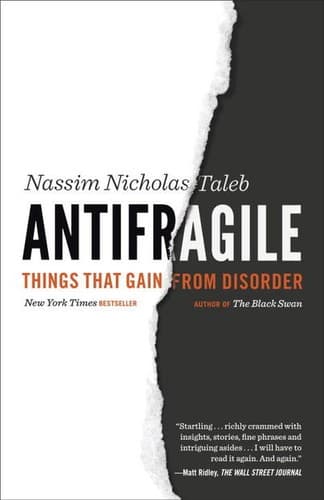
Antifragile
Nassim Nicholas Taleb·2012·Random House·non-fiction
Reading level: Ages 16+ (adult) · 16-hour read · Intermediate difficulty.
- Reading time
- 16h
- Difficulty
- Intermediate
- Recommended age
- Ages 16+
- Guide read
- 5min
- Editor's rating
- 4.3 / 5
- nassim-taleb
- risk
- uncertainty
- philosophy
- black-swan
- economics
- non-fiction
- incerto
— In one sentence —
Taleb's most ambitious book. The central idea — that some things benefit from disorder and stress — is genuinely new. The delivery is combative, digressive, and worth it.
§ 01 · WHY READ
Why read
Nassim Nicholas Taleb published Antifragile in 2012 as the third volume in his Incerto series (preceded by Fooled by Randomness in 2001 and The Black Swan in 2007). He has since added Skin in the Game (2018) and a fifth volume. The series is a sustained philosophical argument about uncertainty, risk, and how institutions and people should organize themselves in conditions of uncertainty — which is all conditions.
The central idea: there are three responses to stress and disorder. Fragile things break under stress. Robust things resist stress and remain the same. But Taleb noticed that the vocabulary of his field had no word for things that benefit from stress — that get stronger, better, or more capable as a result of randomness and disorder. He coined the word "antifragile" for this category.
Examples: the human immune system is antifragile (it gets stronger with appropriate challenge). Muscles are antifragile (they grow under stress and atrophy without it). Small businesses are often antifragile; large bureaucracies are fragile. Innovation in a field is antifragile — crises produce breakthroughs. Restaurants as a category are antifragile even though individual restaurants are fragile: the failures clear the space for what works.
The policy implication: systems should be designed to be antifragile rather than robust. Attempts to eliminate all risk and volatility from a system (a government that prevents any business from failing, a central bank that smooths all economic cycles) do not make the system safer; they suppress the feedback mechanisms that allow the system to learn and adapt, and the result is a bigger, more catastrophic failure later.
What this is not: a self-help book about resilience. Antifragile is not the same as resilient. Resilient things bounce back to where they were; antifragile things come back stronger. Taleb is careful about this distinction and irritated when his work is reduced to "be resilient."
§ 02 · KEY CONCEPTS
Key concepts
The Triad: fragile / robust / antifragile — Taleb's foundational taxonomy. The triad allows you to categorize anything — a person, an organization, an argument, a portfolio — according to how it responds to uncertainty and stress.
Via Negativa — the principle of improvement through subtraction rather than addition. Often the best thing to do to make something more antifragile is to remove things that create fragility rather than add things that create robustness. In medicine: stop doing harmful things before adding interventions. In diet: remove industrial food before adding supplements.
Skin in the Game — the principle that decision-makers should bear the consequences of their decisions. Fragilizes systems when those who make decisions are protected from their consequences (bankers whose banks are bailed out, academics whose theories are tested by others). The opposite creates antifragility.
Barbell strategy — a risk management approach: put assets in two extremes (very safe and very risky) and avoid the middle. The middle gives the illusion of moderate risk while actually being fragile to tail events.
§ 03 · HIGHLIGHTS
Three highlights
No. 1 · The restaurant example. Restaurants as a category are antifragile: the individual restaurant is fragile (most fail), but the failures allow the category to evolve — bad restaurants close, good ones survive, new concepts develop. Attempts to prevent restaurants from failing (regulatory protection, guaranteed customer bases) would make the category fragile. This is Taleb's argument about competition and creative destruction applied at the category level.
No. 2 · Seneca and the Stoics. Taleb's ethical touchstone throughout the series is Stoic philosophy, particularly Seneca's letters. The Stoics' practice of negative visualization — imagining the worst case so you're not destroyed by it when it arrives — is a form of antifragility. Taleb is not a Stoic in the simple sense; he uses Stoicism as an example of practical wisdom about uncertainty that preceded modern risk management and outperforms it.
No. 3 · Iatrogenics. Iatrogenics is the harm caused by healers — treatment that makes the patient worse. Taleb extends this concept from medicine to government policy, economics, and personal life: interventions that appear helpful but create hidden fragility. The clearest contemporary example: suppressing small forest fires leads to larger, more catastrophic fires. The intervention created the problem it was solving.
§ 04 · EDITIONS
Recommended editions
| Edition | Why pick it |
|---|---|
| Random House (hardcover / paperback) | The standard edition. |
| Incerto collection (all five volumes) | For readers who want the full series. Read in order: Fooled by Randomness, The Black Swan, Antifragile, Skin in the Game. |
| Audiobook (Joe Ochman) | Ochman's reading is clear; at 16 hours, the audio is a reasonable format for this book. |
§ 05 · FIT
Who it's for / not for
Read this if you are…
- Anyone interested in how to think about risk and uncertainty — not how to eliminate it but how to position yourself to benefit from it.
- Readers interested in philosophy applied to practical decisions: Taleb's use of Stoic philosophy and Seneca is genuine, not decorative.
- Anyone in fields where uncertainty is inherent: finance, startups, public health, military strategy.
Skip it if you are…
- Intolerant of Taleb's prose style, which is combative, digressive, frequently contemptuous of people he calls "fragilistas," and occasionally self-aggrandizing. These qualities are separable from the central ideas but inseparable from the reading experience.
- Looking for a short version. Antifragile is 500+ pages; there is no significantly shorter version that preserves the argument.
§ 06 · TIPS
Reading tips
- The central idea is in the Prologue and Part I. The rest of the book is applications and elaborations. Read the beginning carefully; the applications can be read more quickly.
- "Antifragile" is not "resilient." Taleb is insistent about this; the distinction matters. Resilient returns to baseline; antifragile improves under stress.
- Skin in the Game matters for Antifragile. The principle that decision-makers should bear the consequences of their decisions is presented as an ethical claim; it is also an antifragility mechanism.
- Via Negativa is the practical takeaway. Subtraction — removing things that cause fragility — is often more effective than addition. This is counterintuitive and worth holding.
§ 07 · COMPARE
Read alongside
- Nassim Nicholas Taleb — The Black Swan (2007). The predecessor: the argument that rare, high-impact events are systematically underestimated and cannot be predicted. Read before Antifragile.
- Daniel Kahneman — Thinking, Fast and Slow (2011). Taleb and Kahneman disagree about several things but their work is complementary: Kahneman on cognitive biases in decision-making, Taleb on how to position for uncertainty.
- Seneca — Letters from a Stoic (c. 65 CE). Taleb's ethical touchstone. Reading Seneca alongside Antifragile clarifies what Taleb is drawing from and what he's adding.
§ 08 · DISCUSSION
Discussion questions
- The restaurant example: individual restaurants are fragile, but the restaurant category is antifragile. How does this translate to other domains? Can you identify categories that are antifragile even though individual members are fragile?
- Taleb distinguishes antifragile from resilient: resilient returns to baseline, antifragile improves under stress. Is this a meaningful distinction? Give an example where it matters.
- Iatrogenics — harm caused by interventions — is one of Taleb's central concerns. Can you identify a policy or practice that appears helpful but creates hidden fragility?
- The barbell strategy: concentrate in very safe and very risky positions, avoid the middle. Is this a general principle or specific to certain domains?
- "Skin in the Game" — decision-makers should bear consequences. What systems currently lack this property? What would change if they had it?
- Taleb's prose style is combative and contemptuous of people he disagrees with. Does this affect your assessment of the ideas? Is there a version of the argument that would be more persuasive without the style?
One line to remember
“Wind extinguishes a candle and energizes fire. Likewise with randomness, uncertainty, chaos: you want to use them, not hide from them. You want to be the fire and wish for the wind.”— Prologue
Appears in collections
Reading lists featuring this book
7 books
The Best Book Gifts for Father's Day
Seven books that take fathers, fatherhood, and decision-making seriously.
Open list →
5 books
Best Books About Capitalism
Five books — two novels and three business books — that take capitalism seriously enough to argue with it from inside and outside.
Open list →
6 books
The Best Books About Innovation
Six books about how new things actually come into being — the patterns of invention, the mechanics of disruption, and the people who see what others miss.
Open list →
6 books
The Best Books About Risk and Uncertainty
Six books on the one problem every decision shares — that the future is unknown and you have to act anyway — from how the mind misjudges odds to how institutions, founders, and strategists operate when the answer can't be known in advance.
Open list →
6 books
Books for Engineers
Six books engineers actually read — none of them about engineering.
Open list →
8 books
Best Books for Entrepreneurs
What to read before, during, and after starting a company.
Open list →
8 books
Best Books for Managers
The reading list for people who lead other people.
Open list →
6 books
Books That Changed How I Think
Six books that installed a new mental model — specific, not vague.
Open list →
5 books
Books That Teach Strategy
Five books on how to think before you act.
Open list →
10 books
Ten Books Every Programmer Should Read That Have Nothing to Do With Code
The books that change how you think, not what you type.
Open list →
You might also like
Read next
Thomas S. Kuhn · 1962
The Structure of Scientific Revolutions
Kuhn introduced the word 'paradigm' to the general vocabulary in 1962. This is the book that made science studies possible — and the one scientists still argue about.
Read · 5 min
Daniel Kahneman · 2011
Thinking, Fast and Slow
A Nobel Prize winner's life work in one book. The two systems that govern human thought — and why we are wrong more often, and more predictably, than we believe.
Read · 5 min
Clayton M. Christensen · 1997
The Innovator's Dilemma
Why good companies fail. Christensen's answer — that they fail precisely because they are well-managed — is the most uncomfortable idea in business literature.
Read · 4 min