Editor-reviewed
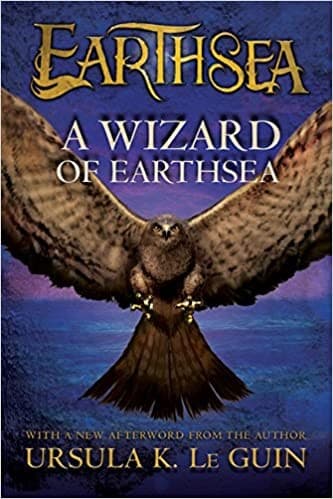
A Wizard of Earthsea
Ursula K. Le Guin·1968·Parnassus Press·Sci-Fi & Fantasy
Reading level: Ages 10–12 (middle grade) · 5-hour read · Beginner difficulty.
- Reading time
- 5h
- Difficulty
- Beginner
- Recommended age
- Ages 10–12
- Guide read
- 4min
- Editor's rating
- 4.7 / 5
- ursula-le-guin
- earthsea
- fantasy
- childrens-fiction
- coming-of-age
- magic
- shadow
- series
— In one sentence —
Le Guin wrote this for a publisher who wanted a fantasy for young readers. She gave them a world with a skin darker than any fantasy hero before it, a magic built on language, and a shadow that is the self.
§ 01 · WHY READ
Why read
Ursula K. Le Guin was asked in 1967 by the editor Herman Schein at Parnassus Press to write a fantasy novel for young adults. She accepted, with one condition she did not name explicitly: she would write the world she wanted to write. The result was A Wizard of Earthsea (1968), the first book in the Earthsea Cycle.
Le Guin made two decisions that were unusual for fantasy in 1968 and remain significant. First, Ged — the protagonist, the greatest wizard who would ever live in Earthsea — is Brown-skinned. Most of the people of Earthsea are Brown or Black; the white-skinned people come from the cold north and are called Kargs. Le Guin had grown up in Berkeley, the daughter of the anthropologist Alfred Kroeber and the writer Theodora Kroeber (author of Ishi in Two Worlds); she understood that the default whiteness of fantasy heroes was a choice, not a fact, and she made a different choice. She was frustrated for decades that illustrators and publishers kept lightening Ged's skin.
Second, the magic system of Earthsea is built on language: every thing has a true name in the Old Speech, and knowing the true name of a thing gives power over it. Magic in Earthsea is not a technology; it is a form of knowledge. The wizard who learns the true name of the wind can command it. The limit is that using power changes the world, and every act of magic has consequences — the balance of the world, called the Equilibrium, must be maintained.
The novel: Ged is a boy with extraordinary innate power, born on the island of Gont. His pride leads him to make a terrible mistake at the school of wizardry on Roke: he tears open the boundary between the living and the dead, releases a shadow creature, and spends the rest of the novel pursued by it. The shadow cannot be fought or fled; it must be confronted and named.
§ 02 · CHARACTERS
Characters
Ged (Sparrowhawk) — the protagonist; born poor on Gont, trained by a mage, sent to Roke where his gift and his pride collide. He is not a hero by disposition — he is impatient, arrogant, wounded by his own mistakes — and Le Guin is honest about his flaws in a way that makes his eventual maturation feel earned rather than announced. The name Ged is his true name; Sparrowhawk is the use-name by which the world knows him.
Ogion — the mage of Gont who first takes Ged as an apprentice. He teaches by silence and patience, which Ged finds intolerable. His lesson — that doing nothing is sometimes the right thing to do, that a mage's first obligation is to the Equilibrium — is the thesis Ged must live out before he understands it.
Vetch — Ged's best friend at Roke, the one character whose loyalty to Ged is unconditional. He is steadier, warmer, and less gifted than Ged; his function is partly to provide a counterpoint and partly to show what Ged might have been without the pride.
The shadow — the creature Ged releases when he tears open the boundary between worlds. It takes his form; it can take the forms of people he loves; it cannot be fought because fighting it gives it strength. Le Guin's shadow is the most precisely imagined version of the Jungian concept in children's literature: the repressed self, the unacknowledged darkness, the part of a person they have refused to face.
§ 03 · HIGHLIGHTS
Three highlights
No. 1 · The school at Roke. The chapters at the school of wizardry are the novel's world-building core: the Old Speech, the true names, the rules of the Equilibrium. Le Guin builds the magic system from first principles rather than convention, and the result feels inevitable — as if this is how magic must work. The school also establishes Ged's pride and the competition with Jasper that leads to the catastrophic summoning. The disaster is prepared carefully; when it comes, it is entirely Ged's doing, and he knows it.
No. 2 · Ged pursues the shadow. Having fled the shadow across the sea for most of the novel, Ged makes the critical decision to turn and pursue it instead. This is the novel's central moral and formal movement: the hunter becomes the hunted and then becomes the hunter again, which is also the movement of how a person relates to the parts of themselves they have refused to face. Le Guin renders this reversal without abstraction — it is a decision Ged makes, in a specific boat, on a specific sea — but the meaning is structural.
No. 3 · The naming. The confrontation with the shadow is one of the most formally economical climaxes in fantasy fiction. What Ged must say — what he does say — is a single word. Le Guin's choice here is aesthetically precise and philosophically complete: the integration of the shadow self is not a battle won, it is an acknowledgment made. The shadow is named with Ged's own name. They are the same thing. The scene is three paragraphs; it does what 300 pages have been preparing.
§ 04 · EDITIONS
Recommended editions
| Edition | Why pick it |
|---|---|
| HMH Books (current standard) | The standard US edition; includes the revised text Le Guin approved. |
| Puffin Modern Classics | The UK edition; clean text and well-produced. |
| The Earthsea Cycle (omnibus) | Includes all six Earthsea books; Le Guin continued the cycle for decades, and the later books — particularly Tehanu (1990) — revisit and revise the earlier ones in important ways. |
| Audiobook (Rob Inglis) | Inglis reads the full Earthsea cycle; his voice is exactly right for the mythic register Le Guin writes in. |
The Tombs of Atuan (1971) and The Farthest Shore (1972) complete the original trilogy and are each very different from A Wizard of Earthsea in setting and theme. Tehanu (1990) returned to Earthsea twenty years later with a feminist revision of the earlier books' assumptions. Read the series in publication order.
§ 05 · FIT
Who it's for / not for
Read this if you are…
- A reader who wants to introduce a child (or themselves) to serious fantasy: the novel is short, accessible, and does not condescend.
- Anyone interested in how a magic system can be built from a coherent philosophical premise rather than from convention.
- Readers who have read Tolkien and want to see what another great fantasy-builder did with a shorter, more compressed form.
- Anyone interested in Jungian psychology rendered as narrative without being labeled as such.
Skip it if you are…
- Expecting the plot density of epic fantasy. A Wizard of Earthsea is episodic and mythic; it does not have subplots, a large cast, or extensive world-building exposition. It is spare by design.
§ 06 · TIPS
Reading tips
- Read the epigraph. "Only in silence the word, only in dark the light, only in dying life." The entire novel is this epigraph extended. Re-read it after you finish.
- The magic's rules are the thesis. When Ogion teaches that every act of power disturbs the Equilibrium, he is stating Le Guin's political philosophy in miniature. Track how this plays out.
- Ged's pride is not a character flaw to be corrected. It is the engine of everything. Le Guin does not punish him for having power; she traces what happens when power is not accompanied by wisdom.
- The shadow is Ged. Le Guin is not ambiguous about this. The shadow takes his form; it can only be named with his name. Sit with what this means before the climax arrives.
§ 07 · COMPARE
Read alongside
- Ursula K. Le Guin — The Dispossessed (1974). Le Guin's other great work, in a very different register: political, theoretical, structured around two worlds in dialogue. Reading both shows the full range of her imagination.
- C. S. Lewis — The Lion, the Witch and the Wardrobe (1950). The comparison is instructive: both are secondary-world fantasies for children; Lewis's world is allegorically Christian; Le Guin's world is built on Taoist and Jungian premises. The worldviews are very different.
- Philip Pullman — The Golden Compass (1995). Another children's fantasy that takes its young readers seriously; a different theology, a different politics, the same refusal to condescend.
- J. R. R. Tolkien — The Hobbit (1937). The companion in scale and accessibility; both novels are shorter than their authors' other works, both are first-person encounters with a larger world. The comparison between Tolkien's magic (mysterious and powerful) and Le Guin's magic (built on language and equilibrium) is useful.
- Carl Jung — The Archetypes and the Collective Unconscious (1959). For readers who want to understand the theoretical framework under Earthsea: Jung's concept of the shadow is the direct source of the novel's central image. You don't need to read Jung to read Le Guin, but the reading is richer if you have.
§ 08 · DISCUSSION
Discussion questions
- Ged is brown-skinned; most people in Earthsea are brown or black. Le Guin made this choice deliberately in 1968. What does it do for the novel? What does it say about who fantasy heroes had been before?
- The magic of Earthsea is built on true names: knowing the true name of a thing gives power over it, but power disturbs the Equilibrium. What kind of responsibility does this magic impose on the wizard?
- Ged's error at Roke comes from pride — from wanting to prove his power to Jasper. Le Guin doesn't present pride as a simple moral failing. By the end of the novel, how do you understand what went wrong?
- The shadow takes Ged's form. When Ged turns to pursue it rather than flee it, the dynamic of the novel changes fundamentally. What does this reversal represent?
- The climax is three paragraphs. Ged names the shadow with his own name. What does this mean? What would be lost if Le Guin had written a battle instead?
- Ogion teaches Ged by silence and doing nothing. Ged finds this intolerable and leaves. By the end of the novel, what has he learned that Ogion was trying to teach?
- The novel was published in 1968 and is short — five hours to read. What does Le Guin achieve in this compression that longer fantasies might not?
- Tehanu (1990), Le Guin's fourth Earthsea novel, revisits the world of the first three books through the eyes of a woman and questions some of the assumptions of the earlier books. Does anything in A Wizard of Earthsea seem, in retrospect, to be asking for that revision?
One line to remember
“Only in silence the word, only in dark the light, only in dying life: bright the hawk's flight on the empty sky.”— The Creation of Éa — epigraph
Appears in collections
Reading lists featuring this book
7 books
The Best Book Gifts for Graduation
Seven novels for a reader leaving one chapter and starting another.
Open list →
7 books
The Best Books for 10-Year-Olds
Seven books for the year a child stops needing books to be easy.
Open list →
7 books
Books About Starting Over in Life
Seven novels about second acts, leaving the wreckage of the first life, and building from nothing.
Open list →
5 books
Books Like Harry Potter for Adults
From the closest match to the most literary departure — each preserves something specific from Rowling.
Open list →
6 books
Books That Give You Hope
Six books that earn the word hope by refusing to look away from what makes hope hard.
Open list →
7 books
Books to Read in Your 20s
Seven novels for the decade when you're figuring out who you're going to be.
Open list →
6 books
Books to Read When You Feel Lost in Life
Protagonists with no map who keep moving anyway — each one a different kind of lost.
Open list →
7 books
Best Coming of Age Novels
Six novels about the specific moment of becoming — organized by protagonist age and what each book says about that moment.
Open list →
10 books
The Gateway: Fantasy for Young Readers Ages 8–12
The books that made readers. A curated path into fantasy for children who are ready for a real story.
Open list →
You might also like
Read next
Ursula K. Le Guin · 1974
The Dispossessed
An anarchist physicist travels from his austere moon to the wealthy planet below. Le Guin built two complete societies to ask one question: what does freedom cost?
Read · 5 min
Ursula K. Le Guin · 1969
The Left Hand of Darkness
A man arrives on a planet where no one is permanently male or female. Le Guin uses the thought experiment to ask what gender is actually for.
Read · 5 min
Ted Chiang · 2002
Stories of Your Life and Others
Ted Chiang writes 30-page stories that take longer to think about than most novels. He has won more awards per word than any writer alive.
Read · 5 min