Editor-reviewed
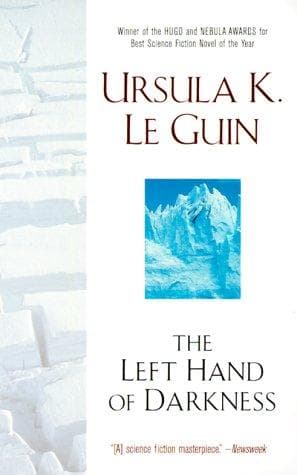
The Left Hand of Darkness
Ursula K. Le Guin·1969·Ace Books·Sci-Fi & Fantasy
Reading level: Ages 14+ (adult) · 9-hour read · Intermediate difficulty.
- Reading time
- 9h
- Difficulty
- Intermediate
- Recommended age
- Ages 14+
- Guide read
- 5min
- Editor's rating
- 4.8 / 5
- ursula-le-guin
- hainish-cycle
- gender
- hugo
- nebula
- political-fiction
- speculative
- winter
— In one sentence —
A man arrives on a planet where no one is permanently male or female. Le Guin uses the thought experiment to ask what gender is actually for.
§ 01 · WHY READ
Why read
Ursula K. Le Guin published The Left Hand of Darkness in 1969 and won both the Hugo and Nebula Awards — the only novel to win both in the same year at that point. She was thirty-nine years old. She would later say that she had written the book as a thought experiment: what would society look like if humans were not divided into permanent sexes? Not if they were all one gender, but if all humans cycled through periods of sexuality (a state called kemmer) and spent the rest of their time neither male nor female.
The Gethenians — the people of the planet Winter, where the novel is set — are ambisexual. They have no permanent sex. During most of the month, they are what Le Guin calls "somer" — sexless. During kemmer, they become sexually active, and the sex they become depends on the partner and the encounter. There is no rape on Gethen, Le Guin notes, because the rapist would have to be in kemmer, which requires mutual receptivity. There is no gender discrimination, because no one is permanently gendered. There is no gender-based division of labor. Anyone can bear children; any adult may be a mother or a father.
Genly Ai, the novel's narrator, is a man from the Ekumen — the interstellar league of human worlds — sent to Winter alone to ask the planet to join. He is stranded in a deeply alien society without quite understanding what makes it alien, because the way his gendered assumptions shape his thinking is invisible to him.
What the novel does technically: Le Guin structures the book as multiple documents — Genly's first-person report, excerpts from a Gethenian anthropologist's field notes, Gethenian myths and folktales — and these different voices comment on each other. The myths especially: Le Guin wrote four of them for the novel, and they are complete as myths, not summaries of myths. They tell you things about Gethenian consciousness that the human narrator cannot access.
§ 02 · CHARACTERS
Characters
Genly Ai — the narrator, a young black man from Earth, trained as a First Mobile (a solo emissary sent to make first contact with potential member worlds). He is intelligent and observant and consistently misreads the Gethenians through the lens of a gendered imagination he doesn't know he has. His inability to fully see Estraven is the novel's central irony: he is a trained observer who cannot observe past his own assumptions.
Therem Harth rem ir Estraven — the Prime Minister of the nation of Karhide at the novel's opening, who is exiled before Genly can secure his meeting with the King. Estraven is the novel's most complex figure: politically shrewd, personally loyal to Genly in ways Genly can't understand, and ultimately heroic in ways Genly only recognizes after it is too late. Le Guin uses Estraven to show what the neutral pronoun can do: Genly's consistent misreading of Estraven's gender (he keeps trying to decide if Estraven is more like a man or a woman) is how Le Guin dramatizes the limits of gendered perception.
§ 03 · HIGHLIGHTS
Three highlights
No. 1 · The Gethenian myths. Le Guin interrupts the narrative four times with Gethenian myths and folktales. They are the novel's deepest world-building: they tell you how the Gethenians understand the world, what they find important, what their culture's deep structures are. The myth of the Hearth of Shath — about a shifgrethor (the untranslatable Gethenian concept of honor/self-respect/presence) violated and restored — is more revealing about Gethenian consciousness than any amount of description could be. Read them as myths, not as interruptions.
No. 2 · The ice crossing. The novel's second half: Genly and Estraven, exiled and in danger, cross the Gobrin Ice together — eighty days on foot across a glacier in winter. The journey is physically detailed and emotionally central. The two of them, stripped of social context, develop a relationship that is the novel's argument about what human connection looks like when gender stops organizing it. Le Guin's ice is precise — she researched polar exploration for this section — and the cold is real, not allegorical. The warmth that develops between the two characters is also real.
No. 3 · Genly's failure of perception. Throughout the novel, Genly tries to decide whether Estraven is more like a man or a woman. He describes Estraven in feminine terms when he finds Estraven warm and in masculine terms when he finds Estraven cold. Le Guin is making the irony structural: the trained observer, sent to understand an alien world, cannot see past his own categories. His failure of perception costs Estraven's life. This is not stated; it accumulates.
§ 04 · EDITIONS
Recommended editions
| Edition | Why pick it |
|---|---|
| Ace Books (current standard) | The standard US edition; includes Le Guin's 1976 introduction "Is Gender Necessary? Redux," in which she revisits and partially revises the novel's approach. Read the introduction after. |
| Gollancz SF Masterworks (UK) | Clean text; good introduction. |
| Audiobook (multiple narrators) | Several audiobook versions exist; the version with separate narrators for Genly and Estraven is the most dramatically appropriate. |
The Left Hand of Darkness is part of the Hainish Cycle but stands completely alone. The Dispossessed (1974) is the other major Hainish Cycle novel; reading both shows Le Guin's political imagination at full stretch.
§ 05 · FIT
Who it's for / not for
Read this if you are…
- Anyone interested in how speculative fiction can use a thought experiment to illuminate assumptions so embedded in our world that we can't see them.
- Readers interested in gender — its functions, its costs, what society would look like without it — from an author who was thinking carefully about these questions before most theoretical frameworks existed to describe them.
- Anyone who has read The Dispossessed and wants more of Le Guin's political SF.
- Readers of literary fiction who haven't read SF: this is the argument for what the genre can do.
Skip it if you are…
- Looking for a novel in which the gender thought experiment is resolved or concluded. Le Guin does not tell you what to think about gender; she makes the thought experiment available and watches what happens when Genly Ai moves through it.
- Wanting plot momentum. The novel's pleasures are conceptual; the ice crossing is the closest it gets to sustained narrative tension.
§ 06 · TIPS
Reading tips
- Le Guin uses "he" for the Gethenians throughout, which she later reconsidered. In her 1976 essay "Is Gender Necessary? Redux," she said she would use a different pronoun now. Some readers find this distracting; some don't. Know going in that the pronoun choice is a formal limitation the author herself acknowledged.
- Read the myths as myths. When Le Guin interrupts the narrative with Gethenian folktales, don't skip them or read them quickly. They are the world's interior; the rest of the novel is its surface.
- Track Genly's language when he describes Estraven. When he calls Estraven feminine, when he calls Estraven masculine: the pattern reveals the mechanism of gendered perception that the novel is analyzing.
- The ice crossing is the emotional center. The novel's first half is political and anthropological; the second half is physical and relational. The shift is abrupt; it is also necessary.
- Le Guin's Gethenian terms (shifgrethor, kemmer, somer) are not explained on arrival. They accumulate meaning through context. Trust the process.
§ 07 · COMPARE
Read alongside
- Ursula K. Le Guin — The Dispossessed (1974). The companion Hainish Cycle novel: political economy rather than gender as the thought experiment. Le Guin's two great works of speculative political fiction.
- Joanna Russ — The Female Man (1975). The other great SF feminist thought experiment of the era: four women from four different possible worlds, one of which is a world without men. Written in direct dialogue with Le Guin.
- Samuel R. Delany — Babel-17 (1966). Delany's Nebula winner from just before Le Guin's: language as the subject of SF. The comparison puts Le Guin's use of language (the Gethenian myths, the untranslatable terms) in context.
- Octavia E. Butler — Kindred (1979). Another canonical SF novel that uses the genre's thought-experiment capacity to illuminate power structures invisible within them.
- Judith Butler — Gender Trouble (1990). The theoretical framework that Le Guin was anticipating: the argument that gender is performative rather than essential. Le Guin's novel dramatizes this argument twenty years before the theory named it.
§ 08 · DISCUSSION
Discussion questions
- Genly Ai consistently tries to categorize Estraven as more like a man or a woman. He is a trained observer who cannot see past his own assumptions. What does Le Guin do with this irony?
- The Gethenians have no rape, no gender-based discrimination, no gender-based division of labor — because no one is permanently gendered. Which of these consequences do you find most surprising? Most plausible?
- The Gethenian myths interrupt the narrative. What do they tell you about Gethenian consciousness that the human narrator cannot access?
- The ice crossing strips Genly and Estraven of social context. What kind of relationship develops between them? What does Le Guin argue this relationship demonstrates?
- Le Guin uses "he" for all Gethenians, which she later called a mistake. How does this choice affect your reading? What would be lost or gained by a different pronoun?
- Shifgrethor is described as "presence, prestige, honor, self-respect" — an untranslatable concept. How does it function in the novel? What does an untranslatable concept do in a novel about first contact?
- Genly's failure to fully see Estraven has consequences. Does the novel present this as individual moral failure, or as a structural problem — the inevitable consequence of having been formed by a gendered world?
- Le Guin was writing in 1969. How does the theoretical framework she anticipated (gender as performance, gender as social construction) change how you read the novel now?
One line to remember
“The only thing that makes life possible is permanent, intolerable uncertainty: not knowing what comes next.”— Genly Ai — Chapter 5
Appears in collections
Reading lists featuring this book
9 books
Science Fiction for People Who Don't Read Science Fiction
Nine novels that will change what you think the genre is allowed to do.
Open list →
5 books
Books Like Harry Potter for Adults
From the closest match to the most literary departure — each preserves something specific from Rowling.
Open list →
7 books
Feminist Literature Worth Reading
Seven books across 150 years — each making a different argument through a different form.
Open list →
8 books
Best Mind-Bending Sci-Fi Books
Eight books that destabilize reality, consciousness, time, or the self — and know exactly what that destabilization is for.
Open list →
6 books
What to Read After The Three-Body Problem
Continue the trilogy, then six novels with the same intellectual ambition.
Open list →
You might also like
Read next
Ursula K. Le Guin · 1974
The Dispossessed
An anarchist physicist travels from his austere moon to the wealthy planet below. Le Guin built two complete societies to ask one question: what does freedom cost?
Read · 5 min
Ursula K. Le Guin · 1968
A Wizard of Earthsea
Le Guin wrote this for a publisher who wanted a fantasy for young readers. She gave them a world with a skin darker than any fantasy hero before it, a magic built on language, and a shadow that is the self.
Read · 4 min
Ted Chiang · 2002
Stories of Your Life and Others
Ted Chiang writes 30-page stories that take longer to think about than most novels. He has won more awards per word than any writer alive.
Read · 5 min