Editor-reviewed
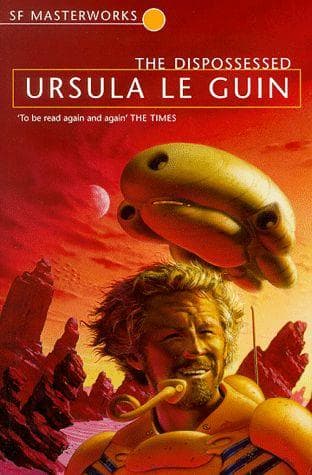
The Dispossessed
Ursula K. Le Guin·1974·Harper & Row·Sci-Fi & Fantasy
Reading level: Ages 14+ (adult) · 13-hour read · Intermediate difficulty.
- Reading time
- 13h
- Difficulty
- Intermediate
- Recommended age
- Ages 14+
- Guide read
- 5min
- Editor's rating
- 4.8 / 5
- ursula-le-guin
- hainish-cycle
- anarchism
- utopia
- dystopia
- nebula
- hugo
- political-fiction
- hard-sf
— In one sentence —
An anarchist physicist travels from his austere moon to the wealthy planet below. Le Guin built two complete societies to ask one question: what does freedom cost?
§ 01 · WHY READ
Why read
Ursula K. Le Guin published The Dispossessed in 1974, the same year as the end of the Vietnam War and eighteen months into Watergate. She subtitled it "An Ambiguous Utopia" — a subtitle she insisted on keeping and that her publisher accepted after some resistance. The ambiguity is the point.
The premise: Shevek is a physicist on Anarres, an anarchist moon settled 170 years ago by dissidents who left the wealthy planet Urras. Anarres has no government, no private property, no possessions — only community obligation, communal work assignments, and a social structure maintained by consensus and mutual aid. Urras, visible from Anarres as a brilliant blue-green world, is wealthy, stratified, beautiful, and exploitative. Shevek is the first person to travel from Anarres to Urras in a century and a half.
Le Guin's formal innovation: the novel alternates chapters between two timelines — Shevek on Anarres (his childhood, his youth, his growing intellectual isolation, his decision to leave) and Shevek on Urras (his arrival, his experience of wealth and beauty and oppression, his gradual understanding of what he has walked into). Neither timeline is primary; each one comments on the other. The reader assembles Shevek's complete self from two simultaneous trajectories.
She won both the Hugo and Nebula Awards for The Dispossessed. She is the writer who most clearly demonstrated that science fiction could carry the intellectual and moral weight of any literary form.
§ 02 · CHARACTERS
Characters
Shevek — a physicist working on a General Theory of Temporality that would unify sequential time and simultaneous time into a single framework. He is intellectually formidable and socially uncertain, shaped by an Anarresti upbringing that gave him no categories for hierarchy, property, or status. On Urras, he encounters all three simultaneously. His experience of Urras — the beauty, the food, the art, the visible suffering of those excluded from it — is the novel's central moral education.
Takver — Shevek's partner on Anarres. Their relationship is the novel's emotional center: she is a biologist, his intellectual equal, committed to him without ownership. Their separations — work assignments that take them to different locations for years — are the costs Anarresti society extracts. She makes the anarchist world real by showing what it costs to live in it honestly.
Bedap — Shevek's friend on Anarres, who radicalizes him by showing him that Anarresti society, despite having no government, has developed its own form of conformist pressure: that the social structure punishes dissent not through law but through ostracism and work-assignment manipulation. The anarchist society has replicated some of what it was built to escape.
Vea — a woman Shevek meets on Urras, wealthy, intelligent, and a prisoner of a society that gives women property and comfort and no political existence. She is Le Guin's portrait of what the alternative to Anarres produces: a woman who owns beautiful things and cannot own her own choices.
§ 03 · HIGHLIGHTS
Three highlights
No. 1 · The alternating structure. The novel's chapters alternate between the two timelines without marking which is "past" and which is "present." Both are equally present to the reader; the reconstruction of Shevek's whole life from the alternating streams is Le Guin's argument that simultaneity and sequence are both true and that neither is more fundamental than the other. This is not just formal play — it is the physics of the General Theory of Temporality rendered in narrative structure.
No. 2 · Anarres as an ambiguous utopia. Le Guin spends the first half of the book establishing that Anarres is genuinely better than Urras in the ways that matter — no exploitation, no poverty, no war — and that it is also genuinely worse in specific ways: monotonous, harsh, socially coercive in the informal way that communities without enforcement mechanisms become coercive through judgment and exclusion. She does not let either world win the comparison. This is the "ambiguous" in the subtitle.
No. 3 · The wall. The novel's first page: "There was a wall. It did not look important. It was built of uncut rocks roughly mortared. An adult could look right over it, and even a child could climb it. Where it crossed the roadway, instead of having a gate it degenerated into mere geometry, a line, an idea of boundary. But the idea was real." Le Guin's opening is as formally complete as her structure: the wall separates Anarres from the Urrasti port. It is real and it is an idea. The whole novel is about that distinction.
§ 04 · EDITIONS
Recommended editions
| Edition | Why pick it |
|---|---|
| Harper Perennial Modern Classics | The standard US edition; includes Le Guin's introduction to the 1974 edition. Read the introduction after. |
| Gollancz SF Masterworks (UK) | The UK edition in the SF Masterworks series; clean text, well-designed. |
| Audiobook (Don Leslie) | The most widely available audio version; Leslie's pacing is correct for Le Guin's measured prose. |
The Dispossessed is part of the Hainish Cycle — a loose series of novels set in the same universe, including The Left Hand of Darkness (1969) and The Word for World is Forest (1972). Each novel stands alone; the universe accumulates rather than continuing a single story.
§ 05 · FIT
Who it's for / not for
Read this if you are…
- Anyone interested in political philosophy rendered as narrative: this is the best argument against the criticism that utopian fiction can't be dramatically compelling.
- Readers interested in anarchism as a serious political theory rather than chaos. Le Guin's Anarres is a genuine attempt to imagine what anarchist organization looks like in practice.
- Anyone who has read Le Guin's Left Hand of Darkness and wants more of her political intelligence in a different register.
- Readers interested in physics, particularly in the philosophical implications of relativity and simultaneity. Shevek's General Theory is imaginary but coherent.
Skip it if you are…
- Looking for plot-driven science fiction. The Dispossessed is ideas-driven; its pleasures are intellectual and moral rather than narrative. The physics and the politics are the content.
- Wanting a novel with a clear moral winner between its two societies. Le Guin doesn't provide one. Both worlds have genuine virtues; both have genuine costs.
§ 06 · TIPS
Reading tips
- The alternating structure becomes intuitive quickly. The odd-numbered chapters are Anarres (past); the even-numbered are Urras (present at the time of his arrival). Le Guin doesn't mark this — let it arrive naturally.
- Anarres's failures are as important as Urras's. Le Guin is not writing a pro-anarchism polemic; she is asking what freedom costs. The social conformism on Anarres — the way people exclude and marginalize without formal power to do so — is the novel's honest answer.
- Shevek's physics is the theme. The General Theory of Temporality, which unifies sequential and simultaneous time, is an argument about how the two worlds relate — not in opposition, but as aspects of a single thing. Le Guin developed it carefully and it holds together.
- Read the first page slowly. "There was a wall." The meditation that follows is the novel's complete argument in miniature; everything that happens is an elaboration of that first page.
§ 07 · COMPARE
Read alongside
- Ursula K. Le Guin — The Left Hand of Darkness (1969). The earlier Hainish Cycle novel: an envoy from the interstellar League arrives on a planet where all humans are ambisexual. Le Guin's other great political SF novel; the two together show the full range of her political imagination.
- Octavia E. Butler — Parable of the Sower (1993). Le Guin and Butler as the two poles of what literary SF can do with political imagination — Le Guin's formal utopia/dystopia against Butler's practical community-building under collapse.
- Peter Kropotkin — Mutual Aid: A Factor of Evolution (1902). Le Guin's primary source for the anarchist theory underlying Anarres. Kropotkin's argument that mutual aid rather than competition is the primary driver of evolutionary success is the intellectual foundation of the world she built.
- George Orwell — Nineteen Eighty-Four (1949). The contrast: Orwell's dystopia that shows what totalitarianism destroys, Le Guin's ambiguous utopia that shows what freedom costs. Both are honest, and both are necessary.
- Kim Stanley Robinson — The Ministry for the Future (2020). Robinson is Le Guin's closest intellectual heir: SF as a venue for rigorous engagement with political and economic questions. A useful contemporary companion.
§ 08 · DISCUSSION
Discussion questions
- Le Guin subtitled the novel "An Ambiguous Utopia." By the end, which world is the utopia — Anarres or Urras — and in what sense is either of them one?
- Anarres has no government and no laws, but it has developed informal mechanisms of social control: ostracism, work-assignment manipulation, the pressure of consensus. Is this anarchism's failure, or is it the inevitable form that social pressure takes in any community?
- Shevek leaves Anarres and arrives on Urras to find it beautiful, wealthy, and exploitative. What changes in his understanding of Anarres as a result of seeing Urras? What changes in his understanding of Urras as a result of coming from Anarres?
- Takver and Shevek's relationship is built on genuine mutuality with no ownership. Le Guin presents it as one of the novel's affirmative arguments. Do you find it convincing? What does she leave out?
- The alternating structure — past on Anarres, present on Urras — is Le Guin's formalization of Shevek's physics (sequential and simultaneous time as aspects of the same thing). Does the form reinforce the content? Where do you see it working?
- Vea on Urras is intelligent, beautiful, and unable to own her own political existence. Le Guin uses her to show what the alternative to Anarres's equality produces. Is this a fair portrait of Urras's society?
- "You cannot buy the revolution. You cannot make the revolution. You can only be the revolution." What does Shevek mean? Does the novel validate this claim, complicate it, or both?
- The Dispossessed was published in 1974. Which of its political arguments feel most relevant now? Which feel most dated?
One line to remember
“You cannot buy the revolution. You cannot make the revolution. You can only be the revolution. It is in your spirit, or it is nowhere.”— Shevek — Chapter 9
Appears in collections
Reading lists featuring this book
9 books
Science Fiction for People Who Don't Read Science Fiction
Nine novels that will change what you think the genre is allowed to do.
Open list →
5 books
The Best Books About Colonialism
Five novels that look at empire as a mechanism — what it does to colonizers and colonized, and what it costs to refuse to look away.
Open list →
7 books
Books About Identity and Belonging
Seven novels about the self that society refuses, and the self that refuses society.
Open list →
6 books
Books Like 1984
From the book that directly inspired Orwell to the ones that took the nightmare somewhere new.
Open list →
6 books
Books Like The Handmaid's Tale
Six novels for readers who want that particular combination of dread, clarity, and controlled fury.
Open list →
5 books
Books Like The Road by Cormac McCarthy
Five novels with the same stripped intensity — and something The Road doesn't have.
Open list →
6 books
Books That Changed How I Think
Six books that installed a new mental model — specific, not vague.
Open list →
8 books
Best Mind-Bending Sci-Fi Books
Eight books that destabilize reality, consciousness, time, or the self — and know exactly what that destabilization is for.
Open list →
7 books
Overlooked Masterpieces
Seven novels that belong in the first tier but rarely get there — and why.
Open list →
7 books
What to Read After Murakami
Seven novels for when you finish Norwegian Wood and don't know where to go next.
Open list →
6 books
What to Read After The Three-Body Problem
Continue the trilogy, then six novels with the same intellectual ambition.
Open list →
You might also like
Read next
Ursula K. Le Guin · 1969
The Left Hand of Darkness
A man arrives on a planet where no one is permanently male or female. Le Guin uses the thought experiment to ask what gender is actually for.
Read · 5 min
Ursula K. Le Guin · 1968
A Wizard of Earthsea
Le Guin wrote this for a publisher who wanted a fantasy for young readers. She gave them a world with a skin darker than any fantasy hero before it, a magic built on language, and a shadow that is the self.
Read · 4 min
Ted Chiang · 2002
Stories of Your Life and Others
Ted Chiang writes 30-page stories that take longer to think about than most novels. He has won more awards per word than any writer alive.
Read · 5 min