Book list · Editor's pick·Fiction
Harry Potter Reading Level by Book
The age range, reading difficulty, and content notes for every book in the Harry Potter series — book by book.
- Books
- 7
- harry-potter
- reading-level
- for-parents
- age-recommendations
- middle-grade
- young-adult
Updated 2026-05-27
— Why read this list —
The series starts as a middle-grade chapter book and ends as a young-adult war novel. The shift happens at Book 4. If you are buying these for a child, that's the fact most reviews bury.
At a glance: reading level for each Harry Potter book
The Harry Potter books are not one reading level. Books 1–3 are middle-grade chapter books for ages 8–12. Books 4–7 are young-adult novels for ages 10–14 and up, with the transition happening sharply at Book 4 (Goblet of Fire). If you are buying the series for one child to read straight through, plan for them to start at roughly age 9 and finish at roughly age 12 or 13 — most kids don't read the whole series in a single year, and most shouldn't.
| Book | Year | Recommended age | Reading level |
|---|---|---|---|
| The Philosopher's Stone | 1997 | Ages 8–12 | Middle grade |
| The Chamber of Secrets | 1998 | Ages 8–12 | Middle grade |
| The Prisoner of Azkaban | 1999 | Ages 9–13 | Middle grade |
| The Goblet of Fire | 2000 | Ages 10–14 | Young adult |
| The Order of the Phoenix | 2003 | Ages 11+ | Young adult |
| The Half-Blood Prince | 2005 | Ages 12+ | Young adult |
| The Deathly Hallows | 2007 | Ages 12+ | Young adult |
These ages are guidelines, not rules. A precocious 7-year-old can handle Book 1 read aloud; a sensitive 12-year-old may find Book 5 too heavy. Use them as a starting point, not a verdict.
When the series stops being a children's book
The single most-Googled question by parents and teachers about this series is when the books stop being safe for younger kids. The answer is specific: Book 4, Goblet of Fire, published 2000.
Three things happen in Book 4 that hadn't happened in Books 1–3.
- A named, sympathetic character is murdered on the page. Cedric Diggory — a 17-year-old who has done nothing wrong — is killed by an adult villain in a graveyard, fifteen minutes after winning a school tournament. Rowling has said in interviews that she planned this death from Book 1. The series before Cedric is a different series than the one after.
- Voldemort returns in a physical body. Not a memory in a diary, not a parasite on the back of someone's head. A flesh-and-blood adult man walks out of a cauldron after a ritual involving blood, bone, and severed flesh. The scene runs roughly twenty pages and is not softened.
- The page count nearly doubles. Book 1 is around 76,000 words. Book 4 is around 190,000. From Book 4 onward, the books are longer, the chapters longer, the plot more political, the morality greyer. The Order of the Phoenix (Book 5) is the longest at around 257,000 words — longer than War and Peace per volume.
Many parents pre-read the final 100 pages of Book 4 and decide whether the child is ready, or whether to pause the series for a year. That is a reasonable thing to do. Stopping after Book 3 is a clean place to stop — the trio is intact, the school year ends well, and a child who isn't ready for the darker books can return to them later without missing a coherent ending.
Books 5, 6, and 7 escalate from there. Torture, depression, war, complicity, grief, and the on-page deaths of beloved adult characters become recurring elements. None of it is gratuitous — the series knows what it is doing — but none of it is for an 8-year-old either.
Reading approaches by age
Ages 6–8 (read aloud only). Book 1 works well as a bedtime read-aloud for this range, and most of Book 2 does too. Pause at the basilisk and the spider scenes if the listener is sensitive. Don't push into Book 3 until they can sit with dementors and a backstory involving a betrayal. Independent reading at this age is usually still on shorter chapter books.
Ages 8–10 (independent reader). Books 1, 2, and 3 are comfortable independent reading at this range. Book 4 should wait, or be read with an adult who is willing to discuss the graveyard scene. Many 9-year-olds want to power through the whole series because their friends have; many regret it by Book 5. A reasonable rule: finish Book 3, then take a six-month break before starting Book 4.
Ages 10–12. Books 1 through 4 are independent reading. Books 5, 6, and 7 are paced to maturity — some 11-year-olds are ready, some aren't, and the difference is usually emotional rather than verbal. Read alongside the child if you can; the political and moral material in these books is worth talking about.
Ages 12 and up. Full series, independent reading. A second read at 15 or 16 will pick up most of the architecture (Snape's behavior, Dumbledore's manipulations, the foreshadowing density) that a first reader at 12 misses. The series rewards rereading more than almost any other YA fantasy.
Adult first-time readers. Plenty of adults read these for the first time at 30, 40, or 60. There is no shame in it, and the books are not diminished by reading them late. If you are coming to the series as an adult, Books 3, 5, and 7 are where the writing is strongest; Books 1 and 2 read fastest. The full series is roughly 87 hours of reading — four to six months at a normal adult pace.
A final honest note: these books are also a famously good way for a reluctant reader to discover that reading can be the thing they stay up past midnight for. The reading level on the page matters less than the reading level of the reader in front of you. If a 13-year-old who has never finished a novel wants to start with Book 1, the answer is yes, regardless of what the age range says.
The 7 books
In publication order
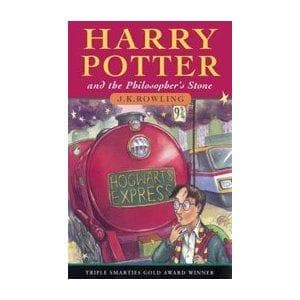
Book 1·Middle-grade entry point
Harry Potter and the Philosopher's Stone
J. K. Rowling·1997
HP1 is a middle-grade chapter book, suitable for ages 8–12. Beginner difficulty — short chapters, accessible vocabulary, brisk pace; an independent third- or fourth-grade reader can handle it without help. Content is mild: brief moments of peril (a troll, a three-headed dog, a confrontation in the final chapter), no on-page death, no language, no romance. The villain is defeated by a child who has been at school for nine months. Independent readers from age 8; read-aloud works from age 6 or 7.
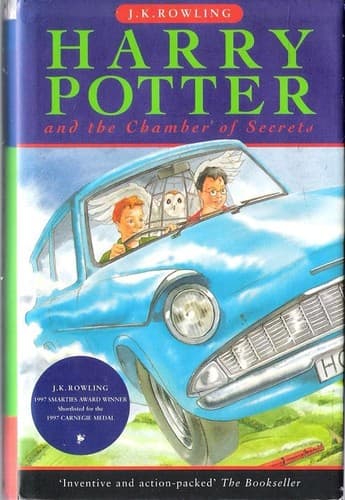
Book 2·Middle-grade, slightly darker
Harry Potter and the Chamber of Secrets
J. K. Rowling·1998
HP2 is middle-grade, suitable for ages 8–12, at the same reading level as Book 1. Beginner difficulty — the prose and chapter length barely change. Content is a half-step darker: a giant snake that petrifies students, a possessed eleven-year-old, the word 'mudblood' introduced as a slur (worth a parent conversation). Still no on-page human death. Independent readers from age 8; the basilisk and the spider scenes are the only places a sensitive 7-year-old listening along may need a pause.
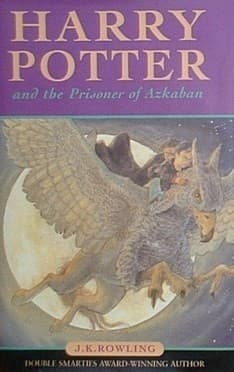
Book 3·Last of the safely middle-grade books
Harry Potter and the Prisoner of Azkaban
J. K. Rowling·1999
HP3 is middle-grade, suitable for ages 9–13. Beginner difficulty, but the plot is more layered — time travel, an unreliable narrator, a moral grey area in the climax. Content is emotionally heavier than Books 1 and 2: dementors literally drain happiness, Harry hears his parents' deaths replayed, there's a frank conversation about a man wrongly imprisoned for twelve years. No on-page death; a betrayal and a reprieve. Independent readers from age 9; read-aloud still fine for younger listeners with a parent nearby for the dementor scenes.
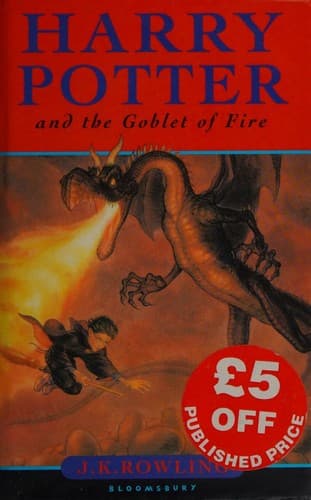
Book 4·The turn toward young adult
Harry Potter and the Goblet of Fire
J. K. Rowling·2000
HP4 is young adult, suitable for ages 10–14, and this is where the series stops being a children's book. Intermediate difficulty — the page count nearly doubles, the political plot demands more from a reader, the chapter rhythm slows. Content shifts substantially: a named, sympathetic teenage character is murdered on the page; Voldemort returns in a body; there is torture, a graveyard ritual involving blood, and adult cruelty without a soft landing. Many parents pre-read the final 100 pages before deciding. Independent readers from age 10 with adult discussion; read-aloud for younger children is no longer recommended without active parental editing.
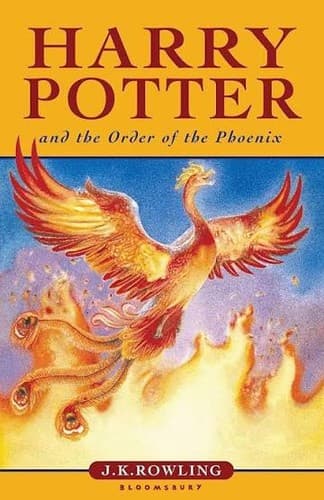
Book 5·Young adult, longest of the seven
Harry Potter and the Order of the Phoenix
J. K. Rowling·2003
HP5 is young adult, suitable for ages 11 and up. Intermediate difficulty and the longest book in the series — twice the length of Book 1, with a political plot about institutional denial, a state-aligned teacher who physically tortures students, and a teenage protagonist whose grief reads as depression. Another beloved character dies. Sexuality stays at the kissing level; violence is heavier and more sustained. Most 11-year-olds can read it; most under-11s shouldn't. Read-aloud is no longer the right format at this length.
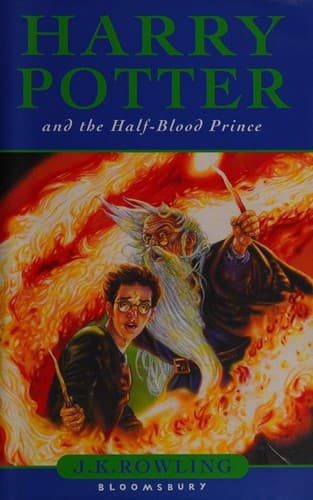
Book 6·Young adult, character-driven
Harry Potter and the Half-Blood Prince
J. K. Rowling·2005
HP6 is young adult, suitable for ages 12 and up. Intermediate difficulty — the prose is more confident, the structure less plot-driven, the central project is the biography of a future mass murderer as an eleven-year-old at an orphanage. Content includes a teen romance subplot at normal teen intensity, a forced poisoning, and the on-page death of a major adult character at the end. A 12-year-old strong reader will handle it; a 10-year-old plot-skimming Book 4 will probably bounce off the character work.
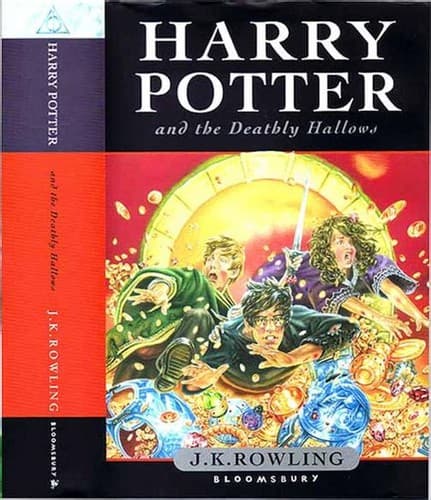
Book 7·Young adult, the war novel
Harry Potter and the Deathly Hallows
J. K. Rowling·2007
HP7 is young adult, suitable for ages 12 and up. Intermediate difficulty, but the emotional weight is the heaviest in the series — it is, in practice, a novel about a seventeen-year-old learning to die. The body count is in double digits, including children and beloved adults; there is a torture scene, a near-execution, and a long stretch of bleak wandering before the resolution. Themes of grief, sacrifice, and complicity in evil are foregrounded. A 12-year-old can read it; many do better with it at 14. Not a read-aloud.