Golden set · editor-reviewed
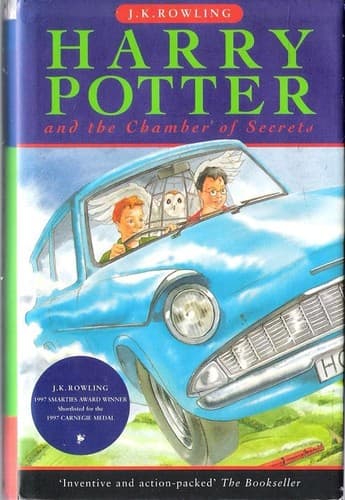
Harry Potter and the Chamber of Secrets
Harry Potter · Book Two
J. K. Rowling·1998·Bloomsbury·Fiction
Reading level: Ages 8–12 (middle grade) · 8-hour read · Beginner difficulty.
- Reading time
- 8h
- Difficulty
- Beginner
- Recommended age
- Ages 8–12
- Guide read
- 5min
- Editor's rating
- 3.6 / 5
- coming-of-age
- british-boarding-school
- modern-fantasy
- millennial-canon
- 1990s
- load-bearing
— In one sentence —
Fans call it the weakest book in the series — and they're not wrong. They're also missing that it's the load-bearing wall the next five books rest on.
§ 01 · WHY READ
Why read
Let's name the problem first. Chamber of Secrets has the slowest opening of the seven books, a comic-relief character (Gilderoy Lockhart) most readers find more grating than funny, and a mid-act plot point — students being turned to stone by a basilisk — that lands closer to children's-cartoon menace than the dread the later books will earn. Most fan polls put it dead last.
The fans are right about all of that. They are also missing that almost every load-bearing mechanism of the next five books is built in this one. Specifically:
- The word "mudblood" — the first time the wizarding world's blood-purity politics breaks into the children's faces.
- The name "Tom Riddle" — given, casually, as a piece of historical trivia.
- A Horcrux — though the term doesn't appear for four more books, the diary is one.
- Parseltongue as Harry's secret link to Voldemort — the entire metaphysics of his arc rests on this one chapter.
The achievement of Chamber of Secrets isn't that it's a great book. It's that Rowling had the structural nerve to hide the foundations of her seven-book argument inside the volume people would later call the weakest. Most series writers can't do that — they front-load the mechanism, and readers feel manipulated when the payoff comes. Rowling buries it in a book about an evil sock and a slug-vomiting jinx. Reread Book 2 after Book 7 and the audacity of the move becomes visible.
§ 02 · CHARACTERS
Characters
The book is structured around two orphans, refracted.
The mirror pair
- Harry — orphan saved by Hogwarts, by Ron and Hermione, by being loved.
- Tom Riddle — orphan rejected by Hogwarts (in his own telling), by his family, by his own incapacity to be loved. The book's secret thesis question is why the same starting condition produces opposite endings. The seven-book answer, when it arrives, is: friends.
The new faculty · authority figures who fail
- Gilderoy Lockhart — the character Rowling has on record called her least favorite to write. A celebrity-memoirist fraud who fails upward into a teaching post. In 1998 he reads as a parody of self-help authors. In 2026 he reads as a parody of every monetized influencer in your feed.
- Snape, continued — every Snape scene in Book 2 is doing double work. Bookmark them; reread after Book 7.
- Dobby — the first house-elf. House-elves are the series' running subtext about an oppressed people the wizarding world has decided not to see.
The Weasleys, deepened
- The Burrow is introduced. The most important place in the series outside Hogwarts.
- Ginny Weasley — has almost no spoken lines and is the book's victim. We will come back to her.
The villains
- Lucius Malfoy — Draco's father, the first adult Death Eater the children deal with. Much more frightening than his son, because he is competent and the system protects him.
- Diary-Tom Riddle — sixteen-year-old Voldemort. Scarier than the adult version, because he is charming.
§ 03 · HIGHLIGHTS
Three highlights
No. 1 · Dobby's first scene. Chapter 2. A small, self-harming, terrified servant appears in a child's bedroom and bangs his own head against the wardrobe to punish himself for speaking ill of his masters. This is in a children's book. Rowling is opening the series's longest-running political subplot — the wizarding world's tolerated chattel labor — in a way most readers don't notice the first time because they're laughing at the comedy of the scene. Reread it. It's not actually comedy.
No. 2 · The "mudblood" scene. Draco Malfoy uses the slur on Hermione. Ron breaks his wand trying to curse him for it. Hagrid explains the word's history in a quiet aside. This is the moment the safe boarding-school world of Book 1 cracks. The series is a fantasy until this scene; from here on it's about a society where some bloodlines are deemed worthier than others, and what happens to the children unlucky enough to grow up inside that.
No. 3 · "It is our choices…" The climax dialogue in Dumbledore's office, after the basilisk is dead and Ginny saved. Harry confesses he's worried he should have been sorted into Slytherin. Dumbledore answers, in the line that becomes the series' epitaph: it is our choices, Harry, that show what we truly are, far more than our abilities. On a first read, it lands like a teacher's pep talk. On the seventh read, every plot of every later book is in this sentence.
§ 04 · EDITIONS
Recommended editions
| Edition | Why pick it |
|---|---|
| Bloomsbury UK first edition (1998) | The canonical text. Same title in UK and US — no Sorcerer's Stone–style retranslation needed. |
| Scholastic US edition (1999) | A handful of Americanizations ("revising" → "studying", etc.). Fine, but the UK edition is the cultural artifact. |
| Bloomsbury House Editions (2018) | Twentieth-anniversary paperbacks in four house colors. The gift edition. |
| Jim Kay illustrated edition (Bloomsbury 2016) | Full-color hardback. The Aragog sequence is a high point of the entire illustrated reissue series. |
| MinaLima illustrated edition (Scholastic 2021) | Movie-graphic-design house. Diary spread is the showpiece. |
| Stephen Fry audiobook (UK) | His Dobby is justly famous. |
| Jim Dale audiobook (US) | Grammy-winning. Camp choice. |
| 2002 film (Chris Columbus) | The last film of the children's-film phase. Watchable; faithful to a fault. |
| HBO television series | In production, episode count not announced; second-season material expected 2027–28. |
Recommended order: read straight from Book 1 in the Bloomsbury UK paperback. Don't skip to Book 3 because the internet told you Book 2 is weak. The internet is wrong about why.
§ 05 · FIT
Who it's for / not for
Read this if you are…
- Continuing from Philosopher's Stone — yes, even if you've heard this one is weaker.
- Rereading the series as an adult and want to spot the mechanisms.
- A writer studying how to plant a payoff five books in advance.
Skip it if you are…
- A "best books only" reader. There are objectively better children's novels. None of them set up the series you're about to read.
- Someone who watched the 2002 film and thinks it covered the book. The film leaves out 80% of the load-bearing material. The Dobby scenes are essentially gone.
§ 06 · TIPS
Reading tips
- Difficulty: low–medium. Mid-section is slower than Book 1; finish is faster.
- Length: ~85,000 words; 7–9 hours.
- Read aloud age: 7+ with light editing for the basilisk sequence; independent at 9+.
- Don't quit at page 100. The first third is structurally the slowest in the series. The structural payoff is Books 6 and 7.
- High reread value. Once you know what the diary is, the whole book becomes a different book. Most series have one book that opens up on reread; Book 2 is the Harry Potter one.
§ 07 · COMPARE
Read alongside
- C. S. Lewis — Prince Caspian (1951). The other famous "weakest second book" in a children's fantasy series, and instructive comparison: Lewis solves the second-book problem by introducing a new protagonist; Rowling solves it by burying foundations.
- Roald Dahl — Matilda (1988). Like Chamber, a story about an overlooked, mistreated child whose underestimation by adults is the central engine.
- Madeleine L'Engle — A Wind in the Door (1973). The sci-fi equivalent — second book in a series that catches flak for slowness, but does foundational metaphysical work the later books need.
- Robert Galbraith — The Cuckoo's Calling (2013). If you're curious what J. K. Rowling looks like writing for adults, the Cormoran Strike novels are her under-discussed second career.
§ 08 · DISCUSSION
Discussion questions
- Rowling herself called Lockhart her least favorite character to write. Read the Lockhart chapters as if they were satire of celebrity authorship in your current decade — what targets do they hit? What targets do they miss?
- House-elf rights become a running theme through the series (S.P.E.W., Dobby's death, Kreacher's redemption). Re-reading Book 2, does Rowling actually finish what she starts here, or does the series let the subplot slide?
- Ginny Weasley spends most of this book unconscious, possessed, or off-page. As a piece of writing, is silent-female-victim defensible — or is it the structural problem readers complain about, dressed in something else?
- Compare Tom Riddle in Book 2 to Voldemort in Book 4. Which version is scarier on the page, and what does the answer reveal about how charm and menace relate?
- Hermione is the only main character petrified mid-book. What does it cost the story to have her absent for the final act, and is the cost worth what it earns?
- The blood-purity politics introduced here are an unmistakable echo of twentieth-century European fascism. As a children's book in 1998, what was Rowling allowed to do with that material that an adult novelist might not have been?
- If you had to cut 30% of the book to tighten it, what 30% would you cut — and how many later-series payoffs would you accidentally break?
- The Dumbledore "choices" line is one of the most-quoted in modern fantasy. Does it still hold up as wisdom for you, or has it aged into greeting-card territory?
One line to remember
“It is our choices, Harry, that show what we truly are, far more than our abilities.”— Albus Dumbledore — Chapter 18, Dobby's Reward
Appears in collections
Reading lists featuring this book
7 books
Harry Potter · A 7-Book Reader's Guide
Seven novels, one boy who grows up. Where to start, how to pace, what each book is actually about — and when to take a break.
Open list →
7 books
Harry Potter Reading Level by Book
The age range, reading difficulty, and content notes for every book in the Harry Potter series — book by book.
Open list →
You might also like
Read next
Kazuo Ishiguro · 2005
Never Let Me Go
A science-fiction novel so quiet about being science fiction that most readers finish it before they realize what they've agreed to.
Read · 5 min
Emily St. John Mandel · 2014
Station Eleven
A pandemic kills most of humanity. Twenty years later, a travelling Shakespeare company performs for survivor settlements. Mandel is interested in what survives and why.
Read · 5 min
Caro Claire Burke · 2026
Yesteryear
A high-concept 2026 novel about nostalgia, motherhood, faith, internet performance, and old gender roles.
Read · 5 min