Golden set · editor-reviewed
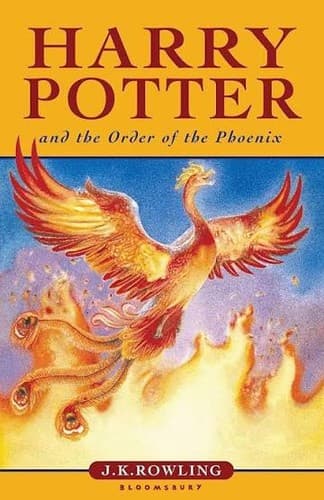
Harry Potter and the Order of the Phoenix
Harry Potter · Book Five
J. K. Rowling·2003·Bloomsbury·Fiction
Reading level: Ages 11+ (YA) · 20-hour read · Intermediate difficulty.
- Reading time
- 20h
- Difficulty
- Intermediate
- Recommended age
- Ages 11+ (YA)
- Guide read
- 5min
- Editor's rating
- 4.0 / 5
- coming-of-age
- british-boarding-school
- modern-fantasy
- political-allegory
- 2000s
- longest-book
— In one sentence —
The longest, hardest, most polarizing book in the series — and the one a 2020s reader will recognize fastest, because its real subject is how a society chooses to disbelieve a truth it can no longer afford.
§ 01 · WHY READ
Why read
Order of the Phoenix is consistently the most-disliked book in the series on first read. The complaints are real. It is the longest book in the seven — about 257,000 words, more than three times Philosopher's Stone. Harry is angry on almost every page. The villain isn't Voldemort, it's a smiling middle-aged bureaucrat in a pink cardigan. There is no satisfying battle climax — the climax is a confused fight in a basement, and the death it produces feels arbitrary.
All of that is accurate, and all of that is the point.
Order of the Phoenix is also the book in which Rowling stops writing a children's adventure with adult overtones and starts writing a political novel that happens to feature children. Its real subject is what happens to a society when the truth is too inconvenient to face. The Ministry of Magic chooses to deny Voldemort's return because acknowledging it would require action. The press follows. The school is brought under government control. Anyone who speaks the truth is smeared as unstable. The kids form an underground.
If you lived through any part of the 2020s — pandemic denial, climate denial, election denial, the public discovery that institutional credibility is not self-renewing — Order of the Phoenix now reads as one of the more accurate political novels of its decade. Rowling wrote it in 2001–2002. She wasn't predicting; she was writing about the post-2001 UK she was watching. The fact that it scans onto your country twenty years later is the warning that's worth taking from the reread.
Most readers who dislike Phoenix on the first read love it on the second. That should tell you what kind of book it is.
§ 02 · CHARACTERS
Characters
The book is built around soft evil vs. powerless anger.
The antagonist · banal evil
- Dolores Umbridge — Senior Undersecretary to the Minister, installed as Hogwarts High Inquisitor. Rowling has said Umbridge was "the easiest character to write, and the most loathsome." Pink cardigan, kitten plates, a voice she keeps at a sing-song pitch, an apparent sincerity that she is doing the right thing. She is more frightening than any Death Eater because she is recognizable — she is every functionary who has ever enforced a cruel policy with a smile. Rowling's most enduring villain.
- Cornelius Fudge — escalates from the "denial" of Goblet to a full state-media campaign of smearing Harry and Dumbledore. The book's portrait of how an institution defends itself against an inconvenient fact.
The resistance · the Order
- Sirius Black — once a wrongly imprisoned hero, now a wrongly cooped-up middle-aged man stuck in his childhood house. His arc this book is the cruelest: the freedom he was promised in Book 3 turns out to be a different cage. His death lands as it's meant to — sudden, stupid, irreversible.
- Kingsley Shacklebolt — Auror, future Minister. Rare in the series: an authority figure Rowling writes straight.
- Remus Lupin — returns, still on the margin.
- Nymphadora Tonks — pink-haired young Auror. The youngest of the adult resistance and its emotional center.
Dumbledore's Army
- Neville Longbottom begins his real arc here. The character with the longest growth curve in the series — from comic-relief klutz to the boy who pulls Gryffindor's sword from the Sorting Hat — starts the rise in Book 5.
- Luna Lovegood — arguably the most-loved minor character of the series, debuting fully formed. The wizarding world's only completely un-self-conscious adolescent.
The school resistance
- Hermione vs. Umbridge — Hermione organizes the DA, drafts the contract, designs the coin, plots the rescue, and plans the revenge ("the deep, deep forest"). Book 5 is her book as much as anyone's.
- Fred and George — their resignation scene, swamp included, is among the most cathartic passages in the series.
§ 03 · HIGHLIGHTS
Three highlights
No. 1 · The educational decrees. Umbridge takes over Hogwarts one corridor poster at a time. Read the rhythm of the educational decrees Rowling stages — first banning practical Defense Against the Dark Arts, then banning student gatherings of more than three, then taking over the inspection of staff, then dissolving inconvenient subjects. The book is a step-by-step demonstration of how authoritarianism advances in the language of "for your own good." No Death Eater in the series ever sounds as much like a real-world functionary as Umbridge does.
No. 2 · Snape's Worst Memory. Mid-book, Harry breaks into Snape's Pensieve and watches his father bullying Snape as a teenager. James Potter — Harry's idolized dead father — is the popular kid laughing while a frightened, weird boy is humiliated upside-down on a riverbank. The hero's foundational myth about his own dad cracks open. This is one of the most important growth moments in any character in the series — and Rowling has the nerve to spring it not on Voldemort, not on Snape, but on the reader's last surviving idea of who James Potter was.
No. 3 · The Department of Mysteries. The climax is six teenagers and a few adult Order members fighting Death Eaters in a confusing labyrinth at night. It is intentionally messy. Spells miss. Plans collapse. The kids look not heroic but small. Sirius is killed mid-banter by a curse that knocks him through a curtain. Rowling refuses to make their courage look professional, because it isn't. The point is that they showed up. The series's later battle scenes will all rhyme with this one.
§ 04 · EDITIONS
Recommended editions
| Edition | Why pick it |
|---|---|
| Bloomsbury UK first edition (2003) | The canonical text. 766 pages. |
| Scholastic US edition (2003) | 870 pages (different typesetting). Identical title; light Americanization. |
| Bloomsbury House Editions (2023) | Twentieth-anniversary house-color paperbacks. |
| MinaLima illustrated edition | In production at the time of writing (scheduled 2025–26). |
| Stephen Fry audiobook (UK) | His Umbridge alone is worth the price. 26+ hours. |
| Jim Dale audiobook (US) | Grammy-winning. |
| 2007 film (David Yates) | Yates's first Potter film; he will direct the remaining four. The film is the most aggressively cut of the eight — 870 pages compressed to 138 minutes. Umbridge is excellently cast. The political mechanics of the book are mostly gone. Read the book. |
| HBO television series | Season 5 may span two seasons; expected 2029–30. |
Recommended order: read the book first, on a long stretch (vacation, sabbatical, recovery). Then watch the film as a visual companion. Then reread the book. Phoenix is the second-most reread-rewarding Potter book after Azkaban.
§ 05 · FIT
Who it's for / not for
Read this if you are…
- Reading the series in order. You can't skip; almost every payoff in Books 6 and 7 needs this book.
- An adult who has lived through the 2010s or 2020s and wants to know what a political novel about institutional denial looks like in a children's-fantasy frame.
- A second-time reader. Phoenix is the book everyone says is the best on reread, and they are not wrong.
Skip it if you are…
- A first-time reader looking for the cozy book. This isn't it.
- Unable to tolerate a protagonist who is angry, often unjustly, for ~600 pages. Rowling is doing this on purpose — the book wants you to feel the suffocation Harry feels — but it is a real ask.
- Looking for a tidy battle climax. The climax of Phoenix is a tragedy, not a victory.
§ 06 · TIPS
Reading tips
- Difficulty: medium. The political mechanics require attention; the sentences themselves remain accessible.
- Length: ~257,000 words; 18–22 hours. The longest book of the seven. Plan for a week, not a weekend.
- Read aloud age: 12+. The Pensieve sequence and the Department of Mysteries are not for younger children.
- Pushing through the low chapters. The Grimmauld Place section (Chapters 4–11) is the single hardest stretch of the series — claustrophobic, depressed, oppressive. This is design, not failure. Rowling is making the reader feel what Harry feels. Get to the DA forming in Chapter 16 and the book opens up.
- High reread value. Like Azkaban, Book 5 is a different book the second time. Half of Snape's behavior gains a second meaning; every Umbridge scene gains political force.
§ 07 · COMPARE
Read alongside
- George Orwell — 1984 (1949). Phoenix is the children's-fantasy ancestor in this lineage. Same questions: what does it cost a society to believe a lie, what does it cost an individual to refuse, who breaks first?
- Margaret Atwood — The Handmaid's Tale (1985). Soft and hard authoritarianism in conversation. Phoenix writes the soft version (Umbridge); Handmaid's writes the hard.
- Harper Lee — To Kill a Mockingbird (1960). A community persuaded of an obvious untruth by social inertia; one person refuses to go along.
- Hannah Arendt — Eichmann in Jerusalem (1963). Non-fiction. The phrase "the banality of evil" is the academic version of what Umbridge looks like on the page.
§ 08 · DISCUSSION
Discussion questions
- Rowling makes Umbridge — not Voldemort — the book's true antagonist. Reread her chapters with that in mind. Why is the smiling Ministry functionary scarier than the wizard Hitler?
- Harry's anger is the single most-criticized character choice in the series. Defend it as a reader who liked it; defend the critique as a reader who didn't. Which defense holds up better?
- Sirius's death is widely called "wasted" — he dies in a fall through a curtain in the middle of a sentence. Is that bad writing or excellent writing? Argue both.
- The Pensieve scene with young James and young Snape inverts everything the previous four books told us about Harry's father. Is that an honest move by an author, or a cheap one?
- The DA — students teaching themselves a banned subject because the institution has decided not to — has been read as everything from civic disobedience to mutual-aid pedagogy. Which reading does the text actually support?
- Cornelius Fudge's "Harry is lying / Dumbledore is delusional" strategy maps unsettlingly well onto a number of real-world 2010s–2020s political playbooks. Did Rowling foresee something, or are political denial playbooks just always available?
- Luna Lovegood is many readers' favorite character. Why does an entirely un-self-conscious adolescent register as so remarkable in a children's book about adolescents?
- The book makes the reader feel claustrophobic, then trapped, then complicit. Is that a successful piece of writing, or is it a writer breaking the implicit contract of pleasant escape that children's fantasy is supposed to honor?
One line to remember
“Indifference and neglect often do much more damage than outright dislike.”— Albus Dumbledore — Chapter 37, The Lost Prophecy
Appears in collections
Reading lists featuring this book
7 books
Harry Potter · A 7-Book Reader's Guide
Seven novels, one boy who grows up. Where to start, how to pace, what each book is actually about — and when to take a break.
Open list →
7 books
Harry Potter Reading Level by Book
The age range, reading difficulty, and content notes for every book in the Harry Potter series — book by book.
Open list →
You might also like
Read next
Kazuo Ishiguro · 2005
Never Let Me Go
A science-fiction novel so quiet about being science fiction that most readers finish it before they realize what they've agreed to.
Read · 5 min
Emily St. John Mandel · 2014
Station Eleven
A pandemic kills most of humanity. Twenty years later, a travelling Shakespeare company performs for survivor settlements. Mandel is interested in what survives and why.
Read · 5 min
Kathryn Stockett · 2009
The Help
Jackson, Mississippi, 1962. Three women — two Black maids and a young white woman — collaborate on a book that could destroy all of them. A novel about courage, complicity, and the stories that get left out.
Read · 4 min