Golden set · editor-reviewed
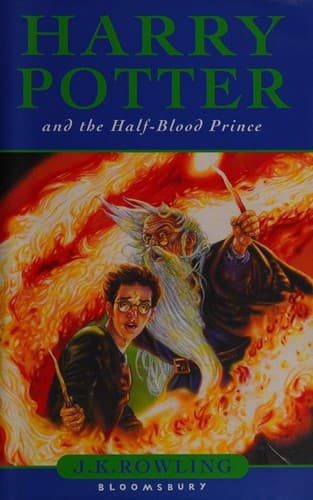
Harry Potter and the Half-Blood Prince
Harry Potter · Book Six
J. K. Rowling·2005·Bloomsbury·Fiction
Reading level: Ages 12+ (YA) · 14-hour read · Intermediate difficulty.
- Reading time
- 14h
- Difficulty
- Intermediate
- Recommended age
- Ages 12+ (YA)
- Guide read
- 5min
- Editor's rating
- 4.5 / 5
- coming-of-age
- british-boarding-school
- modern-fantasy
- millennial-canon
- 2000s
- villain-origin
— In one sentence —
Pitched as the setup book for the finale — and quietly the best character novel in the series, because its real subject is a biography: how an eleven-year-old orphan named Tom Riddle became Voldemort.
§ 01 · WHY READ
Why read
Most readers treat Half-Blood Prince as a setup volume — the book that lays the cards on the table so Deathly Hallows can play them. That's not wrong. The book does explain Horcruxes, set up Snape's apparent betrayal, finalize the central romances, and kill its mentor. But it isn't the whole picture.
The real subject of Book 6 is a question the series has dodged for five books: how did Voldemort become Voldemort?
Across nine Pensieve sequences — the orphanage, the young Riddle at Hogwarts, the visit to his uncle Marvolo, the cave by the sea, the famous conversation with Professor Slughorn — Rowling does something children's literature almost never does. She writes the antagonist's biography. Not his villainy. His coming-of-age. We meet Tom Riddle at eleven, again at sixteen, again at twenty-something. By the end of the book your fear of Voldemort is no longer fear of a noseless monster. It's something stranger and more useful: a sense of the specific places, choices, and small refusals of love that produced him.
This is the most psychologically ambitious work Rowling does in the series. It's also, page-for-page, the funniest book of the seven — the romance subplots are her best comic writing. The combination — high-comedy and biography-of-evil running in parallel — is the technical reason readers come out of Book 6 saying, more often than for any other volume, "I didn't realize that was happening underneath."
§ 02 · CHARACTERS
Characters
The book is organized around a doubled adolescence: Tom Riddle's, retold from memory, against Harry Potter's, sixteen and unfolding in real time.
The two boys
- Young Tom Riddle — eleven, sixteen, twenty-something, in pieces, via Pensieve. The most carefully built character study in the series. The orphanage scene alone — Dumbledore's first meeting with a strange child who already hurts other children — is among the most quietly disturbing chapters Rowling wrote.
- Harry Potter at sixteen — for the first time the protagonist of his own future. The book ends with him deciding to leave Hogwarts. Everything in Books 1–6 has been leading to that decision; now it's his to make.
The new faculty
- Horace Slughorn — Potions master, restored to teaching, walking definition of soft moral failure. Slughorn is the series's most interesting "neutral" character: not evil, not heroic, an old academic who once told a brilliant student about a magical possibility and has been editing the memory ever since. The scene in which Harry finally extracts the real version is the best teacher-student scene in the series.
- Snape teaches Defense Against the Dark Arts at last. The book holds his real position till the final twenty pages.
The villains (deeper now)
- Draco Malfoy becomes a real character for the first time. He has been given an impossible job by Voldemort and a year to do it. The book lets you watch a sixteen-year-old fail at a task no sixteen-year-old should be doing — crying in a bathroom, terrified, alone. Reread this arc after Book 7 and feel something complicated about a character who used to be a one-note bully.
- Bellatrix Lestrange has more time on the page. The series's portrait of true-believer fascism, doing well.
- Fenrir Greyback — the werewolf foil to Lupin. The series's running discussion of how oppression produces opposite responses from members of the same group.
The romances (the comic engine)
- Harry & Ginny — Rowling's most-criticized romantic arc. Functional, quickly resolved, not entirely earned on the page.
- Ron & Hermione — moves slowly, painfully, and with the most acutely observed mid-adolescent jealousy in mainstream YA.
- Ron & Lavender — the comic relief subplot that does important emotional work.
§ 03 · HIGHLIGHTS
Three highlights
No. 1 · The orphanage scene. Chapter 13. Dumbledore visits eleven-year-old Tom Riddle at the orphanage where he's grown up. Roughly fifteen pages in which Rowling shows you a child who is already cruel — not for trauma reasons, not because anyone made him this way, but because something is missing in him from the start. Children's literature almost never permits this scene to exist. Most stories about evil begin with the evil being made; Rowling shows you a boy in whom it was always present, and asks what was missing from the world that might have made it different.
No. 2 · Slughorn's real memory. Chapter 23. Slughorn has spent fifty years editing a single memory — the conversation in which young Tom Riddle asked him about Horcruxes — because he is ashamed of having answered the question. The book's most important scene is Harry getting the old man, after the longest manipulation in the series, to face the unedited version. The whole series's villain is created in two sentences spoken by an embarrassed teacher. It is a brilliant indictment of academic complicity.
No. 3 · The Astronomy Tower. Chapter 27. Dumbledore is killed by Snape, in front of Harry, after a long and quiet conversation between an old man and a frightened boy. On a first read it's a shocking betrayal. On a reread — knowing what's in Book 7 — it becomes one of the series' most devastating scenes: Dumbledore is asking Snape to do this, and Snape, of all people, is being asked to commit the act that will damn his reputation for the rest of his life. The architecture of this scene is the high point of Rowling's craft.
§ 04 · EDITIONS
Recommended editions
| Edition | Why pick it |
|---|---|
| Bloomsbury UK first edition (2005) | The canonical text. Famously sold over nine million copies in the first 24 hours. |
| Scholastic US edition (2005) | Identical title; light Americanization. |
| Bloomsbury House Editions (2025) | Twentieth-anniversary house-color paperbacks; the most attractive HP6 in print. |
| MinaLima illustrated edition | In production (scheduled 2026–27). |
| Stephen Fry audiobook (UK) | His Slughorn alone is worth the cost. ~20 hours. |
| Jim Dale audiobook (US) | Grammy-winning. |
| 2009 film (David Yates) | Yates's third Potter. Often criticized for its dim color grading and for cutting the funeral. The cave sequence is excellent. The Pensieve memories are abbreviated; the book is essential. |
| HBO television series | Season 6 expected ~2029–30. |
Recommended order: read the book first, paying special attention to every Pensieve chapter. Stephen Fry's audio is excellent as a second pass.
§ 05 · FIT
Who it's for / not for
Read this if you are…
- Reading the series in order. Don't skip; the Horcruxes and Snape arc both require Book 6 to make sense.
- An adult who wants to see Rowling at her most psychologically ambitious — the orphanage scene is the strongest single chapter she wrote.
- A reader interested in the craft of how to write a sympathetic villain origin without softening the villain.
Skip it if you are…
- Looking for the series's most action-driven volume. Half-Blood Prince is paced as character study.
- Allergic to comic-romantic subplots in a book that's also about death. The two registers run side by side here, and the contrast is the design.
§ 06 · TIPS
Reading tips
- Difficulty: medium. Sentences are accessible; subtext is dense.
- Length: ~170,000 words; 13–16 hours.
- Read aloud age: 11+. The cave sequence is genuinely frightening.
- Pensieve discipline. Each Pensieve chapter is a load-bearing brick. Don't skim them, even when the present-day plot is more fun.
- High reread value. After Book 7, the Astronomy Tower chapter alone is a different scene. The whole book quietly rearranges itself.
§ 07 · COMPARE
Read alongside
- Mary Shelley — Frankenstein (1818). The other foundational children's-fantasy lineage about creating the antagonist. Half-Blood Prince is in the same genre — the origin of a villain — and has many of the same problems.
- Vladimir Nabokov — Lolita (1955). Adult fiction's most uncomfortable example of how to write inside a monster's head without exonerating him. Useful comparison for what Rowling is trying to do with Tom Riddle.
- Patricia Highsmith — The Talented Mr. Ripley (1955). Another character study of a person who shouldn't generate sympathy but does. Compare Highsmith's strategy with Rowling's.
- Robert Galbraith — The Silkworm (2014). Rowling herself doing adult crime fiction; she carries Slughorn's voice forward.
§ 08 · DISCUSSION
Discussion questions
- Dumbledore takes Harry on a tour of Tom Riddle's life. Is that education or grooming? When does a teacher's preparation for what a student must do tip into something less defensible?
- Rowling lets you feel something complicated about Voldemort by Book 6. Is producing reader sympathy for a future genocidaire an honest craft move, or a manipulative one?
- Draco Malfoy's arc this book — a sixteen-year-old crying alone in a bathroom because the adults gave him a job he cannot do — was a controversial pivot for many readers. Is it a redemption, a complication, or an excuse?
- Slughorn's "Slug Club" is a kindly version of academic patronage. Is the book critical of it, or quietly fond of it? How can you tell?
- The romance lines in Half-Blood Prince are the most-criticized in the series. Reread them with the question: what work are they doing structurally that the book would lose without them?
- Reread the Astronomy Tower chapter with Book 7's revelations in mind. Identify three details whose meaning changes completely on second read.
- Dumbledore here is closer to the manipulative chess-master his critics accuse him of being than at any prior point. Has Rowling been arguing this all along, or did she change her mind about him between books?
- Of the seven books, which has the most narrowly accurate adult portrait of being a teenager — and is Half-Blood Prince on that list?
One line to remember
“It is the unknown we fear when we look upon death and darkness, nothing more.”— Albus Dumbledore — Chapter 26, The Cave
Appears in collections
Reading lists featuring this book
7 books
Harry Potter · A 7-Book Reader's Guide
Seven novels, one boy who grows up. Where to start, how to pace, what each book is actually about — and when to take a break.
Open list →
7 books
Harry Potter Reading Level by Book
The age range, reading difficulty, and content notes for every book in the Harry Potter series — book by book.
Open list →
You might also like
Read next
Kazuo Ishiguro · 2005
Never Let Me Go
A science-fiction novel so quiet about being science fiction that most readers finish it before they realize what they've agreed to.
Read · 5 min
Emily St. John Mandel · 2014
Station Eleven
A pandemic kills most of humanity. Twenty years later, a travelling Shakespeare company performs for survivor settlements. Mandel is interested in what survives and why.
Read · 5 min
Kathryn Stockett · 2009
The Help
Jackson, Mississippi, 1962. Three women — two Black maids and a young white woman — collaborate on a book that could destroy all of them. A novel about courage, complicity, and the stories that get left out.
Read · 4 min