Golden set · editor-reviewed
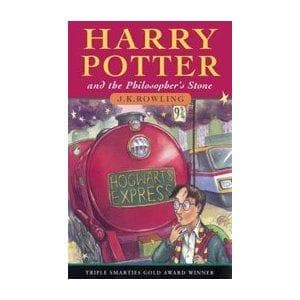
Harry Potter and the Philosopher's Stone
Harry Potter · Book One
J. K. Rowling·1997·Bloomsbury·Fiction
Reading level: Ages 8–12 (middle grade) · 7-hour read · Beginner difficulty.
- Reading time
- 7h
- Difficulty
- Beginner
- Recommended age
- Ages 8–12
- Guide read
- 5min
- Editor's rating
- 4.2 / 5
- coming-of-age
- british-boarding-school
- modern-fantasy
- millennial-canon
- 1990s
— In one sentence —
The book that taught a generation of TV-raised kids to stay up all night reading — and built the cultural grammar a quarter of the planet still talks in.
§ 01 · WHY READ
Why read
J. K. Rowling is not the most graceful sentence-level writer in English fantasy. Saying so doesn't take anything away from this book — it just frees us to talk about what it actually achieved.
Philosopher's Stone did one thing better than almost any novel of the late twentieth century: it made millions of kids who had never voluntarily finished a book stay up past midnight to finish a 223-page chapter book. Library lending data, school reading surveys, and the publishing industry's own statistics all show the same break point in 1997. Whatever you think of the writing, that is a feat of cultural engineering on the level of Star Wars.
The method is specific and worth understanding. Rowling welds two completely safe genres — the English boarding-school story (Tom Brown, Enid Blyton, Jennings) and the orphan-discovers-secret-inheritance fairy tale (Cinderella, every Disney film up to 1996) — onto a third element kids almost never see in either: a school where the curriculum is the magic. Latin lessons become spell vocabulary. Bullies have wands. The detention is in a forest with a unicorn corpse in it.
The author has, in the years since, said things many readers find hard to live with. That conversation deserves its own honest hearing — but it is a different book than the one in your hands. The book in your hands is from 1997, and it is doing something the 1997 book is responsible for. Read it as a 1997 book first.
§ 02 · CHARACTERS
Characters
The cast of HP1 is small but tightly designed. The cleanest way to track it is as four groups facing the same question — what do you do with power you didn't ask for?
The trio · three answers to the same question
- Harry has fame pressed on him before he can speak. His arc is restraint — learning to under-use what he's been handed.
- Ron has almost nothing materially, in a family that loves him. His arc is acceptance — learning that ordinary, in a magical world, is still magical.
- Hermione earns her power through work and pays for it socially. Her arc is humility — learning the difference between knowing and being right.
The faculty · four flavors of authority
- Dumbledore is the genre's archetypal wise old wizard, played mostly straight, with one telling exception (see Highlights below).
- McGonagall is the strict-but-fair authority you wish you'd had.
- Snape is the deliberately ambiguous one. Reread him only after Book 7 — Rowling is playing a very long game.
- Hagrid is the most morally important adult in the book: an adult who never quite grew up and is therefore unguarded with children.
The two families · the book's moral compass
- The Dursleys are the Muggle world done as horror. Vernon is the only character in 1990s children's fiction allowed to be this petty.
- The Weasleys show up briefly but stake a flag: this is what a warm family looks like in this world. The rest of the series will be in dialogue with them.
The shadow
- Voldemort is barely on the page. That restraint is one of the book's best decisions. The series has six more books to put him on screen.
- The Malfoys are the everyday face of his ideology — much harder to dismiss than the disembodied villain.
§ 03 · HIGHLIGHTS
Three highlights
No. 1 · The opening chapter is told from the wrong POV — on purpose. Chapter 1 is narrated almost entirely from Vernon Dursley's perspective. Harry appears only at the end, asleep, as a baby on a doorstep. For a children's book this is structurally daring: most kids' novels open inside the protagonist. Rowling's choice lets the reader meet the magical world as a Muggle who refuses to see it — which is exactly the cultural posture the rest of the series will spend seven books dismantling.
No. 2 · Quidditch is worldbuilding, not sport. Many readers skim the Quidditch chapters. They're missing the trick. Quidditch isn't there for the matches; it's there because a society's chosen game is the cleanest possible way to show its values without lecturing. The Snitch — a single point worth more than all other plays combined — is a class system, a celebrity culture, and a critique of both, in one rule. Notice how every Quidditch match in the series ends on a Snitch catch. Then notice which character finally refuses to play that way.
No. 3 · The Mirror of Erised, and a sentence no children's book is required to contain. Halfway through the book, an eleven-year-old looks into a mirror that shows his deepest desire and sees his dead parents. The headmaster finds him there at 3 a.m. and says, gently: "It does not do to dwell on dreams and forget to live." This is a grown-up's grief, addressed at child height, in twelve words. The series doesn't earn another sentence at this register until Book 7. Read this chapter twice.
§ 04 · EDITIONS
Recommended editions
The translation question doesn't apply here — the book is written in English. The version question does, and the differences are bigger than most readers realize.
| Edition | Why pick it |
|---|---|
| Bloomsbury UK first edition (1997) | The canonical text. "Philosopher's Stone" — the title Rowling wrote. |
| Scholastic US edition (1998) | Retitled Sorcerer's Stone by the US publisher; some Britishisms Americanized ("jumper" → "sweater", etc.). Fine, but a worse cultural artifact. |
| Bloomsbury House Editions (2017) | Twentieth-anniversary paperbacks in four colors keyed to Hogwarts houses. Best gift edition. |
| Jim Kay illustrated edition (Bloomsbury 2015) | Full-color illustrated hardcover. The Diagon Alley spread alone justifies the price. |
| MinaLima illustrated edition (Scholastic 2020) | Movie-graphic-design house. Heavier on infographic spreads. |
| Stephen Fry audiobook (UK) | Widely held as one of the best English audiobooks ever recorded. Start here if you commute. |
| Jim Dale audiobook (US) | Grammy-winning. More character voices than Fry; slightly more theatrical. Camp choice. |
| 2001 film (Chris Columbus) | Faithful to a fault. The casting of Maggie Smith and Alan Rickman is half the reason this film series still works. |
| HBO television series | In production as of 2026; expected 2027. Showrunner Francesca Gardiner. Wait and see. |
Recommended order: read the Bloomsbury UK paperback first. Listen to the Stephen Fry audiobook on a second pass — you will catch jokes you missed.
§ 05 · FIT
Who it's for / not for
Read this if you are…
- An 8-to-12-year-old reading their first long novel.
- An adult who never read it as a kid and wants to know what everyone has been quoting for thirty years.
- A reader of fantasy who wants to understand the post-1997 commercial ground state of the genre.
- A parent deciding whether to read it aloud (yes, but pre-read so you can soften the Dursley chapters if needed).
Skip it if you are…
- Looking for sentence-level literary fiction. Beloved this is not.
- Allergic to fantasy as a genre. The whole series will not convert you.
- Unable to separate the 1997 book from the 2020s author — that is a defensible position and the book is not going anywhere if you change your mind later.
§ 06 · TIPS
Reading tips
- Difficulty: low. Most adult readers finish in a single long evening.
- Length: about 76,000 words; 6–8 hours.
- Read aloud age: 6+ with light editing; independent read at 9+.
- Skip the films first. The cast is so iconic that the book's descriptions will collapse into the actors' faces. Read the book once with your own pictures.
- Don't stop at Book 1. The series only finds its real subject — what fascism looks like inside a teenager's school — from Book 4 onward. If you're reading as an adult, give it through Goblet of Fire before deciding.
§ 07 · COMPARE
Read alongside
- C. S. Lewis — The Lion, the Witch and the Wardrobe (1950). The grandparent. More explicitly Christian, shorter, structurally cleaner.
- Philip Pullman — Northern Lights / The Golden Compass (1995). Same decade, opposite politics. Often called the "anti-HP." More ambitious philosophically; less warm.
- Roald Dahl — Matilda (1988) or The Witches (1983). The other big author kids who hate reading actually finish. Sharper sentences than Rowling; meaner worldview.
- Ursula K. Le Guin — A Wizard of Earthsea (1968). The wizard-school book Rowling has politely declined to acknowledge owing anything to. Read it and judge for yourself.
- Patrick Rothfuss — The Name of the Wind (2007). Magic school for grown-ups. Better prose; worse pacing.
§ 08 · DISCUSSION
Discussion questions
- The book opens from Vernon Dursley's POV. What would change if it opened from Harry's? What does Rowling buy by choosing the more boring narrator?
- Ron is often called "the third wheel" of the trio. Reread his role: what would the book lose if you replaced him with a more competent Hermione-type?
- Dumbledore withholds the truth about Harry's parents, the Stone, and several other things from an eleven-year-old who has nearly died because of that withholding. Is this protection or manipulation?
- The Sorting Hat says Slytherin would help Harry achieve greatness. Harry refuses. Does the book actually believe in the moral system the Hat represents, or is it critiquing it?
- The book's villain is a man who returns from the dead and wants to live forever at the cost of others. The hero, by Book 7, will choose to die. Is the seven-book argument really about choice, or about death? Pick one and defend it.
- Read the Mirror of Erised chapter again. Is Dumbledore's line ("It does not do to dwell on dreams and forget to live") aimed at Harry, or at the reader?
- The "pure-blood" rhetoric in the wizarding world maps onto twentieth-century racism in fairly direct ways. Does the 1997 reader and the 2026 reader read this rhetoric the same way? Should they?
- You're a parent. Your eight-year-old asks for this book. The author has, in the years since, said things you don't want repeated at the dinner table. What's the conversation, and when do you have it?
One line to remember
“It does not do to dwell on dreams and forget to live.”— Albus Dumbledore — Chapter 12, The Mirror of Erised
Appears in collections
Reading lists featuring this book
7 books
The Best Books for 8-Year-Olds
Seven books an eight-year-old can actually finish — and remember the rest of their life.
Open list →
12 books
Best Children's Books by Age
A parent-friendly reading list from baby read-alouds and picture books to early readers, first chapter books, middle grade, and teen crossover.
Open list →
6 books
Most Addictive Books to Read
Six books with hooks so specific you'll remember exactly where you were when you couldn't stop.
Open list →
7 books
Best Coming of Age Novels
Six novels about the specific moment of becoming — organized by protagonist age and what each book says about that moment.
Open list →
10 books
The Gateway: Fantasy for Young Readers Ages 8–12
The books that made readers. A curated path into fantasy for children who are ready for a real story.
Open list →
7 books
Harry Potter · A 7-Book Reader's Guide
Seven novels, one boy who grows up. Where to start, how to pace, what each book is actually about — and when to take a break.
Open list →
7 books
Harry Potter Reading Level by Book
The age range, reading difficulty, and content notes for every book in the Harry Potter series — book by book.
Open list →
You might also like
Read next
Kazuo Ishiguro · 2005
Never Let Me Go
A science-fiction novel so quiet about being science fiction that most readers finish it before they realize what they've agreed to.
Read · 5 min
Emily St. John Mandel · 2014
Station Eleven
A pandemic kills most of humanity. Twenty years later, a travelling Shakespeare company performs for survivor settlements. Mandel is interested in what survives and why.
Read · 5 min
Kathryn Stockett · 2009
The Help
Jackson, Mississippi, 1962. Three women — two Black maids and a young white woman — collaborate on a book that could destroy all of them. A novel about courage, complicity, and the stories that get left out.
Read · 4 min