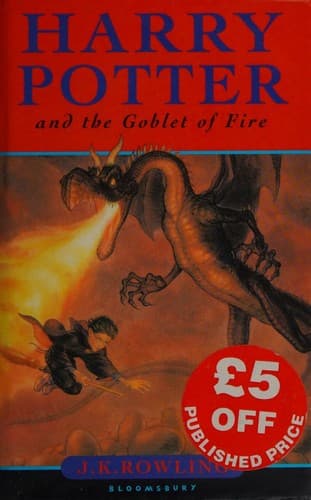
Golden set · editor-reviewed
Harry Potter and the Goblet of Fire
Harry Potter · Book Four
J. K. Rowling·2000·Bloomsbury·Fiction
Reading level: Ages 10+ (YA) · 13-hour read · Intermediate difficulty.
- Reading time
- 13h
- Difficulty
- Intermediate
- Recommended age
- Ages 10+ (YA)
- Guide read
- 5min
- Editor's rating
- 4.4 / 5
- coming-of-age
- british-boarding-school
- modern-fantasy
- millennial-canon
- 2000s
- tonal-pivot
— In one sentence —
The pivot book. The series before it is a children's adventure; the series after it is a war novel. The hinge is one funeral, one resurrection, and one speech.
§ 01 · WHY READ
Why read
Rowling has said in interviews that Goblet of Fire was the book where she stopped writing for children and started writing for the readers her original children had become. She's right, and the change is visible on the page.
Three things happen in this book that hadn't happened before:
- Someone dies. Cedric Diggory — a decent seventeen-year-old who has done nothing wrong — is killed in a graveyard fifteen minutes after winning a sporting trophy. Rowling has said she planned the death from Book 1. The series before Cedric is a different series than the one after.
- Voldemort comes back in a body. Not a faint memory in a diary, not a parasite on the back of someone's head, not a name in a history lesson. A flesh-and-blood man walks out of a cauldron, surrounded by his old followers, fully restored. Children's literature has not staged anything like this resurrection scene since.
- Politics enters. Up to this book, the wizarding world is an interesting place with a few worrying signs. In Book 4 it has a Ministry, an international press, a sports lobby, a corrupt journalism class, and a state that will choose denial over difficult truth. The next three books are about that state failing.
Read alongside Book 1 if you only have time for two. The arc bends here, and you can feel it bending.
§ 02 · CHARACTERS
Characters
The book's central move is horizontal world-expansion. For three books we've been in one school in one country. Now there are two more schools, an international press corps, a Ministry-level event, and characters Harry meets who do not call him by name.
The Triwizard champions · three flavors of seventeen
- Cedric Diggory — Hufflepuff prefect, conventionally golden-boy good. The book's reason for existing. Reread him on a second pass knowing where he ends.
- Fleur Delacour — Beauxbatons champion, part-Veela. Often dismissed by readers as decorative; rewards a second look when you see what Rowling does with her in Books 6–7.
- Viktor Krum — Durmstrang champion, international Quidditch star, courteous bear of a young man. Hermione's date to the Yule Ball, which is also the trio's first real fracture.
The new political characters
- Cornelius Fudge — Minister for Magic. Embodies the politics of motivated reasoning. His refusal at the end of this book to believe Voldemort is back is the entire engine of Book 5.
- Barty Crouch Sr. — Director of International Magical Cooperation, former head of Magical Law Enforcement. The book's portrait of authoritarian justice — sent his own son to Azkaban, gave the Aurors permission to use Unforgivables. Get a good look at him; the book will pivot on his name.
- Rita Skeeter — Daily Prophet columnist. Rowling's sharpest portrait of tabloid journalism, written eight years before phone-hacking became a UK national scandal.
- Ludo Bagman — Head of the Department of Magical Games and Sports, indebted gambler, charming fraud. The third in the series's recurring portrait of incompetent men in important offices.
The villain returns
- The fake Mad-Eye Moody. The most cleanly executed long-form deception in the series. On a reread, every Moody scene gains a second, malevolent meaning.
- Voldemort. First full bodily appearance. Eyes, voice, hands, breath.
§ 03 · HIGHLIGHTS
Three highlights
No. 1 · The Quidditch World Cup riot. Goblet of Fire opens at the wizarding Olympics. For 150 pages it is the most joyful Harry Potter book yet — Veela cheerleaders, leprechaun gold, a sport played 100 metres in the air. The morning after, masked figures torch a campsite, hang Muggle children upside-down in the sky, and burn the Dark Mark into the clouds. The tonal switch from carnival to pogrom takes two pages. It's the most technically impressive transition Rowling ever attempts.
No. 2 · The graveyard. Chapter 32, "Flesh, Blood, and Bone." Eleven pages, almost real-time. A boy your hero met three months ago is killed with a casual two-word curse. Your hero is tied to a gravestone. A traitor cuts off his own hand for power. Voldemort steps out of a cauldron and crucio's a teenager for sport. Read this chapter and ask yourself when the last time you read children's fiction at this register was.
No. 3 · Dumbledore's end-of-year speech. Final feast. Dumbledore tells the entire school that Cedric was murdered by Voldemort — defying the Ministry's official line in front of two foreign schools — and asks them to face "the choice between what is right and what is easy." This is the moment the series declares it has become a different kind of book. From here on we are in a war novel that happens to feature wizards.
§ 04 · EDITIONS
Recommended editions
| Edition | Why pick it |
|---|---|
| Bloomsbury UK first edition (2000) | The canonical text. First Potter book to cross 600 pages. |
| Scholastic US edition (2000) | Identical title; light Americanization. |
| Bloomsbury House Editions (2020) | Twentieth-anniversary house-color paperbacks. The Yule Ball edition is gorgeous. |
| MinaLima illustrated edition (Scholastic 2024) | Triwizard Cup fold-out is one of the highlights of the illustrated reissue line. |
| Stephen Fry audiobook (UK) | Fry's Krum accent is justly controversial; his Cedric is straight perfection. |
| Jim Dale audiobook (US) | Grammy-winning; about 21 hours unabridged. |
| 2005 film (Mike Newell) | Often criticized for pacing — necessarily, because the book is twice the length of the previous three. Cedric's death and the graveyard sequence are extremely well-shot. The film loses the SPEW subplot, the Bagman thread, and most of the politics, all of which matter for Book 5. Read the book first. |
| HBO television series | Season 4 expected ~2028–29 — the first book likely to span two TV seasons. |
Recommended order: read the book before any film or audiobook. The graveyard sequence in particular reads differently when you didn't already know what's coming.
§ 05 · FIT
Who it's for / not for
Read this if you are…
- Reading the series in order and arrived here on schedule. Don't skip.
- An adult who heard Harry Potter "gets serious in Book 4" and wants to know if that's true. It is.
- A writer studying how to escalate tone across a long series without losing the readers who came in for the cozy book.
Skip it if you are…
- A reader hoping the series will stay light. From Book 4 forward it does not.
- Reading aloud to a child under ten. The graveyard chapter is not for them.
§ 06 · TIPS
Reading tips
- Difficulty: medium. Sentences and politics are now genuinely adult.
- Length: ~190,000 words; 12–15 hours. Twice the length of Philosopher's Stone. The page count starts climbing here and doesn't come back down.
- Read aloud age: 11+, and we'd recommend pre-reading the graveyard chapter as a parent first.
- Pace yourself. A common reader experience is to skim the middle 200 pages (Yule Ball politics, SPEW, Bagman). Don't — the second-tournament-task chapters carry the Bagman/Crouch Jr. payoffs that matter in Books 5 and 7.
- Mark the chapter numbers of every Moody scene on a first read. On reread you'll want to find them.
§ 07 · COMPARE
Read alongside
- Stephen King — It (1986). The other famous "the children's adventure stops being children's" pivot book. King's pivot lasts seven chapters; Rowling's lasts seven hundred pages. Compare.
- Diana Wynne Jones — Hexwood (1993). A children's-fantasy book in which the world the protagonist thought they understood turns out to be a much larger and more dangerous one.
- Madeleine L'Engle — Many Waters (1986). The Murry series's pivot toward darker theology — the structural parallel to Goblet of Fire in L'Engle's sequence.
- Susanna Clarke — Jonathan Strange & Mr Norrell (2004). Adult fantasy at the scale of nation-states and ministries. The book Harry Potter starts to look like in Books 4–7.
§ 08 · DISCUSSION
Discussion questions
- Cedric Diggory is killed essentially because the plot requires it: he is innocent, well-liked, and structurally available. Is sacrificing a minor character to mature a series a defensible craft move, or a cheap one?
- The Triwizard Tournament is full of plot holes (why would Hogwarts host a tournament with three lethal tasks for seventeen-year-olds?). Why do most readers not care? What does that reveal about how fantasy contracts work?
- Rita Skeeter's coverage of Harry is a sharp portrait of tabloid press. In 2026, is the satire more accurate than in 2000, or has the media landscape shifted in ways the book can't capture (Twitter, podcasts, algorithmic outrage)?
- Cornelius Fudge's denial of Voldemort's return is, in retrospect, an extremely current portrait of political denial. Does the book argue that Fudge is uniquely weak — or that any official, given the choice, would have done the same?
- Voldemort's resurrection scene is among the most graphic in mainstream children's fiction. Did Rowling earn it — and could a debut author publish that chapter today?
- The trio's first real fight happens at the Yule Ball. Reread Hermione's part of that argument. Is she right? Are they?
- Harry's first romantic interest (Cho Chang) is widely considered the series's weakest romantic line. What does the book want from this subplot that it doesn't get?
- If you had to cut 200 pages from Goblet of Fire, where would you cut — and what would you accidentally break in Book 5?
One line to remember
“We must all face the choice between what is right and what is easy.”— Albus Dumbledore — Chapter 37, The Beginning
Appears in collections
Reading lists featuring this book
7 books
The Best Books for 10-Year-Olds
Seven books for the year a child stops needing books to be easy.
Open list →
7 books
Harry Potter · A 7-Book Reader's Guide
Seven novels, one boy who grows up. Where to start, how to pace, what each book is actually about — and when to take a break.
Open list →
7 books
Harry Potter Reading Level by Book
The age range, reading difficulty, and content notes for every book in the Harry Potter series — book by book.
Open list →
You might also like
Read next
Kazuo Ishiguro · 2005
Never Let Me Go
A science-fiction novel so quiet about being science fiction that most readers finish it before they realize what they've agreed to.
Read · 5 min
Emily St. John Mandel · 2014
Station Eleven
A pandemic kills most of humanity. Twenty years later, a travelling Shakespeare company performs for survivor settlements. Mandel is interested in what survives and why.
Read · 5 min
Kathryn Stockett · 2009
The Help
Jackson, Mississippi, 1962. Three women — two Black maids and a young white woman — collaborate on a book that could destroy all of them. A novel about courage, complicity, and the stories that get left out.
Read · 4 min