Book list · Editor's pick·Vol. 002·Fiction
Harry Potter · A 7-Book Reader's Guide
Seven novels, one boy who grows up. Where to start, how to pace, what each book is actually about — and when to take a break.
- Books
- 7
- Total reading
- 87h
- Authors
- 1
- Time span
- 1997–2007 (UK first editions)
- harry-potter
- rowling
- reading-order
- where-to-start
- ya-fantasy
- 1990s
- 2000s
- millennial-canon
Updated 2026-05-20
— Why read this list —
The best-selling fantasy series of the twentieth century gets a million words of competent analysis. Here is the part most of them miss: which books in the seven are quietly doing the real work.
Why these seven
It is an unusual fact about the modern English-speaking world that an extremely large share of adults under forty have, as part of their basic literacy, the same seven children's novels. Harry Potter is the most-shared piece of capital-L Literature of the millennial and Gen-Z generations — comparable, in cultural distribution, to Pilgrim's Progress for the late-Victorians or Treasure Island for the Edwardians. You can argue with the comparison; you cannot, in 2026, argue with the reach.
This collection assumes that fact and tries to be useful about it. We are not here to convince you to read the series. If you've made it this far, you have an opinion. We are here to help you read the seven books well — in a defensible order, at a workable pace, paying attention to the parts most adult readers miss.
We've covered the questions you might bring to this list one by one in the individual book guides. Read those for the deep dive. What this collection adds, on top:
-
The publication-order argument. Every "out-of-order" reading plan you see floating around the internet is, at best, a curiosity. The series is engineered to be read 1 through 7. Reveals are timed. Snape's actual position is hidden by the running joke that he is a villain. The trio's friendship rhymes with adult relationships you only see later. You get this once. Skip an installment and you don't get the surprises that book is timed to deliver.
-
The "Book 2 isn't the weakest" argument. Many readers skim Chamber of Secrets because the internet has told them it's the worst. They miss four mechanisms (mudblood, Tom Riddle's name, the first Horcrux, Parseltongue) that the next five books require. Half-Blood Prince doesn't work without them.
-
The literary-peak argument. Prisoner of Azkaban is, by most adult readers' second read, the strongest book in the series. Voldemort is offstage. The climax is a recognition. The metaphors land. If you are coming back as an adult, this is the book you've been remembering.
-
The reread-vs-read distinction. Order of the Phoenix is the most disliked book on a first read and the most reread-rewarding book in the series. Goblet of Fire and Deathly Hallows are the opposite — extraordinary on first read; flatter on the third.
A few honest notes the marketing copy will not tell you:
- The author. J. K. Rowling has said things in the years since publication that many readers find difficult. The relationship between a 1997 children's novel and a 2025 author's political positions is a personal call. We separate them in our guides; you may not want to. Both are defensible.
- The prose. Sentence-level, Rowling is competent but not stylish. If you're coming from George Eliot or Toni Morrison, calibrate. The series's strengths are architecture, voice, and emotional precision — not the line.
- The page count. 87 hours of reading is a non-trivial commitment. The average reader who finishes the series takes 4-6 months. Plan accordingly.
How to use this guide
Below is the index. Books appear in publication order with a one-paragraph collection-internal pitch — our editorial argument for why this book matters in the context of the series. The full 10-module reader's guide (why read, characters, three highlights, recommended editions, fit, reading tips, read alongside, discussion questions) lives at the linked book page.
Above the entries: three reading paths. Pick one before you start.
Editions and translation notes are at the book level. In English the seven books are simple — Bloomsbury UK first editions for purists, Scholastic US for slightly Americanized text, Bloomsbury House Editions (2017–2027) for the gift versions, Jim Kay illustrated through Book 4 (paused due to illness), MinaLima illustrated in progress through 2026.
Films and TV: skip the films on first read so the book's descriptions don't collapse onto the actors' faces. The Cuarón Prisoner of Azkaban is the one film genuinely worth your time on its own merits. HBO's series begins production in 2026 with a 2027–28 release window.
The seven book entries follow.
Reading paths
Three orders. Pick one before you start.
If you have never read the series
Read in publication order, 1 through 7. The series is engineered to be read this way — every reveal is timed to surprise a first-time reader. Don't read summaries, don't watch the films first, don't skip Book 2 even if the internet tells you to.
Book 1›Book 2›Book 3›Book 4›Book 5›Book 6›Book 7
If you read it as a kid and want to come back as an adult
Skim Books 1 and 2 for refresh, then read 3 through 7 slowly. The series's literary strength accelerates after Book 3; you already know the plot, so spend time on the architecture (Snape's behavior, Dumbledore's manipulations, Rowling's foreshadowing density).
Book 3›Book 4›Book 5›Book 6›Book 7
If you are reading aloud to a child
Start when they're 7-8. Books 1-3 are safe for that age. Pause before the Book 4 graveyard sequence — many parents pre-read it and decide whether to soften or skip. Books 5-7 are a 12+ commitment and benefit from being read independently after a break.
Book 1›Book 2›Book 3
The 7 books
In publication order
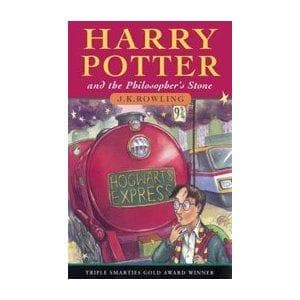
Book 1·The entry point
Harry Potter and the Philosopher's Stone
J. K. Rowling·1997
The book that made millions of non-readers stay up past midnight. Not Rowling's best sentence-level writing — she's said so herself — but the most important act of cultural engineering in late-twentieth-century children's literature. Read the Bloomsbury UK first edition; the US 'Sorcerer's Stone' loses small things that matter.
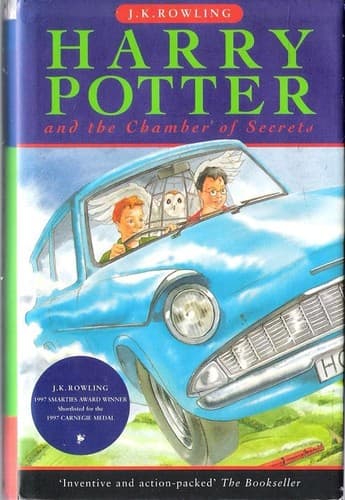
Book 2·The load-bearing wall
Harry Potter and the Chamber of Secrets
J. K. Rowling·1998
Fan consensus weakest of the seven. Also the volume in which Rowling secretly installs four mechanisms (the word 'mudblood', the name Tom Riddle, the first Horcrux, Parseltongue) the next five books cannot work without. The achievement is hiding the foundations inside the book everyone calls the worst.
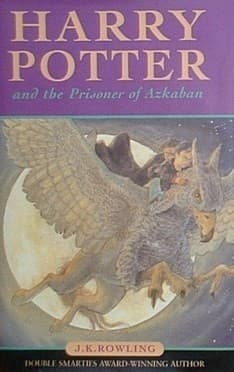
Book 3·The literary peak
Harry Potter and the Prisoner of Azkaban
J. K. Rowling·1999
Fan + critic consensus best in the series. Voldemort is offstage for the whole book. The climax is a quiet recognition in a shack, not a duel. Pair with Cuarón's 2004 film — the only Potter adaptation that's a great film on its own terms. If you reread one Potter book in your life, this is the one.
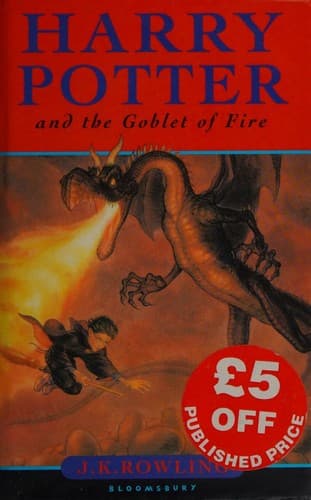
Book 4·The tonal pivot
Harry Potter and the Goblet of Fire
J. K. Rowling·2000
The book where the series stops being a children's adventure and becomes a war novel. First death, first physical Voldemort, first politics. Twice the length of Book 1; the page count climbs here and doesn't come back down. Plan for two long evenings or one full weekend.
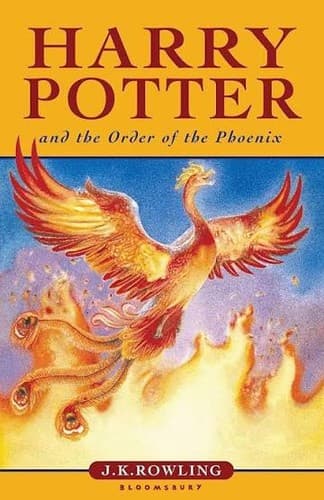
Book 5·The political novel
Harry Potter and the Order of the Phoenix
J. K. Rowling·2003
The longest, hardest, most polarizing volume. Most readers dislike it on first read and love it on reread — that should tell you what kind of book it is. The real subject is institutional denial; the antagonist is a smiling functionary in a pink cardigan. A 2020s reader will recognize it fast.
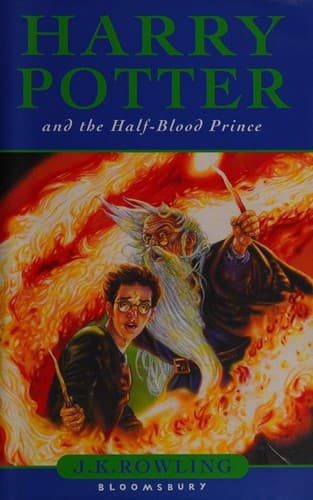
Book 6·The villain biography
Half-Blood Prince
J. K. Rowling·2005
Pitched as setup for the finale. Quietly the best character novel of the seven, because its real subject is the biography of Tom Riddle — how an eleven-year-old at an orphanage became the man at the end of the series. The orphanage chapter is the strongest single scene Rowling wrote.
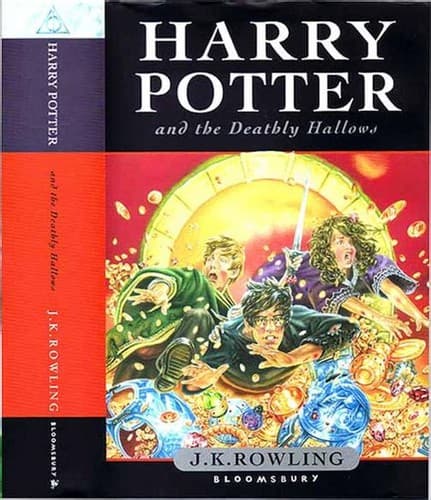
Book 7·The reckoning
Deathly Hallows
J. K. Rowling·2007
Read for six books as a story about good defeating evil — actually a story about a seventeen-year-old learning to die. 'The Prince's Tale' (Ch. 33) and 'King's Cross' (Ch. 35) are the high points of mainstream YA writing in English. Save it for a stretch of time when you can sit with the last page.