Editor-reviewed
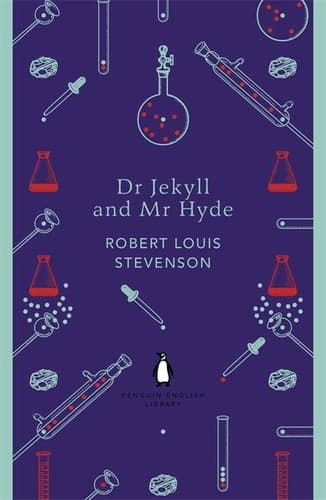
The Strange Case of Dr Jekyll and Mr Hyde
Robert Louis Stevenson·1886·Longmans, Green and Co.·Literature
Reading level: Ages 12+ (YA) · 2-hour read · Beginner difficulty.
- Reading time
- 2h
- Difficulty
- Beginner
- Recommended age
- Ages 12+ (YA)
- Guide read
- 4min
- Editor's rating
- 4.4 / 5
- stevenson
- victorian
- gothic
- horror
- london
- psychology
- novella
- canonical
- duality
— In one sentence —
Stevenson wrote the first draft in six days. Everyone knows the ending. Almost no one has read the novella — which is not the story they think it is.
§ 01 · WHY READ
Why read
Robert Louis Stevenson wrote the first draft of The Strange Case of Dr Jekyll and Mr Hyde in six days in 1885 — the result, he said, of a dream. His wife Fanny read it and said it was too sensational, too much a thriller, not enough of what it was actually about. He burned the draft and rewrote it, this time as the novella that was published in January 1886. It sold 40,000 copies in six months. Gladstone read it; Queen Victoria read it. It went through six editions in the first year.
The cultural knowledge of the story is so complete — Jekyll, Hyde, the transformation, the dual nature of man — that most readers believe they know what the novella contains. Most have not read it.
What the novella actually is: a mystery story. It is narrated not by Jekyll or Hyde but by Gabriel Utterson, a lawyer and friend of Jekyll's, who is investigating what hold Hyde has over Jekyll — why Jekyll has written Hyde into his will, why he seems frightened of Hyde, who Hyde is and where he came from. The reader does not learn that Jekyll and Hyde are the same person until the final two chapters, which are documents — a letter from Dr. Lanyon describing what he witnessed, and Jekyll's own "Full Statement of the Case." The transformation and the explanation arrive at the end; the body of the novella is an investigation.
This structure means that the novella's atmosphere — the fog, the London streets, the locked doors, the sense of something hidden in plain sight — is the experience, not the twist. The gothic sensibility is the content.
§ 02 · CHARACTERS
Characters
Gabriel Utterson — the lawyer-narrator, a dry, rational, loyal man who is troubled by what he knows and what he doesn't know about his friend Jekyll. He is Stevenson's choice of perspective: a man without imagination who encounters something imagination cannot prepare you for.
Dr. Henry Jekyll — a respected physician and scientist who has discovered a chemical means of separating the good and evil aspects of his personality. His experiment produces Hyde. His "Full Statement" at the novella's end is the closest thing to a first-person account of what the experiment did and why it ended the way it did.
Mr. Edward Hyde — Jekyll's other self, given physical form. He is consistently described as disturbing in a way observers cannot articulate — small, deformed somehow, exuding malevolence. The difficulty of describing Hyde is part of Stevenson's point: pure evil, extracted from a human being, does not look like what we expect it to look like.
Dr. Hastie Lanyon — Jekyll's former friend, a rationalist scientist who witnesses Hyde's transformation back into Jekyll and is destroyed by the knowledge.
§ 03 · HIGHLIGHTS
Three highlights
No. 1 · The mystery structure. Because the novella is a mystery rather than the familiar transformation story, Utterson's investigation of Hyde — who is he, why does Jekyll fear him, what is the nature of their relationship — builds genuine dread. The Victorian reader did not know the ending; they were reading a mystery about a hidden crime. Recovering this reading experience requires treating the novella as a mystery, which means not jumping ahead to the explanation.
No. 2 · Hyde in the street. The novel's opening scene: Hyde walks through a crowd in the street and knocks down a small girl. He does not stop. He is compelled by the crowd to pay a fee; he does so with complete indifference. The description of the incident — told by Utterson to Enfield to the reader — is not what makes it disturbing. What is disturbing is that no one can describe why Hyde disturbed them so much. He looked wrong, somehow. He produced an instinctive revulsion. Stevenson is making an argument about what the face of evil actually looks like: not dramatic, just wrong.
No. 3 · Jekyll's Full Statement. The novella's final chapter: Jekyll's explanation in his own words, written knowing he will be dead before it is read. He explains the experiment, the initial pleasure of being Hyde, the gradual loss of control, the point at which Hyde began to appear without the chemical transformation. The explanation is complete, but the completion does not diminish the horror — it intensifies it. Understanding how it happened does not make it less terrible.
§ 04 · EDITIONS
Recommended editions
| Edition | Why pick it |
|---|---|
| Penguin Classics | The standard edition; includes helpful notes and a good introduction. |
| Oxford World's Classics | Includes the novella alongside Stevenson's essays on writing and the dream origin of the story. |
| Collected Stevenson | For readers who want to go further: Kidnapped (1886) and Treasure Island (1883) alongside Jekyll and Hyde. |
The novella is approximately 70 pages. Read it in one or two sittings; the atmosphere accumulates and should not be interrupted.
§ 05 · FIT
Who it's for / not for
Read this if you are…
- Anyone who knows the story from cultural adaptation but hasn't read Stevenson's novella. The experience of reading the mystery before the revelation is unavailable in adaptation.
- Readers interested in Victorian gothic: the fog, the locked doors, London's double life of respectability and hidden vice — Stevenson renders all of it precisely.
- Anyone interested in how a cultural myth is created: Jekyll and Hyde is one of the half-dozen stories so embedded in Western culture that it has become a metaphor. Reading the original reveals how much the myth has simplified.
Skip it if you are…
- Already so familiar with the story that the mystery element is unavailable to you. In this case, read it for Stevenson's prose and his handling of atmosphere; the narrative surprise is gone, but the formal achievement remains.
§ 06 · TIPS
Reading tips
- Resist jumping ahead. Read the novella as Stevenson wrote it — as a mystery, in order. The revelation at the end is the payoff of everything that precedes it.
- Utterson is the right narrator. He is unimaginative, rational, and loyal — exactly the kind of man who would refuse to see what is in front of him until the evidence is overwhelming. His blindness is the novella's perspective.
- Hyde's indescribability is deliberate. When observers say they can't explain exactly what is wrong with Hyde — only that he is disturbing — Stevenson is making an argument about how evil presents itself.
- The Lanyon letter and Jekyll's Statement are the payoff. Read them slowly; the explanation is not a disappointment but a completion.
§ 07 · COMPARE
Read alongside
- Mary Shelley — Frankenstein (1818). The earlier Gothic science-experiment story: the question of what happens when a scientist creates something he cannot control. The comparison shows how the tradition developed.
- Oscar Wilde — The Picture of Dorian Gray (1890). Published four years later: another Victorian novel about a man who separates his outer respectability from his inner corruption, another portrait of what the separation costs.
- Joseph Conrad — The Secret Sharer (1910). Conrad's novella about a ship captain who harbors a fugitive who may be his double. A direct descendant of the Stevenson tradition.
- Sigmund Freud — Civilization and Its Discontents (1930). The theoretical framework: Freud's argument that civilization requires the repression of instinct, and that repression has costs. Stevenson dramatized the argument forty years before Freud articulated it.
§ 08 · DISCUSSION
Discussion questions
- The novella is structured as a mystery rather than a transformation story: Utterson investigates Hyde without knowing who Hyde is. What is gained by this structure compared to a story told in Jekyll's voice from the beginning?
- Observers consistently describe Hyde as disturbing in a way they cannot articulate — wrong, somehow, but not easy to say why. What is Stevenson arguing about what evil actually looks like?
- Jekyll describes Hyde as "pure evil" — as himself freed from conscience and moral constraint. Is this credible? Is Hyde actually all the evil in Jekyll, or something more complicated?
- Dr. Lanyon witnesses the transformation and is destroyed by it. Why? What specifically kills him?
- Jekyll says the experiment initially produced pleasure — that being Hyde was pleasurable. Why? What is the pleasure of being freed from the self one has constructed?
- The novella has been read as a story about Victorian hypocrisy — about the gap between public respectability and private behavior. Is this the right reading? What would a 2025 version of the same story be about?
- Hyde becomes more powerful as Jekyll indulges him — eventually appearing without the chemical transformation, eventually taking over. Is Stevenson making a psychological argument about how vice works?
One line to remember
“I learned to recognise the thorough and primitive duality of man.”— Dr Jekyll's Statement
Appears in collections
Reading lists featuring this book
7 books
The Best Books for 12-Year-Olds
The bridge year — old enough for hard books, not yet ready for adult themes.
Open list →
7 books
The Best Books for People Who Don't Read
Seven short books that earn the first hour and reward the next two.
Open list →
5 books
Books About Addiction and Recovery
Five books that name what compulsion actually feels like from inside it.
Open list →
5 books
Books About Human Nature
Five books, five different verdicts on what people are.
Open list →
8 books
Books You Can Read in One Sitting
Sorted by length — from two hours to a full afternoon. Each one built for continuous reading.
Open list →
7 books
Short Classics High Schoolers Actually Finish
Short, gripping, English-class acceptable — for the student who will not finish a four-hundred-page novel.
Open list →
10 books
Short and Devastating: Ten Classics You Can Read in a Weekend
The most efficient literature ever written. None longer than 200 pages. All of them permanent.
Open list →
You might also like
Read next
Robert Louis Stevenson · 1883
Treasure Island
Stevenson wrote an adventure novel for his stepson and accidentally created the template for every pirate story since.
Read · 4 min
William Faulkner · 1936
Absalom, Absalom!
Four narrators reconstruct a man who destroyed his family. The story keeps changing. That is the point.
Read · 7 min
Toni Morrison · 1987
Beloved
Toni Morrison said she wrote this novel to give voice to the sixty million. It won the Pulitzer, the Nobel, and is the greatest American novel of the second half of the twentieth century.
Read · 6 min