Editor-reviewed
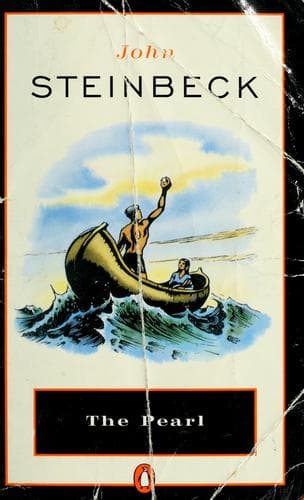
The Pearl
John Steinbeck·1947·Viking Press·Literature
Reading level: Ages 12+ (YA) · 2-hour read · Beginner difficulty.
- Reading time
- 2h
- Difficulty
- Beginner
- Recommended age
- Ages 12+ (YA)
- Guide read
- 4min
- Editor's rating
- 4.3 / 5
- steinbeck
- parable
- mexico
- poverty
- greed
- novella
- baja-california
- 1940s
— In one sentence —
A Mexican fisherman finds the largest pearl in the world. Steinbeck called it a parable. It is 90 pages and it will not leave you.
§ 01 · WHY READ
Why read
John Steinbeck heard the story on a trip to Baja California in 1940, on an expedition with the marine biologist Ed Ricketts that became The Log from the Sea of Cortez (1951). He was told a local legend about an Indian boy who found a great pearl, and he wrote it down in his journal. Seven years later, he shaped it into The Pearl (1947), publishing it first as a story in Woman's Home Companion and then as a novella.
He called it a parable. The word is accurate: the story follows a simple moral logic, the characters represent something larger than themselves, and the lesson — about the relationship between wealth and suffering, about what greed does to people, about the difference between what we want and what we need — is stated plainly rather than implied.
The premise: Kino is a pearl diver in a small Mexican coastal village. His infant son Coyotito is stung by a scorpion. The doctor in town refuses to treat him — they are poor. Kino dives and finds the largest pearl he has ever seen. He believes the pearl will save Coyotito, will pay for his son's education, will free them from the grinding poverty in which they live. What the pearl actually brings is the attention of everyone who wants it.
Ninety pages. The ending is prepared from the beginning. Steinbeck does not soften it.
§ 02 · CHARACTERS
Characters
Kino — a pearl diver who loves his family and his simple life with a completeness that the novel establishes before the pearl arrives, so that what the pearl does to him is visible as change. He is good at the beginning; the pearl makes him desperate, then violent.
Juana — his wife, who sees the pearl's danger before Kino does and says so. She is the novel's moral clarity: she understands what the pearl is doing and tells Kino. He doesn't listen.
Coyotito — the baby, whose scorpion sting sets the plot in motion.
The doctor — a figure of casual colonial cruelty, who refuses to treat Coyotito until he hears about the pearl, then comes immediately, and ultimately does more harm than good. He is the novel's portrait of institutional indifference to poverty.
§ 03 · HIGHLIGHTS
Three highlights
No. 1 · The songs. Kino hears music inside his head: the Song of the Family, the Song of Evil, the Song of the Pearl. Steinbeck uses these auditory leitmotifs to track what Kino is feeling before the narration states it. As the pearl becomes more dangerous, the Song of Evil grows louder; the Song of the Family fades. The technique is simple and precisely used.
No. 2 · Juana's attempt. Juana tries to take the pearl and throw it back into the sea. Kino stops her, violently. The scene is the novel's pivot: the pearl has already begun to replace his love for his family as the center of his existence. He is not the man who found the pearl anymore. The pearl is making him into someone else.
No. 3 · The ending. The ending is the ending the parable requires. Steinbeck writes it without melodrama and without comfort. Kino and Juana return to the village and Kino throws the pearl back into the sea. The final image — the pearl sinking into the water, glowing green in the light before it disappears — is the novel's last sentence, and it is perfectly calibrated.
§ 04 · EDITIONS
Recommended editions
| Edition | Why pick it |
|---|---|
| Penguin (standard paperback) | The canonical edition; clean text. Often published alongside Of Mice and Men. |
| Penguin (with Of Mice and Men) | The natural companion volume; both novellas in one book. |
The novella takes two hours. It can be read in one sitting and probably should be.
§ 05 · FIT
Who it's for / not for
Read this if you are…
- Anyone who wants a parable that works — that achieves its moral argument without becoming preachy.
- Readers of Steinbeck who haven't read the shorter work; The Pearl is the purest distillation of his themes.
- Reading it alongside Of Mice and Men as companion American novellas.
Skip it if you are…
- Averse to fable-like simplicity in fiction. The Pearl is not realist; it is a parable, and it uses characters as representatives of larger forces.
§ 06 · TIPS
Reading tips
- The songs are structural markers. When you hear a new song or a song growing louder, note what it means in Kino's emotional state.
- Juana is right. Track everything she says. She sees the pearl's danger earlier and more clearly than Kino. Her warnings are the moral argument.
- Read it fast. The novella's compression depends on momentum; stopping to annotate interrupts the accumulation.
§ 07 · COMPARE
Read alongside
- John Steinbeck — Of Mice and Men (1937). The companion novella: the same compressed tragedy, the same prepared ending, the same economy of means.
- Gabriel García Márquez — The Old Man Who Read Love Stories (1980). Another Latin American novella about a man tested by forces larger than himself; different tone, similar moral clarity.
- Leo Tolstoy — "How Much Land Does a Man Need?" (1886). The short story most directly comparable: a parable about greed and the desire for more, with an ending equally prepared and terrible.
§ 08 · DISCUSSION
Discussion questions
- Steinbeck called The Pearl a parable. What are the moral lessons it teaches? Are they simple or complicated?
- Juana sees the danger of the pearl before Kino does. Why doesn't he listen? What has the pearl done to him that makes him unable to hear her?
- The doctor treats Coyotito only after hearing about the pearl, and his treatment may have made things worse. What is Steinbeck arguing about the relationship between poverty and medicine?
- The pearl is described as beautiful and as the embodiment of desire. Does Steinbeck make you feel both the beauty and the danger? How?
- Kino becomes violent — against Juana, against other men. Is he the same person at the end as at the beginning? What has changed him?
- The ending is the only ending the parable can have. Does it feel earned or inevitable? Is there a difference?
One line to remember
“In the town they tell the story of the great pearl — how it was found and how it was lost again. They tell of Kino, the fisherman, and of his wife Juana, and of the baby, Coyotito. And because the story has been told so often, it has taken root in every man's mind.”— Chapter 1
Appears in collections
Reading lists featuring this book
7 books
The Best Books for 12-Year-Olds
The bridge year — old enough for hard books, not yet ready for adult themes.
Open list →
7 books
The Best Books for People Who Don't Read
Seven short books that earn the first hour and reward the next two.
Open list →
7 books
Short Classics High Schoolers Actually Finish
Short, gripping, English-class acceptable — for the student who will not finish a four-hundred-page novel.
Open list →
10 books
Short and Devastating: Ten Classics You Can Read in a Weekend
The most efficient literature ever written. None longer than 200 pages. All of them permanent.
Open list →
You might also like
Read next
John Steinbeck · 1939
The Grapes of Wrath
The Joads lost their farm to drought and banks. What happened to them is happening now.
Read · 7 min
John Steinbeck · 1952
East of Eden
Steinbeck's great American Genesis: two families, a valley in California, and the question of whether goodness is possible.
Read · 7 min
John Steinbeck · 1937
Of Mice and Men
One hundred pages. The ending has been prepared from the first paragraph. Steinbeck does not waste a sentence.
Read · 5 min