Editor-reviewed
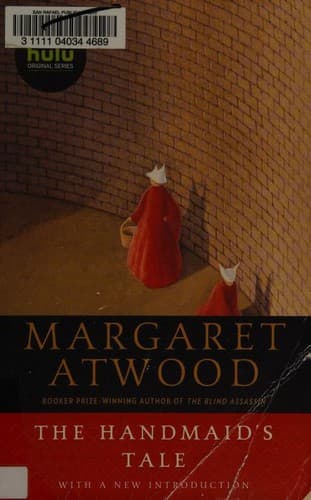
The Handmaid's Tale
Margaret Atwood·1985·McClelland & Stewart·Sci-Fi & Fantasy
Reading level: Ages 16+ (adult) · 9-hour read · Intermediate difficulty.
- Reading time
- 9h
- Difficulty
- Intermediate
- Recommended age
- Ages 16+
- Guide read
- 5min
- Editor's rating
- 4.7 / 5
- dystopia
- feminist-fiction
- atwood
- booker
- gilead
- reproductive-rights
- political-fiction
— In one sentence —
Atwood's rule while writing: nothing in the book that hasn't already happened somewhere. Gilead is not a fantasy — it's a collage of documented history.
§ 01 · WHY READ
Why read
Margaret Atwood began writing The Handmaid's Tale in 1984, in West Berlin, a city still physically divided by the Cold War. She had a rule she kept throughout: nothing in the book that has not already been done somewhere, at some point in human history. The rule was both artistic constraint and moral argument. Every element of Gilead — the handmaids assigned for reproductive purposes, the public executions, the erasure of women's legal identity, the religious justifications for sexual violence, the domestic enforcement of patriarchal norms — has a documented historical precedent. Atwood cites them in an appendix and in interviews. The dystopia is not invented; it is assembled.
The Republic of Gilead has overthrown the United States government, blamed environmental degradation for declining birth rates, and instituted a theocratic state organized around the forced reproduction of the (small) percentage of women who remain fertile. The narrator is a Handmaid — a fertile woman assigned to a Commander and his Wife for monthly ceremonies intended to produce children. She has no name. She is called Offred: of-Fred, the Commander's property.
The novel was shortlisted for the Booker Prize in 1986, won the Arthur C. Clarke Award, and has been continuously in print since. The Hulu television adaptation (2017–) renewed its readership dramatically; the accompanying political events renewed its resonance even more. Atwood wrote a sequel, The Testaments, in 2019, which won the Booker Prize.
What The Handmaid's Tale does that its reputation sometimes obscures: it is a formally sophisticated novel, not just a political polemic. The narrator's unreliability, the novel's structure (including the academic appendix at the end that repositions everything you've read), and Atwood's prose — which is precise, wry, and controlled — place it alongside the best literary fiction of the 1980s.
§ 02 · CHARACTERS
Characters
The cast is deliberately constrained — Offred's perspective is limited by the society she inhabits, which permits her to know very little.
Offred — the narrator, whose real name we learn only in The Testaments. She is intelligent, ironic, and careful: her narration is self-aware about its own unreliability ("This is a reconstruction. All of it is a reconstruction"), which is both Atwood's formal honesty and Offred's survival mechanism. She observes more than she acts; her resistance is mostly internal. This makes her a difficult protagonist for readers who want active defiance — but it is Atwood's point that survival under totalitarianism often looks like compliance from the outside.
The Commander — the head of the household. Educated, thoughtful, complicit. He initiates an illegal relationship with Offred (Scrabble games, contraband magazines, a trip to a government brothel) that complicates the power dynamic without changing it. He is the novel's most unsettling portrait: a man who designed a system that destroys women and thinks of himself as reasonable.
Serena Joy — the Commander's Wife, a former televangelist who helped build the ideology that now oppresses her. Her rage is directed at Offred rather than at the system; her complicity is the novel's clearest statement about how authoritarian systems recruit and use women against each other.
Nick — the Commander's driver. His relationship with Offred is the novel's emotional centre and its greatest ambiguity: whether his apparent sympathy is real, and whether the ending it enables is escape or a different kind of trap.
Moira — Offred's friend from before, whose trajectory through the novel tests what resistance looks like and what it costs.
§ 03 · HIGHLIGHTS
Three highlights
No. 1 · The "Historical Notes" appendix. The novel ends with an academic symposium in 2195 at which Professor Pieixoto presents Offred's narrative — recovered on cassette tape — and analyzes it as a historical document. The tone shifts completely: detached, academic, occasionally condescending. It is a devastating formal move: after 300 pages of intimate first-person narration, the academic voice suddenly makes Offred a specimen, her suffering a data point. It also forces the reader to do interpretive work: Pieixoto's analysis is unreliable in different ways from Offred's narration. The truth of what happened is not recoverable, which is Atwood's statement about history.
No. 2 · The Ceremony. The monthly ritual in which the Commander, his Wife, and the Handmaid participate is described in exact, clinical, almost-domestic terms. Atwood refuses both pornography and melodrama; the scene is deliberately uncomfortable in a way that neither titillates nor allows the reader to experience it as safely remote. The technique is correct: the event is banal and regular and ordinary, which is worse than dramatic.
No. 3 · "Nolite te bastardes carborundorum." Offred finds the phrase scratched into the wardrobe in her room by a previous Handmaid. It is mock Latin: "Don't let the bastards grind you down" in a Latin that doesn't exist. The previous Handmaid is dead; the phrase survives her. Atwood's statement about what persists, about what women pass to each other in conditions that forbid most kinds of communication, is carried in a grammatically incorrect Latin joke. It is the novel's emotional centre in miniature.
§ 04 · EDITIONS
Recommended editions
| Edition | Why pick it |
|---|---|
| Anchor Books (standard paperback) | The canonical US edition; includes Atwood's introduction to the 1998 edition, which is essential context. |
| Penguin Modern Classics (UK) | Annotated; includes Atwood's "A Note on the Novel" and an introduction by Valerie Martin. |
| Folio Society edition | Illustrated; handsome gift edition. |
| Hulu audiobook (Elisabeth Moss reading) | Released alongside the series; Moss's reading is excellent and uses the accent/register of her performance. Worth it for the Moss connection; the text is unchanged. |
The Hulu television series (2017–) is a genuine adaptation, not a summary: it expands the world considerably, adds significant plot and character, and extends far beyond the novel's ending. Watch it as a companion, not a replacement. The first season maps most closely to the novel; subsequent seasons are original.
§ 05 · FIT
Who it's for / not for
Read this if you are…
- Anyone whose reading of the novel has been shaped entirely by the TV show. The book is different in register, scope, and formal sophistication.
- Readers interested in how totalitarianism specifically recruits women and directs women's oppression toward other women.
- Anyone who wants to understand how Atwood builds an argument through form (unreliable narration, the appendix) rather than direct statement.
- Students: the "Historical Notes" appendix alone is worth a seminar.
Skip it if you are…
- Looking for the propulsive thriller energy of the television adaptation. The novel is quieter, more interior, and more formally demanding.
- In a period of personal difficulty around reproductive health or gendered violence. The novel is not gentle with these subjects.
§ 06 · TIPS
Reading tips
- Read the "Historical Notes" appendix as part of the novel, not as an afterword. It is the final chapter; it changes everything before it.
- Atwood's prose is controlled and wry even when describing horror. If you feel the narrator is too calm, you're reading correctly.
- Track what Offred remembers and what she can't access. Her memory of her name, her daughter, her husband: the gaps are deliberate.
- Read The Testaments (2019) afterward if you want to know what happens. It is a different kind of novel — more plot, different narrators — and it works best as a companion to rather than a replacement for The Handmaid's Tale.
§ 07 · COMPARE
Read alongside
- Margaret Atwood — The Testaments (2019). The direct sequel; three narrators, thirty years later. Won the Booker Prize.
- Octavia E. Butler — Kindred (1979). The other foundational feminist speculative fiction of the late 20th century: involuntary service, gendered violence, and the psychology of accommodation.
- Naomi Alderman — The Power (2016). The formal inverse: a world in which women develop the capacity to electrocute men. Atwood blurbed it. The comparison is instructive.
- Christina Lamb / Malala Yousafzai — I Am Malala (2013). The non-fiction complement: a documented account of a theocratic state's restrictions on female education and the cost of resistance.
- Angela Carter — The Bloody Chamber (1979). Contemporary feminist reimaginings of fairy tales; a different formal approach to the same subject matter.
§ 08 · DISCUSSION
Discussion questions
- Atwood's rule was that nothing in the novel could be invented — everything had to have a historical precedent. Does knowing this change how you read Gilead?
- Offred's narration is explicitly unreliable: "This is a reconstruction." What does she reconstruct reliably? What does she distort, and why?
- The Commander says he thinks the new system is better for women than what came before. Does the novel give his argument any credibility, or is it immediately refuted?
- Serena Joy helped build the system that now oppresses her. How does Atwood use her to make an argument about complicity?
- The "Historical Notes" appendix repositions Offred's entire narrative as a historical document analyzed by an academic 200 years later. What does this formal move do to your relationship with Offred's story?
- Moira's resistance is more explicit than Offred's. Does she succeed? What does her trajectory suggest about what resistance costs under totalitarianism?
- Nick's loyalty is deliberately ambiguous. By the end, do you trust him? Does it matter whether you do?
- The novel was published in 1985. Re-read your underlinings after finishing. Which passages feel most specifically 1985? Which feel most current?
One line to remember
“Nolite te bastardes carborundorum.”— Offred — Chapter 9 (mock Latin, scratched into a wardrobe)
Appears in collections
Reading lists featuring this book
7 books
Banned Books That Are Actually Great
Seven books banned for ideas that turned out to be exactly the ideas that needed saying.
Open list →
7 books
Best Book Club Books for Discussion
Seven books that generate real conversation — not just summaries.
Open list →
7 books
The Best Book Gifts for Mother's Day
Seven novels that take mothers seriously as people, not just as mothers.
Open list →
8 books
The Best Books for Teens
What high schoolers actually want to read — not what they're assigned.
Open list →
7 books
The Best Books About Motherhood
Seven novels about motherhood handled with full weight — what it costs, what it makes possible, what it cannot prevent.
Open list →
6 books
Books About Power and Corruption
Six novels, six different mechanisms — all recognizable from today's news.
Open list →
7 books
Read the Book Before the Movie
Seven books where the adaptation is good — but the book contains something the screen can't hold.
Open list →
6 books
Best Books for Ambitious Women
Six novels that take women's serious ambition seriously, without flattering it or apologizing for it.
Open list →
6 books
Books Like 1984
From the book that directly inspired Orwell to the ones that took the nightmare somewhere new.
Open list →
6 books
Books That Predicted the Future
Six novels that named things before we had words for them.
Open list →
5 books
Books to Understand Democracy
Five novels that name what goes wrong before it does.
Open list →
8 books
Eight Dystopian Novels Beyond 1984
Orwell's masterpiece gets all the attention. These eight books are asking harder questions.
Open list →
7 books
Feminist Literature Worth Reading
Seven books across 150 years — each making a different argument through a different form.
Open list →
You might also like
Read next
Ted Chiang · 2002
Stories of Your Life and Others
Ted Chiang writes 30-page stories that take longer to think about than most novels. He has won more awards per word than any writer alive.
Read · 5 min
Cixin Liu · 2008
The Dark Forest
Fan + author consensus pick for the best book in the trilogy. Two simple axioms derive the silence of the universe. After this one, you don't look at the night sky the same way.
Read · 5 min
Octavia E. Butler · 1979
Kindred
Octavia Butler sends a Black woman from 1976 Los Angeles back to antebellum Maryland. The time travel is a device. The horror is real.
Read · 5 min