Editor-reviewed
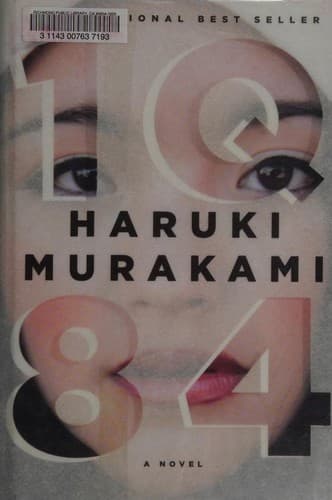
1Q84
Haruki Murakami·2009·Shinchosha (Japanese); Knopf (English)·Literature
Reading level: Ages 16+ (adult) · 35-hour read · Intermediate difficulty.
- Reading time
- 35h
- Difficulty
- Intermediate
- Recommended age
- Ages 16+
- Guide read
- 5min
- Editor's rating
- 4.4 / 5
- haruki-murakami
- japanese-literature
- magical-realism
- cult
- love
- 1984
- orwell
- long-reads
— In one sentence —
Murakami's longest novel: a woman steps off an expressway, a man writes a story that rewrites the world, and two moons hang in the Tokyo sky. Read it as a single thing.
§ 01 · WHY READ
Why read
Haruki Murakami published 1Q84 in Japan in two volumes in 2009; a third volume followed in 2010. The English translation by Jay Rubin and Philip Gabriel appeared in 2011 as a single book of nearly 1,000 pages — Murakami's longest novel. The title plays on the Japanese pronunciation of the number 9, which is "Q" — so 1Q84 sounds like 1984, and Orwell is one of the novel's explicit presences.
The structure: alternating chapters between two protagonists. Aomame is a fitness trainer who is also an assassin for a network of women who protect victims of domestic abuse. Tengo is a math teacher who is also a writer. They were in the same elementary school class twenty years before the novel begins; they touched hands once. In 1984, each of them enters a world with slightly different physical laws — a world that Aomame starts calling 1Q84 when she notices there are two moons in the sky.
The novel is simultaneously a love story — about whether two people who have not seen each other for twenty years and belong to different worlds can find each other — and a thriller about a religious cult, and a meditation on writing and reality and whether the stories we tell can reshape the world they describe.
What works: the two-protagonist structure creates genuine suspense; the chapters cut at the right moments; the love story's premise — two people who touched hands once and have never forgotten — is compelling across 1,000 pages. What is harder: the novel is longer than it needs to be, and the third book feels like a coda extended past its natural conclusion.
§ 02 · CHARACTERS
Characters
Aomame — the female protagonist, precise, physically formidable, emotionally contained. She kills abusive men through an untraceable method and does not consider herself a murderer. Her love for Tengo, whom she has not seen since childhood, is the novel's central implausibility presented with complete conviction.
Tengo — the male protagonist, a writer who is hired to rewrite a young woman's story (a manuscript called Air Chrysalis, written by the teenage Fuka-Eri) into publishable form. The rewriting triggers events neither he nor anyone around him fully controls.
Fuka-Eri — the teenager whose manuscript sets the plot in motion. She escaped from the cult called Sakigake; her story describes the Little People, who appear in the real world of the novel as an actual force.
The Leader — the head of Sakigake, who Aomame is sent to kill and whose encounter with her is the novel's most unexpected sequence.
§ 03 · HIGHLIGHTS
Three highlights
No. 1 · Two moons. Aomame notices there are two moons in the sky — a large one and a small one — when she knows there should be only one. This is her indication that she has entered 1Q84. Murakami handles the discovery with the matter-of-factness that is his signature with the impossible: Aomame notices, adjusts, continues.
No. 2 · The Leader's monologue. When Aomame finds the Leader, he is expecting her. Their conversation — about the Little People, about the nature of what has been happening, about what he is and what she is — is the novel's most ambitious section. Murakami makes the antagonist's explanation genuinely interesting rather than a device for delivering plot information.
No. 3 · The convergence. The novel's long project is bringing Aomame and Tengo into the same space. When it finally happens, across 900 pages of approach, the scene earns its weight. Murakami does not let the reunion be easy or explained.
§ 04 · EDITIONS
Recommended editions
| Edition | Why pick it |
|---|---|
| Knopf (Jay Rubin and Philip Gabriel translations) | The standard English edition; Rubin translated Books 1 and 2, Gabriel Book 3. The transition between them is detectable but not disruptive. |
| Audiobook (Marc Vietor and Allison Hiroto) | Two readers for the two protagonists; 46 hours. The correct audio approach for the alternating structure. |
§ 05 · FIT
Who it's for / not for
Read this if you are…
- An established Murakami reader ready for the maximum extension of his methods.
- Anyone willing to commit to 35 hours knowing the payoff is a love story rather than a plot resolution.
Skip it if you are…
- New to Murakami. The shorter novels demonstrate his methods more efficiently.
- Impatient with pace. Book 3 especially tests patience; knowing this in advance helps.
§ 06 · TIPS
Reading tips
- Read it as a single thing. Murakami conceived it as one work; treating it as three separate books will make Book 3 feel like a disappointment.
- The love story is the point. The cult, the Little People, the two moons: these are the atmosphere. The couple's convergence across 1,000 pages is the content.
- Book 3 is the weakest. Knowing this helps; it is not bad, just extended. The ending is right even if the path to it is longer than necessary.
§ 08 · DISCUSSION
Discussion questions
- Two moons appear in the sky. No explanation is offered; Aomame adjusts. What is Murakami arguing about how people accommodate the impossible?
- Tengo rewrites Fuka-Eri's story and the rewriting changes the world. What is Murakami saying about the relationship between writing and reality?
- Aomame and Tengo touched hands once twenty years ago and have not forgotten. Is the love story credible across 1,000 pages? What makes it hold?
- The Leader explains what the Little People are and what they want. Is the explanation satisfying? Does it need to be?
- Book 3 introduces a new point of view character (Ushikawa). Does this addition strengthen or dilute the novel?
- The title references Orwell's 1984. What specifically is the reference? How is Murakami in dialogue with Orwell?
One line to remember
“If you can't understand it without an explanation, you can't understand it with one.”— Ushikawa — Book 3
Appears in collections
Reading lists featuring this book
7 books
The Best Books for a Long Flight
Seven books substantial enough to disappear into for ten hours in a metal tube.
Open list →
5 books
Books Set in Japan
Five Murakami novels and the Japan only he can see.
Open list →
8 books
Best Mind-Bending Sci-Fi Books
Eight books that destabilize reality, consciousness, time, or the self — and know exactly what that destabilization is for.
Open list →
5 books
First Time Reading Murakami? These Five Books, in This Order.
The most-asked question in contemporary fiction. Here is the honest answer.
Open list →
5 books
Novels Where the City Feels Like a Psychological Maze
Five novels where streets, neighborhoods, weather, and architecture do not just hold the plot — they alter the mind moving through them.
Open list →
7 books
What to Read After Murakami
Seven novels for when you finish Norwegian Wood and don't know where to go next.
Open list →
You might also like
Read next
Haruki Murakami · 1994
The Wind-Up Bird Chronicle
A man's cat goes missing. Then his wife goes missing. He sits at the bottom of a dry well and waits. This is where Murakami's powers reach their full extension.
Read · 5 min
Haruki Murakami · 2002
Kafka on the Shore
Fish rain from the sky. Cats can talk. A fifteen-year-old boy runs away to a library. A simple old man walks into the forest and the world bends around him. Murakami at his most mythic.
Read · 5 min
Haruki Murakami · 1987
Norwegian Wood
Murakami's breakout novel. No magic, no parallel worlds — just Tokyo in the late 1960s, two girls, grief, and the specific sadness of being young and not knowing how to save the people you love.
Read · 4 min