Editor-reviewed
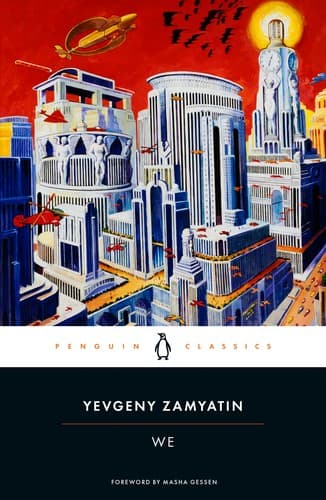
We
Yevgeny Zamyatin·1924·E. P. Dutton (English translation)·Sci-Fi & Fantasy
Reading level: Ages 14+ (adult) · 7-hour read · Intermediate difficulty.
- Reading time
- 7h
- Difficulty
- Intermediate
- Recommended age
- Ages 14+
- Guide read
- 5min
- Editor's rating
- 4.6 / 5
- dystopia
- russian-literature
- soviet
- zamyatin
- origin-text
- modernism
- banned-books
— In one sentence —
Written in Soviet Russia in 1924. Banned immediately. Not published in Russian until 1988. Orwell read it before writing 1984. It is the origin of the genre.
§ 01 · WHY READ
Why read
Yevgeny Zamyatin wrote We in 1920-1921. It was immediately recognized by Soviet authorities as a threat and suppressed — never published in Russian during Zamyatin's lifetime, eventually leading to his exile in 1931. He died in Paris in 1937. The novel was first published in English translation in 1924 by E. P. Dutton; it reached Russian readers only in 1988, when glasnost made publication possible.
Aldous Huxley read We before writing Brave New World (1932). George Orwell read it — the French edition — before writing Nineteen Eighty-Four (1949), and wrote an essay about it for Tribune in 1946 in which he said it was superior to Brave New World as a vision of totalitarianism. Both of the famous English dystopias descend directly from this one Russian novel written by a man who lived inside what he was describing.
Reading We after 1984 and Brave New World is reading the source. The glass city where all walls are transparent and surveillance is total: Zamyatin. The government that controls people through numbering rather than naming: Zamyatin. The revolutionary who believes she can change the system from inside: Zamyatin. The surgical procedure that removes the capacity for imagination: Zamyatin. The glass city is the One State; its citizens are numbers, not names. The narrator is D-503, a mathematician and engineer who designs rockets, who begins keeping a journal — the novel we're reading — and who encounters a woman who makes him feel something the system was designed to prevent.
The translation you read matters considerably.
§ 02 · CHARACTERS
Characters
We has a small cast defined by their relationship to the One State's system of total organization.
D-503 — the narrator, a mathematician who has internalized the One State's values so completely that he is disturbed by his own capacity for emotion. His journal is the novel: as it progresses, his language becomes more fragmented, his logic more unstable, his sentences less grammatically complete. The form of the narration is the story of his disintegration. He is the most formally inventive protagonist in the dystopian tradition: a man who is losing his mind to the experience of having one.
I-330 — the woman who disrupts D-503's equilibrium. She smokes, drinks, and has access to ancient things (a house from before the One State, with wooden furniture and a piano) that are forbidden. She is a revolutionary and uses D-503's attraction to her as a tool. Whether she loves him or uses him — and whether the distinction matters in a world that doesn't recognize love as a valid category — is the novel's central ambiguity.
O-90 — D-503's registered sexual partner, a small, round woman (the name is the letter for the shape) who wants, illegally, to have a child. She loves D-503 simply and is handled by him badly. Her fate is one of the novel's acts of grace.
The Benefactor — the One State's ruler, presented as the embodiment of rational governance. He is seen briefly but described throughout. His purpose is to absorb the citizens' need for a god.
§ 03 · HIGHLIGHTS
Three highlights
No. 1 · The transparent walls. In the One State, all buildings are made of glass — walls, ceilings, floors. Citizens can be observed at all times except for the two hours per week designated as "personal hours," during which they are permitted to lower their shades. The image predates Bentham's Panopticon in the cultural imagination (though Bentham's actual design was earlier) and arrives at the same argument: when observation is total and constant, it is eventually internalized. D-503 does not feel watched; he feels correct. The walls are not surveillance — they are architecture as ideology.
No. 2 · D-503's language deteriorating. The novel begins with crisp, mathematical prose — D-503 is an engineer, and his early entries reflect that. As his exposure to I-330 and his own imagination progresses, the sentences fragment. He stops finishing thoughts. He introduces mathematical symbols into the text. He uses multiple exclamation points where one would do. Zamyatin is doing something technically demanding: showing the disintegration of a rationalist mind as it encounters emotion, through the formal properties of the prose itself. This is a technique almost no other dystopian novel attempts.
No. 3 · The operation. The One State announces that the "imagination" — the source of all social instability — can be surgically removed. The operation is voluntary; D-503 submits to it. The question of what he loses and what remains is the novel's final argument: is a man who has had his imagination surgically removed still a man? Is the stability that results a form of peace or a form of death? Zamyatin does not answer this, but the final pages of D-503's journal make his position clear.
§ 04 · EDITIONS
Recommended editions
Translation is the central question for this novel.
| Edition / Translation | Why pick it |
|---|---|
| Natasha Randall (Modern Library, 2006) | The current gold standard: precise, modernist-appropriate, preserves Zamyatin's formal strangeness. Start here. |
| Mirra Ginsburg (Avon, 1972) | For decades the standard English translation; somewhat smoother than Randall, which means somewhat less strange. Still good. |
| Gregory Zilboorg (Dutton, 1924) | The first English translation; historically important, now dated. |
| Clarence Brown (Penguin, 1993) | Readable; good introduction. |
The novel is short enough that reading two translations is not unreasonable for readers interested in comparing; Randall and Ginsburg together make a good seminar.
§ 05 · FIT
Who it's for / not for
Read this if you are…
- A reader who has read 1984 or Brave New World and wants to read what they were written in response to.
- Anyone interested in the Russian literary tradition — this is modernist Russian fiction at its most formally inventive.
- Readers of literary criticism: the novel has generated more scholarly attention per page than almost any work of speculative fiction.
- Anyone who has lived under a surveillance system and wants a literary frame for the experience.
Skip it if you are…
- Wanting a straightforward reading experience. The formal difficulty — fragmenting prose, mathematical notation, Russian naming conventions — requires patience.
- Starting with dystopian fiction. Read 1984 or Brave New World first; We rewards the comparison but is harder without it.
§ 06 · TIPS
Reading tips
- Read the Randall translation. The formal strangeness of the original is the argument; translations that smooth it are translating a different book.
- Track D-503's language from entry to entry. The sentences become shorter, more broken, more punctuation-heavy. This is intentional.
- The numbering system takes some adjustment. D-503, I-330, O-90: the numbers and letters are both names and physical descriptions (I is thin, O is round, D is strong and angular). Spend a moment with each name when it first appears.
- Don't expect the kind of emotional access you get from Orwell. Zamyatin is working in a more expressionist, fragmented mode. The emotion is real but it comes through form rather than direct statement.
§ 07 · COMPARE
Read alongside
- George Orwell — Nineteen Eighty-Four (1949). Orwell's explicit heir; read together and the genealogy of the genre becomes visible. Orwell's novel is more emotionally accessible; Zamyatin's is formally stranger.
- Aldous Huxley — Brave New World (1932). Huxley's heir; the pleasure-state branch of the same tree.
- Evgenia Ginzburg — Journey into the Whirlwind (1967). The memoir that puts Zamyatin's fictional Soviet Union into documentary context: Ginzburg's account of eighteen years in the Gulag is the world We was predicting from inside.
- Mikhail Bulgakov — The Master and Margarita (1967, written 1930s). Another suppressed Soviet novel, published posthumously; the devil visits Moscow. The comparison with We shows two different ways of writing against a totalitarian state from inside it.
- Kurt Vonnegut — Player Piano (1952). The American industrial heir: a society organized around efficiency, a protagonist who begins to doubt, a resistance that fails. Vonnegut read Zamyatin.
§ 08 · DISCUSSION
Discussion questions
- D-503 narrates in mathematical, engineering language that gradually disintegrates. How does the form of his journal relate to the content of his experience?
- The glass walls allow total visibility. D-503 initially finds this reassuring. At what point, and why, does he begin to find it disturbing?
- I-330 uses D-503's attraction to her to serve the revolution. Is this manipulation? Does the novel condemn it?
- The "imagination" is identified as the source of all social instability. Is the One State right? Is imagination actually destabilizing?
- Zamyatin wrote this novel inside the Soviet state he was describing. What are the risks and constraints of writing politically dangerous fiction from inside the regime it criticizes?
- Orwell wrote in 1946 that We was superior to Brave New World as a dystopia because "it is in some sense the more plausible." Do you agree? What does "plausibility" mean for a dystopia?
- D-503 submits to the imagination-removal operation. Is this surrender, or is it consistent with who he has been throughout the novel?
- We was first published in English in 1924, not in Russian until 1988. What does the publication history suggest about how literature and political power interact?
One line to remember
“There is no final revolution. Revolutions are infinite.”— D-503 — Record 40
Appears in collections
Reading lists featuring this book
7 books
Banned Books That Are Actually Great
Seven books banned for ideas that turned out to be exactly the ideas that needed saying.
Open list →
6 books
Books About Power and Corruption
Six novels, six different mechanisms — all recognizable from today's news.
Open list →
6 books
Books Like 1984
From the book that directly inspired Orwell to the ones that took the nightmare somewhere new.
Open list →
6 books
Books Like The Handmaid's Tale
Six novels for readers who want that particular combination of dread, clarity, and controlled fury.
Open list →
5 books
Books Like The Road by Cormac McCarthy
Five novels with the same stripped intensity — and something The Road doesn't have.
Open list →
6 books
Books That Predicted the Future
Six novels that named things before we had words for them.
Open list →
5 books
Books to Understand Democracy
Five novels that name what goes wrong before it does.
Open list →
8 books
Eight Dystopian Novels Beyond 1984
Orwell's masterpiece gets all the attention. These eight books are asking harder questions.
Open list →
8 books
Best Mind-Bending Sci-Fi Books
Eight books that destabilize reality, consciousness, time, or the self — and know exactly what that destabilization is for.
Open list →
7 books
Overlooked Masterpieces
Seven novels that belong in the first tier but rarely get there — and why.
Open list →
You might also like
Read next
Ted Chiang · 2002
Stories of Your Life and Others
Ted Chiang writes 30-page stories that take longer to think about than most novels. He has won more awards per word than any writer alive.
Read · 5 min
Cixin Liu · 2008
The Dark Forest
Fan + author consensus pick for the best book in the trilogy. Two simple axioms derive the silence of the universe. After this one, you don't look at the night sky the same way.
Read · 5 min
Octavia E. Butler · 1979
Kindred
Octavia Butler sends a Black woman from 1976 Los Angeles back to antebellum Maryland. The time travel is a device. The horror is real.
Read · 5 min