Editor-reviewed
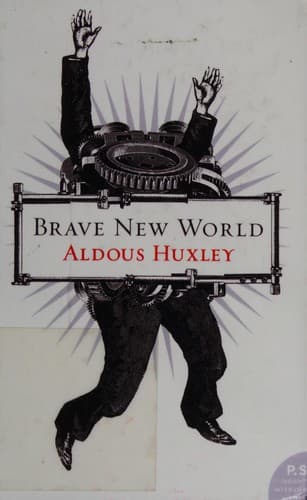
Brave New World
Aldous Huxley·1932·Chatto & Windus·Sci-Fi & Fantasy
Reading level: Ages 14+ (YA) · 8-hour read · Intermediate difficulty.
- Reading time
- 8h
- Difficulty
- Intermediate
- Recommended age
- Ages 14+ (YA)
- Guide read
- 5min
- Editor's rating
- 4.5 / 5
- dystopia
- classic-sf
- satire
- conditioning
- pleasure-state
- huxley
- aldous-huxley
— In one sentence —
Orwell feared those who would ban books. Huxley feared there would be no reason to ban them — that we would choose distraction over truth, freely and happily.
§ 01 · WHY READ
Why read
In 1958, twenty-six years after Brave New World was published, Aldous Huxley wrote an essay called Brave New World Revisited in which he assessed his own prediction. He found it more accurate than he'd expected — and more accurate, he argued, than Orwell's 1984, which had been published in between. Orwell's nightmare was control through fear. Huxley's nightmare was control through pleasure: a society so comfortable, so continuously stimulated, so chemically satisfied, that no one wanted to revolt — because no one felt unhappy enough to try.
Huxley's World State is not a boot stamping on a human face forever. It is a global civilization that has abolished war, poverty, and unhappiness by abolishing the conditions that make those things possible: individuality, family, monogamy, art, religion, and the experience of aging and death. Citizens are genetically conditioned before birth into five castes; psychological conditioning ensures they are happy with their caste and their function; Soma — a drug with no hangover — handles the residual unhappiness. The system is stable because nobody wants to leave it.
The question Huxley is asking is whether a society where everyone is happy is a good society, if the happiness is manufactured. The book gives you characters who represent both sides of the argument, and it doesn't fully resolve the question, which is the honest thing to do. Neil Postman's 1985 argument (in Amusing Ourselves to Death) that Huxley was more prophetic than Orwell about what a twenty-first-century democratic society would look like has only become more pressing.
§ 02 · CHARACTERS
Characters
The novel's first section describes the World State through exposition (the Central London Hatchery and Conditioning Centre, the five castes, the conditioning process) before introducing its principal characters. Huxley is more interested in the system than in any individual within it, but the characters each represent a position in the novel's argument.
Bernard Marx — an Alpha Plus (the highest caste) who is shorter than expected and therefore subtly maladjusted: he feels the conformity around him as a constraint in a way his peers don't. His dissatisfaction makes him the reader's entry point, but Huxley is not kind to him: Bernard's complaints are those of someone who wants access to the privileges of nonconformity, not someone who genuinely challenges the system. He is the novel's warning against mistaking discontent for depth.
Lenina Crowne — a pneumatic (physically attractive) Beta who genuinely likes the World State and participates in its pleasures without anxiety. She is the novel's least satirized character and its most important: she is what the system produces when it works. Her discomfort with the Reservation and the Savage is genuine and unsimulated. Huxley refuses to make her the villain; her contentment is the system's accomplishment, and the novel doesn't let you simply despise her for it.
John the Savage — born to a woman from the World State on the Savage Reservation in New Mexico, raised on Shakespeare and the pain the World State has abolished. He is the novel's most complex figure: someone with a complete alternative value system (Shakespeare as scripture, sexual guilt, physical pain as meaningful) who encounters the World State and rejects it on terms the World State cannot understand. His argument with Mustapha Mond is the novel's philosophical centre.
Mustapha Mond — Resident World Controller for Western Europe. He has read the forbidden books; he chose stability. His debate with John is the most honest moment in the novel: Mond is not a villain and does not claim to be. He is a man who made a choice the novel doesn't fully endorse or condemn.
Helmholtz Watson — an Alpha who is too well-made: he is so gifted that he cannot be satisfied by the system's approved outlets for talent. He is sent into exile at the end, which he welcomes. Huxley's suggestion that genuine creativity is incompatible with the World State is its most optimistic implication.
§ 03 · HIGHLIGHTS
Three highlights
No. 1 · The conditioning sequences. The novel's opening chapters describe how citizens are made: Bokanovsky's Process (mass-producing humans from a single egg), hypnopaedia (sleep-teaching that installs values without understanding), Pavlovian conditioning (training lower castes to dislike books and flowers by pairing them with electric shocks). Huxley presents all of this with the cheerful clarity of a tour guide, and the effect is deeply unsettling precisely because the processes are presented as engineering problems with clean solutions. The horror is in the matter-of-factness.
No. 2 · The Savage Reservation. Bernard takes Lenina to visit a reservation where "savages" live outside the World State system — with family, aging, religion, illness, and Shakespeare. Lenina finds it disgusting; John finds it home. The juxtaposition is Huxley's argument made structural: all the things the World State has abolished (suffering, aging, religion, art requiring effort) are the things John values. His value system is Shakespeare's value system — the tragedies specifically. He cannot explain it in terms Lenina can understand because she has no vocabulary for tragedy.
No. 3 · John's debate with Mustapha Mond. John claims the right to be unhappy. Mond acknowledges the claim, explains why the World State has foreclosed it, and then lists what the right to be unhappy actually entails: "the right to grow old and ugly and impotent; the right to have syphilis and cancer; the right to have too little to eat; the right to be lousy; the right to live in constant apprehension of what may happen tomorrow." John says: "I claim them all." It is one of the most precisely staged philosophical arguments in modern fiction, and Huxley doesn't cheat: Mond's position is coherent. John's position is costly. Both are positions.
§ 04 · EDITIONS
Recommended editions
| Edition | Why pick it |
|---|---|
| Harper Perennial Modern Classics | Standard edition; good introduction by David Bradshaw. |
| Chatto & Windus (UK, original) | First edition; collectible rather than reading edition. |
| Vintage (with Brave New World Revisited) | Some editions bundle the 1958 essay; if available, get this version — read the novel first, the essay after. |
| Audiobook (Michael York, 2000) | Widely regarded as the definitive audio performance. York handles the World State's cheerfulness with exactly the right tone. |
§ 05 · FIT
Who it's for / not for
Read this if you are…
- Anyone who has read 1984 and wants the harder question: what if the dystopia feels good?
- Readers interested in the history of ideas: Huxley's sources include Henry Ford, Sigmund Freud, Ivan Pavlov, and Bertrand Russell, all traceable in the text.
- Anyone who finds themselves using their phone compulsively and wonders what Huxley would say about it.
- Students: this is taught alongside 1984 for a reason — read both and compare the mechanisms of control.
Skip it if you are…
- Looking for the narrative tension of 1984. The World State is deliberately pleasant; it is not an exciting setting.
- Expecting complex characters. Huxley sacrifices individual psychology for systemic argument, which is a choice, not a failure.
§ 06 · TIPS
Reading tips
- Read the 1958 essay Brave New World Revisited afterward. It's short and devastating: Huxley reviewing his own prediction and finding it more accurate than expected.
- The first three chapters are dense with worldbuilding. Stay with them; the novel earns its momentum once John arrives.
- Track what Soma does and when characters reach for it. It is the system's primary tool; every Soma moment is a moment where something uncomfortable has surfaced.
- Don't read Lenina as the villain. She is what the system produces when it works. The novel's discomfort depends on her being genuinely not bad — just fully conditioned.
§ 07 · COMPARE
Read alongside
- George Orwell — Nineteen Eighty-Four (1949). The standard comparison: fear versus pleasure as mechanisms of control. Read together, they cover the field.
- Yevgeny Zamyatin — We (1924). The novel Huxley read before writing Brave New World. The origin of the glass-city, transparent-life idea that Huxley adapts.
- Neil Postman — Amusing Ourselves to Death (1985). The non-fiction argument that Huxley was more prophetic than Orwell about what television (now social media) would do to public discourse.
- Kazuo Ishiguro — Never Let Me Go (2005). The quiet version of the same question: how do people accommodate themselves to circumstances that have assigned them a function they didn't choose?
- Margaret Atwood — The Handmaid's Tale (1985). The feminist response to the same tradition: a dystopia built on biological control rather than psychological conditioning.
§ 08 · DISCUSSION
Discussion questions
- Huxley's World State has abolished war, poverty, and unhappiness. What has it sacrificed to achieve this? Are those sacrifices justified?
- Bernard Marx is dissatisfied with the World State but his dissatisfaction doesn't make him sympathetic. What is Huxley doing by making his "rebel" so unappealing?
- Lenina is not a villain — she genuinely likes her life and participates in the system without coercion. What is Huxley saying about the difficulty of criticizing a system from which you benefit?
- Mustapha Mond has read the forbidden books and chose stability. Is he the novel's villain? Does the novel treat him as one?
- John claims the right to be unhappy. Mond lists what this right actually entails — suffering, illness, aging. Is John's claim noble or naive?
- The World State's stability depends on conditioning from before birth. Is a choice made without the possibility of knowing alternatives a free choice?
- Neil Postman argued in 1985 that Huxley's vision — distraction and pleasure rather than fear and force — was more prophetic of twenty-first-century democracy. Do you agree? What in contemporary life supports or undermines the comparison?
- John's value system is Shakespeare's value system — tragedy, suffering, the soul tested by hardship. Is Huxley endorsing this? Or is the novel more ambivalent about John than a first reading suggests?
One line to remember
“A gramme is better than a damn.”— World State citizens' proverb
Appears in collections
Reading lists featuring this book
7 books
Banned Books That Are Actually Great
Seven books banned for ideas that turned out to be exactly the ideas that needed saying.
Open list →
8 books
The Best Books for Teens
What high schoolers actually want to read — not what they're assigned.
Open list →
6 books
Books Like 1984
From the book that directly inspired Orwell to the ones that took the nightmare somewhere new.
Open list →
6 books
Books Like The Handmaid's Tale
Six novels for readers who want that particular combination of dread, clarity, and controlled fury.
Open list →
6 books
Books That Predicted the Future
Six novels that named things before we had words for them.
Open list →
8 books
Eight Dystopian Novels Beyond 1984
Orwell's masterpiece gets all the attention. These eight books are asking harder questions.
Open list →
6 books
What to Read After The Three-Body Problem
Continue the trilogy, then six novels with the same intellectual ambition.
Open list →
You might also like
Read next
Ted Chiang · 2002
Stories of Your Life and Others
Ted Chiang writes 30-page stories that take longer to think about than most novels. He has won more awards per word than any writer alive.
Read · 5 min
Cixin Liu · 2008
The Dark Forest
Fan + author consensus pick for the best book in the trilogy. Two simple axioms derive the silence of the universe. After this one, you don't look at the night sky the same way.
Read · 5 min
Octavia E. Butler · 1979
Kindred
Octavia Butler sends a Black woman from 1976 Los Angeles back to antebellum Maryland. The time travel is a device. The horror is real.
Read · 5 min