Editor-reviewed
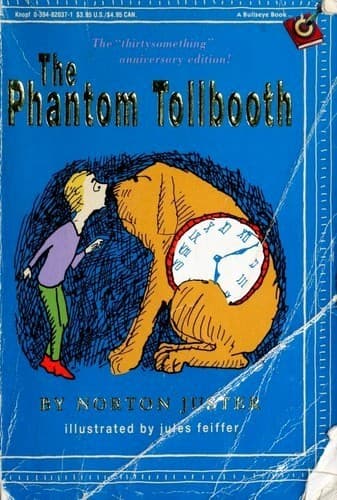
The Phantom Tollbooth
Norton Juster·1961·Random House·Sci-Fi & Fantasy
Reading level: Ages 8–12 (middle grade) · 5-hour read · Beginner difficulty.
- Reading time
- 5h
- Difficulty
- Beginner
- Recommended age
- Ages 8–12
- Guide read
- 4min
- Editor's rating
- 4.6 / 5
- norton-juster
- childrens-fiction
- wordplay
- adventure
- education
- classic
- humor
- 1960s
— In one sentence —
A bored boy drives through a tollbooth and enters a world where every pun is real and every abstraction is a place you can visit. One of the funniest children's books ever written.
§ 01 · WHY READ
Why read
Norton Juster was an architect working on a grant from the Ford Foundation in 1960. The grant was to write a book about urban perception — how people experience cities. He found the project dry, started doodling on the side, and the doodles became The Phantom Tollbooth (1961). His neighbor Jules Feiffer saw the manuscript, drew the illustrations, and the book was published by Random House. It has not gone out of print in sixty years.
The premise: Milo is a boy who finds everything boring. A tollbooth appears in his room; he drives through it in a small car; he enters the Kingdom of Wisdom, where Numbers and Letters are at war because the King banished the Princesses Rhyme and Reason. Milo must rescue them.
What the book actually is: an extended pun. Every abstraction in the Kingdom of Wisdom is a literal place or person. The Doldrums are a physical location where you go when you stop thinking. The Whether Man predicts whether you'll have weather. Digitopolis is the city of numbers; Dictionopolis is the city of words. The Mathemagician rules one; the Duke of Definition rules the other. The Demon of Insincerity and the Senses Taker are real antagonists.
Juster was an architect — someone trained to think about how abstract concepts become physical spaces — and the architecture of the Kingdom of Wisdom is the book's formal achievement: the construction of a world where every abstraction has been made concrete and every pun is a location. The wordplay is not incidental; it is the argument. The Kingdom of Wisdom is what language looks like if you take it seriously.
§ 02 · CHARACTERS
Characters
Milo — the bored boy who becomes, by the end, a boy who cannot stop being interested in things. His transformation is not dramatic or announced; it accumulates through the experience of the journey.
Tock — a watchdog (literally: his body is a watch) who accompanies Milo throughout. He worries about wasted time, which is the book's first moral argument: time is the one thing you can't buy back.
The Humbug — a large beetle who joins them and is consistently wrong about everything in an overconfident way. He is the book's comic relief and its argument about the danger of confident ignorance.
The Whether Man — who predicts whether you'll have weather. A sample of the book's humor register.
Alec Bings — a boy who sees through things rather than looking at them; he floats at adult eye level rather than child eye level, because children don't see things from the ground up, they see them from the level they'll eventually reach. One of the book's best characters.
§ 03 · HIGHLIGHTS
Three highlights
No. 1 · The Doldrums. Milo enters the Doldrums — a gray region where nothing happens — because he stops thinking. Tock (the watchdog) rescues him, because in the Doldrums you're not allowed to think and you're not allowed not to think; the only way to leave is to actually pay attention to something. The Doldrums are boredom made literal, and Juster's rendering of them — the gray nothing, the Lethargarians who are always getting ready to do something without ever doing it — is the book's cleverest set piece.
No. 2 · Alec Bings and perspective. Alec explains to Milo that he sees through things: he sees the insides of boxes, the spaces inside buildings. He also explains that everyone rises to adult height and then stays there — they see the world from five feet rather than growing toward a view from ten feet, because they stop growing early. Juster's argument is about how fixed perspective prevents you from seeing what could be visible from a slightly different angle.
No. 3 · The return. Milo completes the quest and returns home to find that everything he found boring is now interesting — that the Kingdom of Wisdom has taught him to pay attention. The tollbooth is gone when he wakes the next morning. He doesn't need it anymore. The transformation is understated; Juster trusts the reader to understand what has happened.
§ 04 · EDITIONS
Recommended editions
| Edition | Why pick it |
|---|---|
| Random House (with Jules Feiffer illustrations) | The definitive edition; Feiffer's line drawings are integral to the book. The version to get. |
| 50th Anniversary Edition (2011) | Includes an afterword by Juster and new material on the book's creation. Good for adult readers returning to it. |
| Audiobook (David Hyde Pierce) | Pierce's reading is warm and funny; the right audio choice. |
§ 05 · FIT
Who it's for / not for
Read this if you are…
- Any adult who loved it as a child: it is funnier and more precisely constructed at forty than at ten.
- Reading it aloud to a child who is between eight and twelve: the wordplay works brilliantly aloud and the questions it raises — about language, about time, about boredom — generate real conversation.
- Any reader who enjoys books that use wordplay as structural argument rather than decoration.
Skip it if you are…
- Averse to puns. The Kingdom of Wisdom is built out of puns; if the form irritates you, the book will irritate you from beginning to end.
§ 06 · TIPS
Reading tips
- Read it aloud if possible. The wordplay is funnier spoken than read silently; Juster wrote it to be performed as much as read.
- The Doldrums are the thesis. When Milo escapes the Doldrums by paying attention, the book has told you what it is about.
- Alec Bings's chapter rewards slowing down. His arguments about perspective and seeing are more precise than they appear; they're worth reading twice.
§ 07 · COMPARE
Read alongside
- Lewis Carroll — Alice's Adventures in Wonderland (1865). The predecessor: another child entering a world where logic and language work differently. Carroll's nonsense is darker and stranger; Juster's is warmer and more didactic about its lessons.
- C. S. Lewis — The Lion, the Witch and the Wardrobe (1950). Another child entering a secondary world through an unexpected portal; different formal logic and theology.
- Roald Dahl — Charlie and the Chocolate Factory (1964). The contemporary: another children's fantasy built on the premise that a dull world hides something extraordinary. Dahl's is darker; Juster's is more intellectual.
§ 08 · DISCUSSION
Discussion questions
- The Kingdom of Wisdom is built from puns and abstraction made literal. What does Juster gain by making abstract concepts physical places?
- Milo is bored at the beginning and interested in everything at the end. What caused the change? Is the Kingdom of Wisdom real, or is the lesson that paying attention to anything is enough?
- The Doldrums exist because Milo stops thinking. Is the book's argument that boredom is a failure of attention rather than a property of the world?
- Alec Bings sees from adult eye level as a child, because he will grow to that height eventually. What does his perspective represent? What does the book argue about the relationship between perspective and growth?
- The tollbooth disappears when Milo no longer needs it. What does this ending argue about the relationship between magical aids and the person who uses them?
- The book is simultaneously a children's adventure and a philosophical argument about language, time, and attention. Does the argument work for adult readers, or does it require a child's frame?
One line to remember
“So many things are possible just as long as you don't know they're impossible.”— Alec Bings — Chapter 11
Appears in collections
Reading lists featuring this book
7 books
The Best Books for 8-Year-Olds
Seven books an eight-year-old can actually finish — and remember the rest of their life.
Open list →
5 books
Books for People Who Stopped Reading
Five books under 200 pages. No prerequisites. No homework.
Open list →
7 books
Best Coming of Age Novels
Six novels about the specific moment of becoming — organized by protagonist age and what each book says about that moment.
Open list →
10 books
The Gateway: Fantasy for Young Readers Ages 8–12
The books that made readers. A curated path into fantasy for children who are ready for a real story.
Open list →
You might also like
Read next
Ted Chiang · 2002
Stories of Your Life and Others
Ted Chiang writes 30-page stories that take longer to think about than most novels. He has won more awards per word than any writer alive.
Read · 5 min
Cixin Liu · 2008
The Dark Forest
Fan + author consensus pick for the best book in the trilogy. Two simple axioms derive the silence of the universe. After this one, you don't look at the night sky the same way.
Read · 5 min
Octavia E. Butler · 1979
Kindred
Octavia Butler sends a Black woman from 1976 Los Angeles back to antebellum Maryland. The time travel is a device. The horror is real.
Read · 5 min