Editor-reviewed
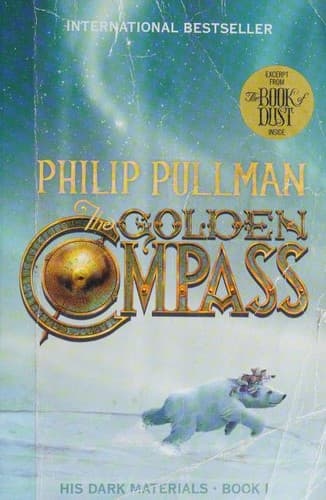
The Golden Compass
Philip Pullman·1995·Scholastic·Sci-Fi & Fantasy
Reading level: Ages 10–12 (middle grade) · 11-hour read · Intermediate difficulty.
- Reading time
- 11h
- Difficulty
- Intermediate
- Recommended age
- Ages 10–12
- Guide read
- 5min
- Editor's rating
- 4.7 / 5
- pullman
- his-dark-materials
- fantasy
- daemons
- oxford
- childrens-fiction
- carnegie-medal
- religious-critique
— In one sentence —
Pullman set out to write a fantasy that would do the opposite of Narnia. He succeeded, and produced one of the great novels of the 1990s.
§ 01 · WHY READ
Why read
Philip Pullman published The Golden Compass — Northern Lights in the UK — in 1995, the first volume of the His Dark Materials trilogy. He said he wrote it explicitly as a response to C. S. Lewis's Narnia chronicles, which he found theologically coercive and what he called dishonest about death. Where Lewis ends Narnia by bringing the children to a paradise and making it the real thing all along, Pullman wanted to write a fantasy that valued this world and this life, that found divinity in human consciousness rather than in obedience to an external authority.
The result is one of the most ambitious children's novels of the twentieth century. It won the Carnegie Medal; the full trilogy won the Whitbread Prize for best book of the year in 2001 (not just best children's book — best book). When readers have tried to explain what they feel the His Dark Materials trilogy achieves that other fantasy does not, the answer usually involves the word "serious."
The premise: Lyra Belacqua is an eleven-year-old girl who has grown up in Jordan College, Oxford, in a world parallel to but different from ours. In this world, human souls exist outside the body as animal companions called dæmons, which settle into a permanent form at adolescence. Children are going missing. A substance called Dust — connected to consciousness and to sin — is at the center of a theological and scientific crisis. Lyra takes the alethiometer, a truth-telling device, and heads north.
What Pullman does technically: he builds a world that is recognizably Oxford, recognizably 20th-century, but tilted — with zeppelins and dæmons and an authority called the Magisterium — and he lets Lyra move through it as a child who is curious and brave and sometimes wrong. He trusts his young readers to handle complexity, uncertainty, and loss. This is rarer than it should be.
§ 02 · CHARACTERS
Characters
Lyra Belacqua — twelve years old, raised at Jordan College among scholars, lying casually and reflexively (it is one of her skills), fiercely loyal to her friends. She is a great literary protagonist partly because she is not immediately sympathetic in the way protagonists are designed to be: she is reckless, she deceives people, she is not humble. Her bravery comes from not knowing quite how much danger she's in, and Pullman is honest about this. She grows — but in the way children grow, not in the way fictional children are supposed to.
Pantalaimon (Pan) — Lyra's dæmon, who can still change form (she is not yet an adult). He is a separate voice inside the first-person experience: more cautious than Lyra, more honest with her than she is with herself. The dæmon relationship is Pullman's most brilliant invention — it externalizes the internal, makes visible the way we argue with ourselves.
Mrs. Coulter — one of the great villains in children's fiction, and one of the most complex. Beautiful, formidable, intellectually brilliant, entirely willing to do monstrous things in the service of a belief she holds genuinely. She is also Lyra's mother, which Pullman reveals at a precisely calibrated moment. Her golden monkey dæmon expresses what she keeps controlled.
Lord Asriel — Lyra's father, an explorer and renegade scholar. He is passionate, ruthless, magnificent, and wrong in the way that certain passionate people are wrong: correct about what's broken, wrong about the cure. He is the trilogy's most Miltonic figure — Pullman's working title was Paradise Lost — and his relationship with Lyra is the emotional through-line beneath the plot.
Iorek Byrnison — the armored bear (panserbjørn) who becomes Lyra's companion and protector. He is the novel's argument that the best kind of protection doesn't require permanent watching: Iorek trusts Lyra to make her own mistakes while being genuinely loyal to her.
§ 03 · HIGHLIGHTS
Three highlights
No. 1 · The dæmons. Every person in Lyra's world has an external dæmon — an animal companion that is the physical form of their soul. Children's dæmons change form constantly; adults' are settled. Touching another person's dæmon is deeply taboo. The Gobblers — the children who are going missing — are being taken to a station in the north where their dæmons are being separated from them by a process called intercision. Pullman's genius here: he makes the horror legible before any event by establishing how central the dæmon is to selfhood. The reader feels the threat of separation viscerally before it happens.
No. 2 · The alethiometer. The golden compass of the title is a truth-telling device that reads symbols to answer questions — but its language is dense and symbolic, and Lyra can read it instinctively, without training, through a kind of grace that will later become a central issue. The alethiometer is Pullman's image for the way truth is available to the unconditioned — to the child who has not yet been told what she's supposed to believe.
No. 3 · The ending of volume one. The final chapters of The Golden Compass are among the most formally demanding in children's fiction: Lyra witnesses something she cannot undo, understands something about the people she trusted, and crosses into a new world. Pullman ends the first book at a point of radical rupture rather than provisional safety. This is the correct choice — it commits the reader to the second volume in the way that a tidy resolution never would — but it requires the reader to absorb a genuine loss. Pullman does not soften it.
§ 04 · EDITIONS
Recommended editions
| Edition | Why pick it |
|---|---|
| Knopf / Scholastic (US, "The Golden Compass") | The standard US edition; the title Northern Lights was changed to The Golden Compass for American audiences. |
| Scholastic UK ("Northern Lights") | The original UK title; same text. Some readers prefer it as the title names what the novel is actually about. |
| His Dark Materials trilogy (boxed set) | Read all three together; the trilogy is a single argument. The Subtle Knife and The Amber Spyglass complete what The Golden Compass begins. |
| Audiobook (full cast, BBC) | The BBC full-cast audio production is exceptional; Pullman narrates, and the voice cast brings the dæmons to vivid life. |
The HBO/BBC TV series His Dark Materials (2019–2022) is a faithful, handsome adaptation. Watch after reading; the first season covers The Golden Compass very closely.
§ 05 · FIT
Who it's for / not for
Read this if you are…
- A reader who loved Narnia as a child and is ready to read the response Pullman wrote to it.
- Anyone interested in how fantasy can carry genuine philosophical and theological argument without becoming a lecture.
- Readers looking for a girl protagonist who is brave in the specific way children are brave — through ignorance of full consequence rather than through adult courage.
- Anyone who wants a fantasy world where the physical detail is as dense as the ideas.
Skip it if you are…
- Reading the synopsis as an anti-religious text and expecting a polemical experience. The trilogy is critical of institutional religion, but Lyra's story is not a lecture; it is a narrative. The argument emerges from the characters' choices, not from speeches.
- Not prepared to read all three books. The Golden Compass ends at a point of rupture; the second and third volumes are necessary to complete the argument.
§ 06 · TIPS
Reading tips
- The dæmon system is the key. Before anything else in the world-building, understand that dæmons are souls, not pets. The taboo on touching is not politeness — it is something like the taboo on violation.
- The alethiometer's language is symbolic, not literal. Lyra reads it through a state Pullman calls not-thinking-about-it. Track when this works and when it fails; the failures in the later books are as important as the successes.
- Mrs. Coulter is always right about something. She is not a simple villain. Every scene with her, identify what she's correct about, not just what she's doing wrong.
- Read the Milton. Pullman's title comes from Paradise Lost: "His dark materials to create more worlds." The trilogy is a dialogue with Milton's poem. You don't need to read Milton first, but the trilogy rewards it.
§ 07 · COMPARE
Read alongside
- C. S. Lewis — The Lion, the Witch and the Wardrobe (1950). The book Pullman was responding to. Reading both together makes both richer: Lewis's argument and Pullman's counter-argument illuminate each other.
- John Milton — Paradise Lost (1667). Pullman's source and explicit dialogue partner. The trilogy re-tells the story of the Fall as a fortunate thing rather than a catastrophe. Read at least Books I and IX.
- Ursula K. Le Guin — A Wizard of Earthsea (1968). The other great 20th-century children's fantasy in the secondary world mode; a different mythology, a different implicit theology, the same seriousness about what children can handle.
- William Blake — Songs of Innocence and Experience (1794). Pullman's other major influence; the concepts of innocence and experience that structure the trilogy's argument about Dust and consciousness come directly from Blake.
- Donna Tartt — The Secret History (1992). Not fantasy, but shares the quality of treating its readers as capable of moral complexity; the comparison is useful for readers who want to identify what makes His Dark Materials feel different from other children's fiction.
§ 08 · DISCUSSION
Discussion questions
- Dæmons in Lyra's world are external animal souls that children can change form but adults cannot. What does the moment of settling represent? Why is it connected to adolescence?
- The Gobblers perform intercision — separating children from their dæmons. What makes this horror legible even before we see it? How does Pullman build dread without showing the act?
- Mrs. Coulter is evil and brilliant and Lyra's mother. How does Pullman use this relationship to complicate the novel's moral structure?
- Lyra can read the alethiometer without training, in a state of unselfconscious openness. What does this capacity represent? Why will it matter later that she loses this ability?
- Pullman wrote his trilogy as a response to Narnia. Having read The Golden Compass (and possibly Narnia), what specific counter-argument do you see Pullman making?
- Lord Asriel is correct about the Magisterium's corruption and willing to do terrible things in response. Does the novel endorse his view of the problem while rejecting his solution? How?
- The ending of The Golden Compass involves a loss that cannot be undone. How does Pullman handle the emotional cost? Why does he not soften it?
- Dust is described as elementary particles that are attracted to adult humans — connected to consciousness, to sin (according to the Magisterium), to wisdom (according to Pullman's implied argument). By the end of this book, what do you understand Dust to mean?
One line to remember
“We have to be all those difficult things like cheerful and kind and curious and patient, and we've got to study and think and work hard, all of us, in our different worlds.”— Lyra Belacqua — end of The Amber Spyglass
Appears in collections
Reading lists featuring this book
7 books
The Best Books for 10-Year-Olds
Seven books for the year a child stops needing books to be easy.
Open list →
5 books
Books Like Harry Potter for Adults
From the closest match to the most literary departure — each preserves something specific from Rowling.
Open list →
6 books
Most Addictive Books to Read
Six books with hooks so specific you'll remember exactly where you were when you couldn't stop.
Open list →
7 books
Best Coming of Age Novels
Six novels about the specific moment of becoming — organized by protagonist age and what each book says about that moment.
Open list →
10 books
The Gateway: Fantasy for Young Readers Ages 8–12
The books that made readers. A curated path into fantasy for children who are ready for a real story.
Open list →
You might also like
Read next
Ted Chiang · 2002
Stories of Your Life and Others
Ted Chiang writes 30-page stories that take longer to think about than most novels. He has won more awards per word than any writer alive.
Read · 5 min
Cixin Liu · 2008
The Dark Forest
Fan + author consensus pick for the best book in the trilogy. Two simple axioms derive the silence of the universe. After this one, you don't look at the night sky the same way.
Read · 5 min
Octavia E. Butler · 1979
Kindred
Octavia Butler sends a Black woman from 1976 Los Angeles back to antebellum Maryland. The time travel is a device. The horror is real.
Read · 5 min