Editor-reviewed
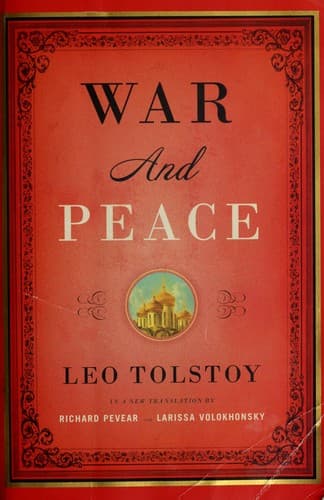
War and Peace
Leo Tolstoy·1869·The Russian Messenger (serial)·Literature
Reading level: Ages 16+ (adult) · 60-hour read · Advanced difficulty.
- Reading time
- 60h
- Difficulty
- Advanced
- Recommended age
- Ages 16+
- Guide read
- 6min
- Editor's rating
- 4.9 / 5
- tolstoy
- russian-literature
- napoleon
- 19th-century
- epic
- war
- historical-fiction
- long-reads
— In one sentence —
580,000 words. 580 named characters. The Napoleonic invasion of Russia. And somehow, also, the best novel about how to live.
§ 01 · WHY READ
Why read
Leo Tolstoy published War and Peace serially between 1865 and 1869, revising it substantially for the first book publication. He was working on it for six years; his wife Sonya Bers copied the manuscript by hand seven times, in whole or in part, because handwritten drafts were the only way to circulate text before typesetting. The novel has 580,000 words in most English translations — longer than the Bible — and approximately 580 named characters. It covers the Napoleonic invasion of Russia between 1805 and 1812, the occupation of Moscow, the retreat, and the aftermath.
What it is not: a history textbook. Tolstoy was obsessed with the question of what actually causes historical events — whether great men make history or whether history makes great men who are subsequently credited with it. His Napoleon is a small man who believes he is directing the war; Tolstoy's argument is that no one directs a war, that the outcome of a battle is determined by millions of small individual acts and the morale of the ordinary soldiers, not by the generals' orders. This is not a military history that happens to have characters; it is a philosophical novel about causation and free will that happens to use the Napoleonic war.
Why you should read all 60 hours of it: the novel's emotional and intellectual scale is its achievement. Tolstoy needs this length to show his characters changing over fifteen years; to show that Pierre Bezukhov at fifty is a different person from Pierre at twenty, and that the difference is the accumulated weight of what happened to him; to show that history and private life are happening simultaneously in the same bodies. A shorter version of War and Peace would be a different and lesser book.
Nabokov called Tolstoy the greatest Russian writer. Woolf said he made other novelists feel like they were building toy houses. James read him with admiration and exasperation. The consensus is not universal adulation; it is that whatever Tolstoy was doing, it was operating at a scale no one else had reached.
§ 02 · CHARACTERS
Characters
Pierre Bezukhov — the illegitimate son of a wealthy count who inherits unexpectedly, is lost for most of the novel, and eventually finds his way through Freemasonry, the war, captivity, and finally a quiet domestic life. He is the novel's spiritual center: a man trying to understand how to live, trying and failing in specific, recognizable ways, eventually arriving at something like wisdom. His trajectory is the novel's argument about what wisdom looks like.
Natasha Rostova — the other great center: a girl of thirteen at the novel's opening, who becomes the woman Pierre eventually marries. Her arc — from vivid, impetuous adolescence through a nearly catastrophic error, grief, and finally maturity — is one of literature's great portraits of a person growing up. The scene in which Natasha dances at her uncle's house — unexpectedly, perfectly — is Tolstoy showing what the Russian soul means, not explaining it.
Prince Andrei Bolkonsky — the third center: a man of principle and intelligence who cannot find a purpose adequate to his gifts. He goes to war seeking glory, is wounded at Austerlitz, nearly finds happiness with Natasha, loses her, and goes back to war. His death is one of the longest and most carefully prepared death scenes in literature.
Kutuzov — the Russian commander-in-chief, who is the novel's implicit hero despite appearing rarely. Kutuzov understands that the way to defeat Napoleon is to let him defeat himself — to retreat, to avoid pitched battle, to let the Russian winter and Russian morale do what generalship cannot. He is old, fat, often asleep, and infallible in his strategic passivity.
Napoleon — present throughout as a figure of Tolstoy's contempt. His self-belief — his certainty that he is directing events — is the novel's negative example of the vanity of great men.
§ 03 · HIGHLIGHTS
Three highlights
No. 1 · Austerlitz. Prince Andrei is wounded at the Battle of Austerlitz. He falls and looks up at the sky — an enormous sky, endless, calm — and everything that seemed important before the wound seems small and false. Napoleon rides past. Andrei looks at him and thinks: here is this small man, so pleased with himself, and it means nothing. The sky is the scene's dominant image, and it returns throughout the novel whenever Andrei approaches understanding.
No. 2 · Natasha at her uncle's house. After the comet of 1812, Natasha and her family stay at her uncle's house in the country. He plays the balalaika; she begins to dance — unexpectedly, correctly, in a way she has never been taught, in a way that she couldn't have learned from her French dancing masters. It is Tolstoy's image of what it means to belong to a people: the knowledge you carry without knowing you carry it.
No. 3 · Pierre in captivity. During the retreat from Moscow, Pierre is taken captive by the French. He walks with the column of prisoners and meets Platon Karataev — a simple Russian peasant who accepts everything, complains about nothing, loves everyone without distinction. Karataev becomes Pierre's guide to a kind of wisdom that requires giving up the self-consciousness Pierre has spent thirty years cultivating. After Karataev dies, Pierre carries something of him forward. The encounter is Tolstoy's case for a different kind of knowledge than the Enlightenment produced.
§ 04 · EDITIONS
Recommended editions
Translation is the central question. The major English translations:
| Translation | Why pick it |
|---|---|
| Richard Pevear and Larissa Volokhonsky (Knopf, 2007) | The current gold standard: preserves Tolstoy's repetitions and rhythms, less smoothed than Maude. Start here. |
| Aylmer and Louise Maude (Oxford World's Classics, 1922–3) | Approved by Tolstoy; graceful and authoritative; somewhat Victorian. The classic English version. |
| Anthony Briggs (Penguin, 2005) | More readable than Pevear/Volokhonsky; somewhat freer. Good for readers who find the P&V version occasionally dense. |
| Audiobook (Neville Jason, P&V translation) | Jason reads all 61 hours of the Pevear/Volokhonsky translation; the correct audio experience. |
§ 05 · FIT
Who it's for / not for
Read this if you are…
- Ready for the longest novel you will ever read, and willing to give it the time it requires. The reward is proportional to the commitment.
- Anyone interested in the questions: What makes history happen? How do people change over decades? What does wisdom look like, and how do you get it?
- Readers who have been told the novel is difficult and daunting: it is long, not difficult. Tolstoy is one of the clearest writers in the European tradition. The length is the challenge, not the prose.
Skip it if you are…
- Wanting a novel with a clear through-line of plot. War and Peace does not have a conventional plot structure; it has characters whose lives move through historical events. The plot is their lives.
- Not ready to learn 580 names. A character list at the front of the book is useful; note that Russians use multiple forms of their names (Natasha/Natalie, Pierre/Pyotr).
§ 06 · TIPS
Reading tips
- Keep a character list. The first hundred pages introduce dozens of characters; noting who's who saves rereading.
- The philosophical essays (especially about Napoleon and causation) are part of the novel. Many readers skip the second epilogue, which is a philosophical treatise on free will and historical causation. Read it; it's Tolstoy stating explicitly what the novel has been showing.
- Natasha's arc requires patience. She does something in Volume II that makes her difficult to sympathize with. Stay with her. Tolstoy knows what he's doing.
- Read a few pages of the Maude translation alongside Pevear/Volokhonsky if you want to hear the difference. The choice of translation is a genuine choice; there is no universally right answer.
§ 07 · COMPARE
Read alongside
- Leo Tolstoy — Anna Karenina (1878). The other great Tolstoy novel: more compressed, more tragic, equally immense in its understanding of people. Read War and Peace first; Anna Karenina is the mature refinement.
- Victor Hugo — Les Misérables (1862). The French companion in epic scope: another massive 19th-century novel about history and individual lives, with similar digressions into historical essay. Published seven years before War and Peace was complete.
- Stendhal — The Red and the Black (1830). The earlier French Napoleonic novel: a young provincial's ambition in the post-Napoleonic world. The comparison shows how differently French and Russian writers processed the same historical event.
§ 08 · DISCUSSION
Discussion questions
- Tolstoy's argument is that great men do not make history — that Napoleon does not direct the battle, that history is made by millions of small individual acts. Is this convincing? Does the novel demonstrate it?
- Kutuzov defeats Napoleon by retreating and doing as little as possible. Tolstoy presents this as wisdom. Do you agree? What is Kutuzov understanding that the other generals are not?
- Pierre goes through Freemasonry, captivity, and Karataev before arriving at something like peace. What has he learned? Can you describe it?
- Natasha's dance at her uncle's house is Tolstoy's image of belonging to a people — of knowing things you haven't been taught. Is this a romantic idea? Is it true?
- Prince Andrei dies in a long, carefully prepared scene. What is he understanding as he dies? Does the novel present his death as meaningful?
- The novel covers 1805 to 1812 and the characters change over seven years. Which character changes most? Which changes least? Is the change Tolstoy describes realistic?
- The second epilogue is a philosophical treatise on free will and historical causation. Why did Tolstoy include it? Does the novel need the argument to be stated explicitly?
One line to remember
“All we can know is that we know nothing. And that's the height of human wisdom.”— Pierre Bezukhov — Volume II
Appears in collections
Reading lists featuring this book
6 books
The Best Books About War and Its Cost
Six novels about what war actually does — not to nations, but to people.
Open list →
7 books
The Best Books for a Long Flight
Seven books substantial enough to disappear into for ten hours in a metal tube.
Open list →
5 books
Books Like Infinite Jest
For readers who finished Wallace and want more — long, demanding, formally ambitious novels with footnotes and the kitchen sink.
Open list →
10 books
Books That Earn Every Hour: Ten Essential Long Reads
Not long because they couldn't be shorter. Long because the size is the point.
Open list →
6 books
Most Immersive Books
Six books that require full surrender — and pay for it.
Open list →
You might also like
Read next
Leo Tolstoy · 1878
Anna Karenina
Not just a love story. Two parallel lives — Anna's destruction, Levin's salvation — ask the same question: how should a person live?
Read · 6 min
William Faulkner · 1936
Absalom, Absalom!
Four narrators reconstruct a man who destroyed his family. The story keeps changing. That is the point.
Read · 7 min
Toni Morrison · 1987
Beloved
Toni Morrison said she wrote this novel to give voice to the sixty million. It won the Pulitzer, the Nobel, and is the greatest American novel of the second half of the twentieth century.
Read · 6 min