Editor-reviewed
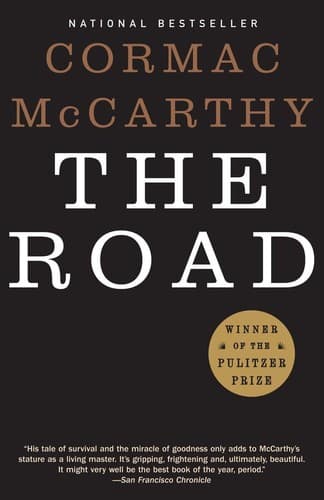
The Road
Cormac McCarthy·2006·Alfred A. Knopf·Literature
Reading level: Ages 16+ (adult) · 7-hour read · Intermediate difficulty.
- Reading time
- 7h
- Difficulty
- Intermediate
- Recommended age
- Ages 16+
- Guide read
- 5min
- Editor's rating
- 4.7 / 5
- cormac-mccarthy
- post-apocalyptic
- survival
- father-son
- pulitzer
- american-literature
- literary-fiction
— In one sentence —
A father and a son on a road through the end of the world. McCarthy wrote it for his son John, who was four. It is a love story.
§ 01 · WHY READ
Why read
Cormac McCarthy wrote The Road for his son John, who was born in 1998 when McCarthy was sixty-four years old. He said in a rare interview that he was lying awake one night in El Paso watching his young son sleep, thinking about what this city might look like in a hundred years, and the novel grew from that thought. He finished it in 2003 and it was published in 2006. It won the Pulitzer Prize in 2007.
The premise is as simple as a myth: an unnamed man and his young son walk south through an American landscape destroyed by a catastrophe never named or explained. The sky is ash. The trees are dead. The animals are gone. Other survivors range from organized cannibals to isolated families trying to stay alive. The man and the boy have a pistol with two bullets — one for each of them, if it comes to that.
McCarthy's technical achievement in this novel is extreme. He strips the prose to something approaching its minimum: no chapters, no quotation marks, minimal punctuation, sentences that are grammatically simple and sometimes not sentences at all. The style is not an affectation — it is an argument. The world of the novel has been stripped; the language matches it. Everything that remains — a word, a sentence, a moment of warmth — matters more because of what has been taken away.
The novel has a reputation as relentlessly bleak, which is partly accurate and partly wrong. It is bleak in its world-building and unsparing in its violence. But McCarthy's subject is not despair — it is love, specifically the particular love of a parent for a child when you know the child will outlive you and you don't know if the world will be worth living in after you go.
§ 02 · CHARACTERS
Characters
The man — unnamed throughout. He is dying of an unspecified lung condition; he coughs blood regularly. What keeps him moving is his son. His internal monologue — rendered indirectly through McCarthy's prose — cycles between grief for the world that was, terror about what might happen to the boy, and moments of love so fierce they stop the narrative. He is not a hero in a conventional sense; he is a father at the end of everything, doing what fathers do.
The boy — also unnamed; the man calls him "the boy." He was born after the catastrophe and knows no other world. He has grown up on his father's stories of a better past he cannot remember. The boy's central moral question — whether to help strangers when helping them risks survival — runs through the whole novel. He is more morally consistent than his father. He is the novel's argument that goodness does not require a world in which goodness is practical.
The woman — the man's wife, who appears only in flashbacks and the man's dreams. She chose to leave before the novel begins, unwilling to survive in this world. Her decision is presented without condemnation; the man grieves it and understands it simultaneously.
§ 03 · HIGHLIGHTS
Three highlights
No. 1 · "Carrying the fire." The man tells the boy that they are "carrying the fire" — that this is what makes them different from the bad people, the people who have abandoned moral consideration to survive. The phrase is never defined. The boy asks if the fire is real. The man says yes. The fire is McCarthy's minimal formulation of what holds human value intact when everything external that supported it has been destroyed. You don't need the world to be worth living in to have the fire; you just have to carry it.
No. 2 · The cellar. The man and the boy find a house, investigate the cellar, and discover something McCarthy presents with clinical precision. The scene is the novel's most extreme descent into what human beings are capable of when civilization is gone. What the man does immediately after — the decision he makes in the next few minutes — is the clearest statement of the novel's ethics: not what he kills, but what he protects.
No. 3 · The ending. McCarthy's ending has been debated since publication. It is either a cheap consolation or a genuine act of hope — or it is McCarthy's statement that the two things cannot be distinguished, that hope is always cheap until it isn't. The boy's choice in the final pages — whom to go with, what to accept — is the entire novel's argument compressed into a single scene. Read it slowly.
§ 04 · EDITIONS
Recommended editions
| Edition | Why pick it |
|---|---|
| Vintage Books (paperback, 2007) | The standard US edition; includes Oprah's Book Club selection materials, which can be ignored. |
| Picador (UK edition) | Same text; slightly different trim. |
| Audiobook (Tom Stechschulte) | Stechschulte's reading is spare and exactly right for the prose — avoids over-dramatizing material that earns its own weight. |
The 2009 film adaptation (directed by John Hillcoat, starring Viggo Mortensen) is good: faithful to the novel's tone, correctly austere. Watch it after reading.
§ 05 · FIT
Who it's for / not for
Read this if you are…
- Any reader who has a child, or was a child, or has thought about what you would do to protect someone you love when all protection is failing.
- Readers interested in McCarthy's prose style — this is his most accessible work and also a good introduction to the syntax.
- Anyone who wants a post-apocalyptic novel that is about something more than survival logistics.
- Readers who have found other post-apocalyptic fiction too consoling or too genre-mechanical.
Skip it if you are…
- Sensitive to graphic violence. The cellar scene and several other passages are extreme. McCarthy does not flinch and he does not let the reader flinch.
- Looking for explanation. The catastrophe is not identified; the novel is not interested in how it happened.
- In a period of depression or grief that makes bleakness harmful to you. The novel is not nihilistic but it earns the word bleak.
§ 06 · TIPS
Reading tips
- Read it fast on first pass. The prose is designed for momentum; stopping to analyze sentences interrupts the accumulation McCarthy is building. Then go back.
- The punctuation is intentional. McCarthy removed quotation marks from the dialogue, and the dialogue between the man and the boy blurs into the narration. This is not an error — it is what the relationship looks like from inside.
- "Carrying the fire" is the key. When the boy asks if they're still carrying the fire, and when the man confirms it, track these moments. They are the novel's moral backbone.
- The ending requires patience. It has provoked accusations of being too easy after everything preceding it. McCarthy is asking whether hope can coexist with honesty about the world. Hold the question rather than answering it.
§ 07 · COMPARE
Read alongside
- Octavia E. Butler — Parable of the Sower (1993). The comparison is the clearest way to see what each novel is doing: Butler's post-collapse America has community, religion, construction, a protagonist who builds rather than protects; McCarthy's has none of these, and that's the point. Both are honest.
- José Saramago — Blindness (1995). A different kind of collapse — sudden, viral — and a different formal approach (Saramago's prose is also stripped of conventional punctuation). The comparison illuminates what each author chose to emphasize.
- Kazuo Ishiguro — Never Let Me Go (2005). The year before; the same subject — what do you do when you know the end is coming and you cannot stop it — handled through repression rather than confrontation.
- Samuel Beckett — Waiting for Godot (1953). Two characters waiting in a blasted landscape, sustained by conversation, going nowhere. McCarthy's two characters are moving, but toward the same horizon. The comparison is not coincidental.
- Denis Johnson — Jesus' Son (1992). Not post-apocalyptic, but McCarthy's stripped prose and Johnson's stripped prose are the closest American analogues; reading them together is useful for understanding what each is doing with minimalism.
§ 08 · DISCUSSION
Discussion questions
- The catastrophe is never named or explained. What effect does this have? Would the novel be stronger or weaker if we knew what happened?
- The man and the boy are "carrying the fire." The phrase is never defined. What is it? Is it a sufficient basis for maintaining moral conduct when survival requires otherwise?
- The woman chose to leave rather than try to survive. The man understands her decision and grieves it. Does the novel condemn her? Does it condone her?
- The boy is consistently more willing to help strangers than his father is. Is the boy right? Is his morality sustainable in the world the novel presents?
- McCarthy's prose strips punctuation, dialogue tags, and most conventional structure. Is this style appropriate to the subject? What would the novel lose if it were written conventionally?
- The cellar scene is the novel's most extreme passage. What does it argue? Why does McCarthy include it at this level of specificity?
- The ending has divided critics: some find it too consoling, some find it exactly right. After finishing, what do you think McCarthy is saying? Can hope coexist with honesty about the world he's depicted?
- The novel was written for McCarthy's young son. Does knowing this change how you read it?
One line to remember
“You have to carry the fire. I don't know how to. Yes you do. Is the fire real? The fire? Yes. Is it real? Oh yes. And we will never let it go.”— The man and the boy — near the end
Appears in collections
Reading lists featuring this book
7 books
The Best Book Gifts for Father's Day
Seven books that take fathers, fatherhood, and decision-making seriously.
Open list →
9 books
Science Fiction for People Who Don't Read Science Fiction
Nine novels that will change what you think the genre is allowed to do.
Open list →
6 books
Best Books About Grief and Loss
Six different kinds of grief — romantic, existential, maternal, historical, friendship, childhood.
Open list →
7 books
The Best Books About Fatherhood and Loss
Seven novels about fathers and sons, fathers who fail, fathers who carry the boy on the road — the grief specific to fatherhood.
Open list →
7 books
Books About Starting Over in Life
Seven novels about second acts, leaving the wreckage of the first life, and building from nothing.
Open list →
6 books
The Best Books About Survival
Six novels about people who have to keep going when everything says they shouldn't.
Open list →
7 books
Read the Book Before the Movie
Seven books where the adaptation is good — but the book contains something the screen can't hold.
Open list →
6 books
Books That Will Make You Cry
Direct about what hits and why — no sentimentality, just the moments that break through.
Open list →
6 books
Books to Read When You Feel Lost in Life
Protagonists with no map who keep moving anyway — each one a different kind of lost.
Open list →
6 books
Best Pulitzer Prize Novels Worth Reading Now
Six winners that held up — and one whose controversy is part of the point.
Open list →
You might also like
Read next
William Faulkner · 1936
Absalom, Absalom!
Four narrators reconstruct a man who destroyed his family. The story keeps changing. That is the point.
Read · 7 min
Toni Morrison · 1987
Beloved
Toni Morrison said she wrote this novel to give voice to the sixty million. It won the Pulitzer, the Nobel, and is the greatest American novel of the second half of the twentieth century.
Read · 6 min
Leo Tolstoy · 1878
Anna Karenina
Not just a love story. Two parallel lives — Anna's destruction, Levin's salvation — ask the same question: how should a person live?
Read · 6 min