Editor-reviewed
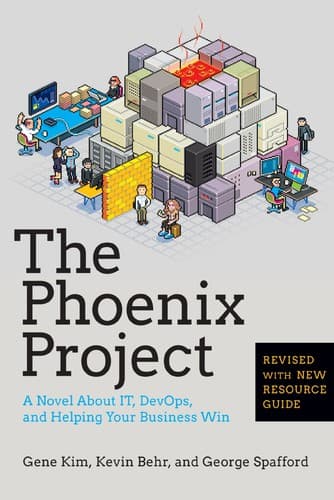
The Phoenix Project
Gene Kim·2013·IT Revolution Press·non-fiction
Reading level: Ages 16+ (adult) · 9-hour read · Beginner difficulty.
- Reading time
- 9h
- Difficulty
- Beginner
- Recommended age
- Ages 16+
- Guide read
- 4min
- Editor's rating
- 4.2 / 5
- gene-kim
- devops
- it-management
- software
- business-novel
- agile
- lean
- technology
— In one sentence —
A novel about DevOps. Yes, really — a novel. The form is a teaching device; the content is one of the most useful frameworks for how software organizations actually fail and can be fixed.
§ 01 · WHY READ
Why read
Gene Kim, Kevin Behr, and George Spafford published The Phoenix Project in 2013 as a business novel — fiction that uses a narrative vehicle to teach management and technology principles. The form was established by Eliyahu Goldratt's The Goal (1984), which used the same approach to teach the Theory of Constraints to manufacturing managers. Kim explicitly models The Phoenix Project on The Goal and applies the same principles to IT and software organizations.
The premise: Bill Palmer is a mid-level IT manager at Parts Unlimited who is unexpectedly promoted to VP of IT Operations when the previous VP quits. The company is in crisis: a major IT project called Phoenix is months late, the CIO is threatening to outsource the entire IT department, and the company's stock price is falling. Bill must fix the organization or it ceases to exist.
Through his work with an eccentric board member named Erik, Bill comes to understand the organization's problems through the lens of lean manufacturing: IT work is like manufacturing, with four types of work (business projects, internal IT projects, changes, and unplanned work), bottlenecks, work-in-progress limits, and the primacy of flow. Most of the novel's crises are caused by the same failure: accumulation of unplanned work that blocks the bottleneck, which blocks everything else.
What the novel teaches: the Three Ways — a simplified framework for DevOps culture. The First Way: optimize for fast flow through the system. The Second Way: create feedback loops from right to left (from operations back to development). The Third Way: create a culture of continual experimentation and learning. These are operationalizations of lean manufacturing principles applied to software delivery.
§ 02 · CHARACTERS
Characters
Bill Palmer — the reluctant VP of IT, the reader's surrogate. His ignorance at the beginning is the reader's ignorance; his learning is the novel's pedagogical vehicle.
Erik Reid — the eccentric board member who becomes Bill's mentor. He asks Socratic questions, refuses to give direct answers, and is clearly the novel's Vehicle for Teaching. He is thinly characterized but serves his function.
Brent — the indispensable engineer who is the organization's bottleneck. Every critical task requires Brent; Brent is always unavailable; everything is always late. Brent is the novel's most useful character because he illustrates a pattern that everyone in software organizations recognizes: the person who is so critical that they become a single point of failure, and whose indispensability prevents the organization from building sustainable processes.
§ 03 · HIGHLIGHTS
Three highlights
No. 1 · The four types of work. Bill's mentor Erik introduces a framework: IT work is either business projects, internal IT projects, changes, or unplanned work. Most organizations track business projects and ignore unplanned work; but unplanned work is the most destructive, because it derails planned work unpredictably. The first step to fixing the organization is making unplanned work visible.
No. 2 · "Any improvement anywhere besides the bottleneck is an illusion." The Theory of Constraints, applied to IT: if Brent is the bottleneck, optimizing anything that feeds into Brent or takes output from Brent doesn't improve the system — it just creates more queue in front of the bottleneck. The entire system's throughput is governed by the bottleneck's capacity. This is counterintuitive and immediately practical.
No. 3 · Deployment frequency as the metric. By the novel's end, the organization has moved from monthly deployments (batches of months of accumulated work, each deployment a crisis) to frequent deployments (many small changes deployed continuously, each one low-risk). This is the DevOps insight: the antidote to deployment anxiety is more deployments, not fewer. Small batches reduce risk even though the intuition says the opposite.
§ 04 · EDITIONS
Recommended editions
| Edition | Why pick it |
|---|---|
| IT Revolution Press (5th anniversary edition, 2018) | Includes a new chapter updating the principles for 2018. The correct edition. |
| Audiobook (various) | The audiobook is good; the novel's dialogue-heavy sections work well in audio. |
The Unicorn Project (2019), also by Kim, is a companion novel from a developer's perspective rather than an operations manager's. Read it after The Phoenix Project.
§ 05 · FIT
Who it's for / not for
Read this if you are…
- Anyone working in IT management, software development, DevOps, or product management who wants a framework for how software organizations fail and how to fix them.
- Engineering leaders who want a common vocabulary for these problems that can be shared with non-technical stakeholders.
- Readers curious about how manufacturing principles (Toyota Production System, Theory of Constraints) translate to software organizations.
Skip it if you are…
- Looking for literary fiction. The novel is a teaching vehicle; the characterization is thin and the prose is functional.
- Already deeply familiar with DevOps principles: the book is an introduction, not an advanced treatment.
§ 06 · TIPS
Reading tips
- The "Brent" pattern is universal. Every software organization has a Brent — the indispensable person who is also the bottleneck. Identify yours before finishing the book.
- The Four Types of Work are the framework. Carrying these categories into your own work is the book's primary practical value.
- Read The Goal by Goldratt first if you want the original Theory of Constraints material. The Phoenix Project is an application; The Goal is the theory.
§ 07 · COMPARE
Read alongside
- Eliyahu Goldratt — The Goal (1984). The original business novel that Kim explicitly models; the Theory of Constraints applied to manufacturing. Read it first; The Phoenix Project will make more sense.
- Gene Kim — The Unicorn Project (2019). The companion novel from the developer's perspective; covers the same events from a different vantage point.
- Eric Ries — The Lean Startup (2011). The product development complement: where The Phoenix Project is about delivery and operations, The Lean Startup is about product discovery. Both draw from lean manufacturing.
§ 08 · DISCUSSION
Discussion questions
- Brent is the bottleneck: every critical task requires him and he's always unavailable. Why do organizations create Brents? What incentives produce the indispensable person?
- "Any improvement anywhere besides the bottleneck is an illusion." Does this apply in your own organization? Can you identify your current bottleneck?
- The organization moves from monthly deployments (batches, crises) to frequent deployments (continuous, low-risk). Why is more deployment frequency safer rather than riskier?
- The four types of work: business projects, internal IT projects, changes, unplanned work. Which type is most invisible in organizations you've seen? What is the cost of that invisibility?
- Erik uses Socratic questioning rather than giving direct answers. Is this an effective teaching method in the novel? Is it realistic?
- The business novel form (teaching through narrative) is deliberately simplified. What is lost compared to a more rigorous treatment? What does the narrative form make accessible that a management text doesn't?
One line to remember
“Any improvement made anywhere besides the bottleneck is an illusion.”— Erik Reid — Chapter 19
Appears in collections
Reading lists featuring this book
6 books
The Best Books About Innovation
Six books about how new things actually come into being — the patterns of invention, the mechanics of disruption, and the people who see what others miss.
Open list →
6 books
Books for Engineers
Six books engineers actually read — none of them about engineering.
Open list →
8 books
Best Books for Entrepreneurs
What to read before, during, and after starting a company.
Open list →
8 books
Best Books for Managers
The reading list for people who lead other people.
Open list →
10 books
Ten Books Every Programmer Should Read That Have Nothing to Do With Code
The books that change how you think, not what you type.
Open list →
You might also like
Read next
Thomas S. Kuhn · 1962
The Structure of Scientific Revolutions
Kuhn introduced the word 'paradigm' to the general vocabulary in 1962. This is the book that made science studies possible — and the one scientists still argue about.
Read · 5 min
Daniel Kahneman · 2011
Thinking, Fast and Slow
A Nobel Prize winner's life work in one book. The two systems that govern human thought — and why we are wrong more often, and more predictably, than we believe.
Read · 5 min
Clayton M. Christensen · 1997
The Innovator's Dilemma
Why good companies fail. Christensen's answer — that they fail precisely because they are well-managed — is the most uncomfortable idea in business literature.
Read · 4 min